


Understanding and improving retrofit delivery
What does it take to deliver retrofit at scale, and how can different approaches better support residents?
The Retrofit Delivery: State of the Nation Review examines delivery across the UK, bringing together programme data and insights from people working in the sector.
NRH’s Delivery Approaches Working Group developed the review in collaboration with Arup and Ashden. Published in 2024, it provides a foundation for understanding delivery models and identifying opportunities to overcome shared barriers.
Its analysis supports discussion about how to improve local retrofit delivery. For updated delivery comparisons and our wider proposals, read A Vision for a Strong Retrofit System.
View or download the review below to explore the delivery pathways and lessons for practice.
Who is this review for?
The review supports organisations planning or delivering retrofit programmes. Local authorities and housing providers can use it to compare delivery approaches, while policymakers and funders can explore where coordinated action can help.
Use its analysis to question how your programme supports residents and where delivery needs to improve. When using specific figures or scheme details, check current sources alongside the report.
Explore related NRH work
Read A Vision for a Strong Retrofit System for updated delivery comparisons and NRH’s proposals for strengthening the retrofit system.
To explore how programmes measure results, read Measuring for success?.
For practical support with local strategy development, explore Place-based retrofit in practice.
How should I use the review today?
Use the review to explore delivery models and inform discussions about improving retrofit programmes. Its data and scheme references reflect its 2024 publication context, so consult current sources for those details. Read it alongside A Vision for a Strong Retrofit System for NRH’s updated delivery comparisons and wider proposals.
WEBINAR – Retrofit Delivery: State of the Nation Review
The Retrofit Delivery: State of the Nation Review Webinar took place on 8th July 2024. Together with Tara Clinton (Arup) and Donal Brown (Ashden) we gave an overview of the Review and set forward what the next steps are for activity
During the webinar we discussed:
1) Retrofit delivery numbers and data statistics
2) The model types and analytical approaches
3) The analysis overview
4) Objective mapping and next steps
Read the full review
The full text of the review, section by section. Charts and diagrams are included as images.
About this review
The core mandate of our Delivery Approaches Working Group (WG5) is to identify opportunities to enhance, improve, and escalate existing models of delivery to meet our national targets and investigate new models of delivery to enable the local delivery of retrofit at scale. Our methodology for this work is to first illustrate the current state of delivery nationally in order to identify how, and with whom, the National Retrofit Hub can deliver upon this mandate.
Aims of this review
- Evaluate the current state of retrofit delivery in the UK across tenures and assess the scale of delivery required to meet decarbonisation targets.
- Examine the ‘customer/resident journey’ across five main delivery pathways in the context of the current policy and industry landscape and analyse key challenges within each pathway.
- Identify best practices and emerging opportunities.
Scope of this review
- The introduction covers current retrofit delivery, challenges, and opportunities, based on existing data, though significant data gaps remain due to lack of monitoring data.
- This study uses CCC targets and EPC data to estimate homes needing retrofit in each country. While benchmarking with EPC data has flaws, it’s the only available UK-wide metric (See NRH work on EPC reform here). Due to data availability, England is the focus for benchmarking.
- Sources are included on each slide; feedback is welcomed to address delivery challenges.
The National Retrofit Hub State of the Nation Review was developed in collaboration with Ashden and Arup.
This document was prepared by the National Retrofit Hub with input from our working group participants.
The NRH is supported by Innovate UK, The MCS Foundation, our partners and sponsors.
Part 1: The numbers
To understand the scale of the delivery challenge, we need to address the following questions:
- What are the delivery targets?
- What is the rate of delivery?
- What is the average spend per tenure?
- Is delivery consistent across tenures?
Delivery targets
To reach EPC C for all domestic properties by 2035, 14,300,000 households require retrofit in the UK.
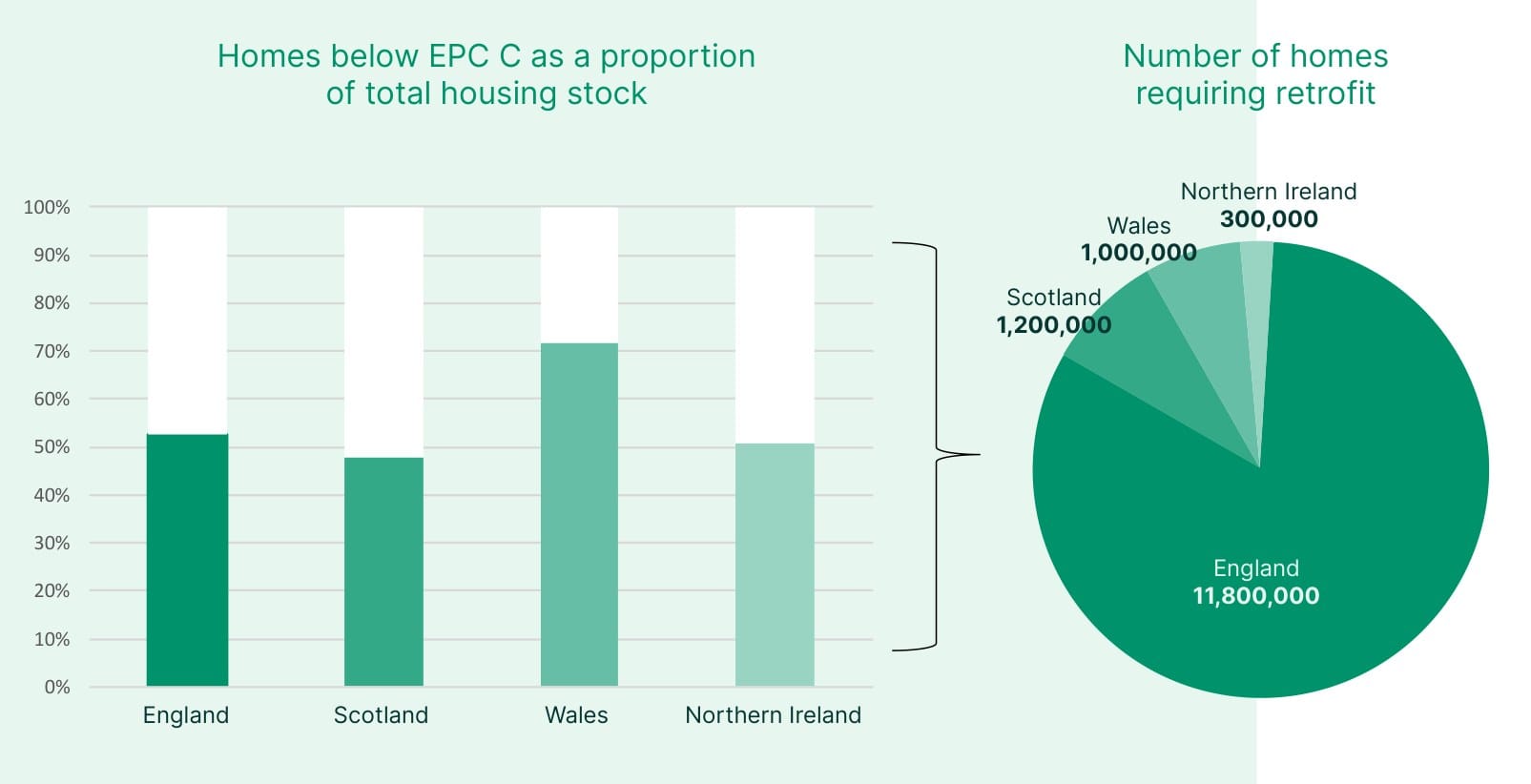
Source: CCC, Sixth Carbon Budget
Source: Housing tenures; Statistical data energy performance, England; Condition surveys, Scotland; Condition surveys, Wales; Condition surveys, Northern Ireland.
Increasing delivery rates
To deliver retrofit proportionally across tenures in England, the current rate of 250,000 homes per year must rise to 1,500,000 by 2035, totalling 11,800,000 retrofits. This graph shows the necessary ramp-up rate to meet targets, ensuring equitable delivery across tenures.
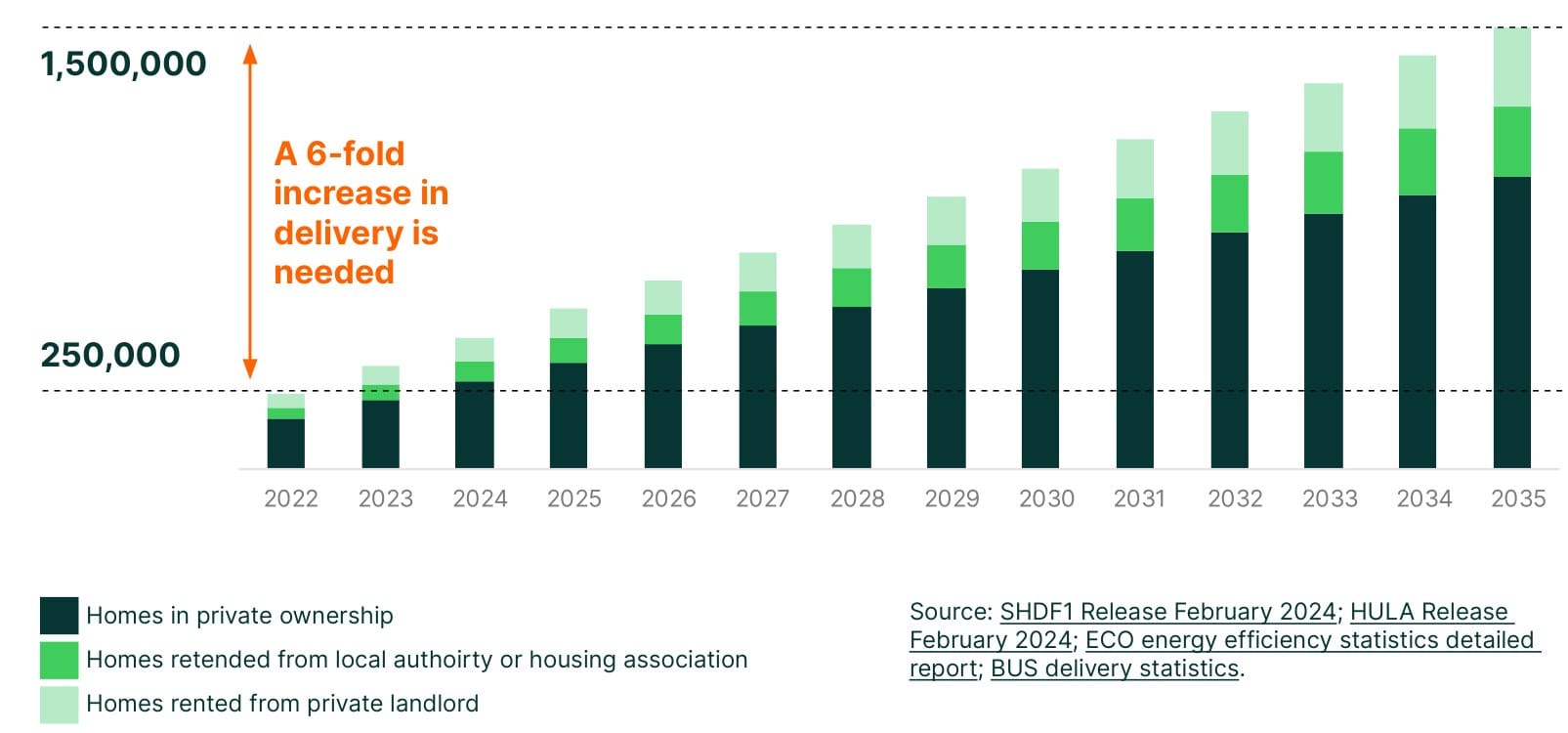
Source: SHDF1 Release February 2024; HULA Release February 2024; ECO energy efficiency statistics detailed report; BUS delivery statistics.
This graph is illustrative of the magnitude of scale of the increase in delivery required, this is not a proposition on how delivery should be increased. We recognise that as retrofit delivery increases it does not stop abruptly at an arbitrary date in the future.
Average spend per tenure
Average retrofit spend per household is not proportionate across tenures. In the absence of monitoring data on the impact of delivered measures, this suggests energy performance uplift varies by tenure.
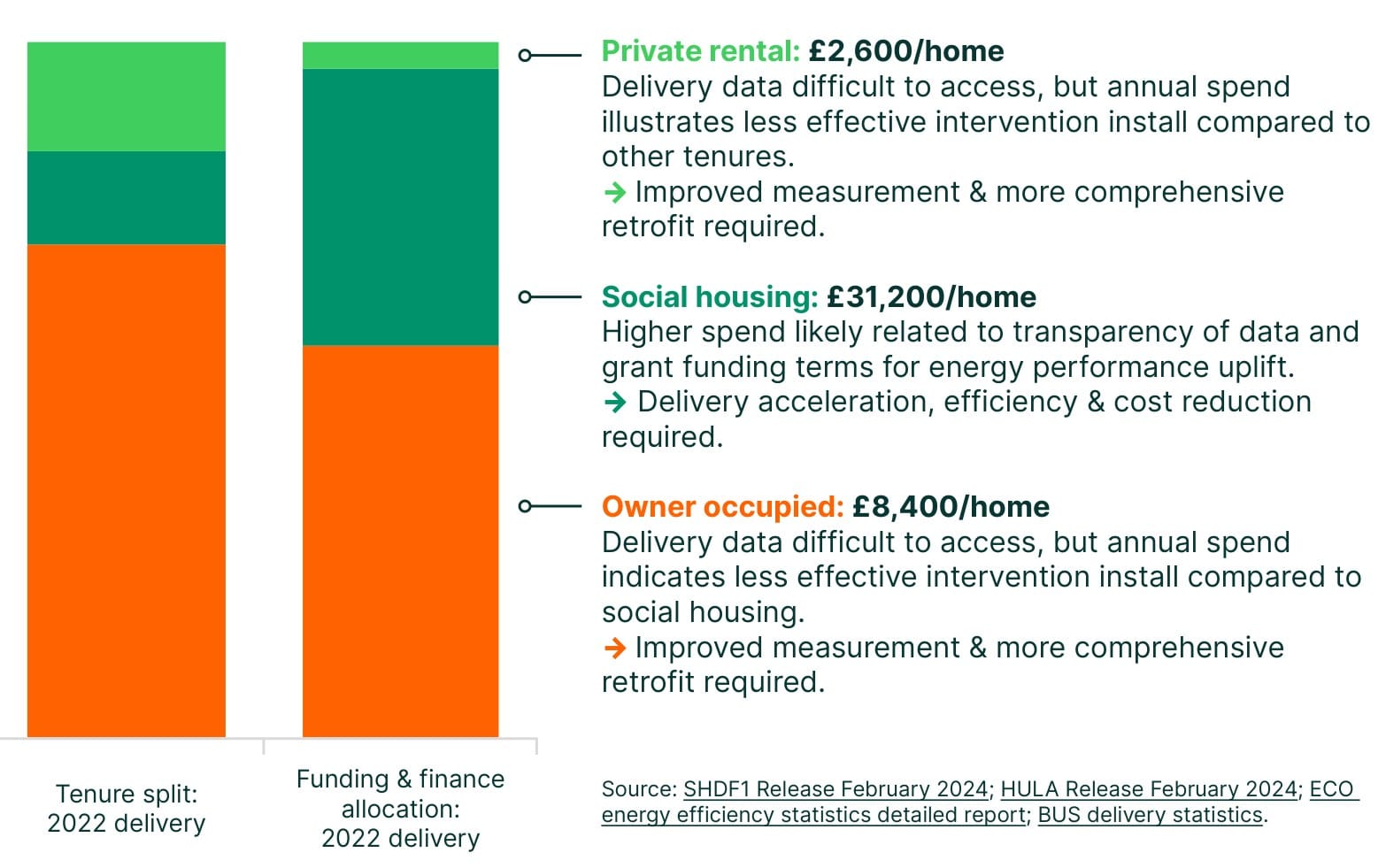
Source: SHDF1 Release February 2024; HULA Release February 2024; ECO energy efficiency statistics detailed report; BUS delivery statistics.
- Private rental: £2,600/home: Delivery data difficult to access, but annual spend illustrates less effective intervention install compared to other tenures. → Improved measurement & more comprehensive retrofit required.
- Social housing: £31,200/home: Higher spend likely related to transparency of data and grant funding terms for energy performance uplift. → Delivery acceleration, efficiency & cost reduction required.
- Owner occupied: £8,400/home: Delivery data difficult to access, but annual spend indicates less effective intervention install compared to social housing. → Improved measurement & more comprehensive retrofit required.
Scale of delivery in England
- 11,800,000 homes below EPC C
- 2,170,000 retrofit measures delivered since 2013, 2,100,000 of those delivered by ECO
- 725,000* ECO measures were boiler replacements
*Ratio of boiler measures based on national breakdown for England.
Whilst there is significant retrofit activity across the sector, this data suggests a real need to identify metrics for both measuring retrofit and quantifying what successful retrofit looks like.
Part 2: The models
How is retrofit being delivered and how well are these models working to deliver successful retrofit at scale?
- What are the delivery models?
- What is the customer/resident journey?
- What was the analysis approach?
- What are the findings? Is delivery consistent across tenures?
Approach to the models
01. Current models of delivery
- Identifying the steps of the resident/ customer journey
- Mapping delivery progress to date and forecast based on committed govt. spending
- Framework for assessing performance and effectiveness of each
- Recommendations for systems improvement
02. Emerging and novel models of delivery
- Identification and mapping of pilots and examples
- Drivers for these; new sector opportunity, failure of existing models?
- Compare performance with current models
- Derive recommendations for replication improvement
03. Initiatives from Europe and beyond
- Research and table models being operated across Europe and wider to maximise learning from a broad range of sources where policy and financial barriers may have been addressed
- Methods of capturing learnings that are applicable
Call out for case studies: a directory of case studies hosted on the Knowledge Hub.
The five Task and Finish 1 pathways are: grant-funded private housing (T&F1A), grant-funded social housing (T&F1B), privately financed private housing (T&F1C), one stop shops (T&F1D) and place-based integrated delivery (T&F1E).
Key delivery pathways
T&F1A Grant-funded private housing
Description: Government-funded or mandated programmes that provide grants to help low-income homeowners and renters improve the energy efficiency of their homes, aiming to reduce fuel poverty.
Examples: Energy Company Obligation (ECO) – UK-wide; Local Authority Delivery Scheme (LADS) – England; Home Upgrade Grant (HUG) – England; Nest & Arbed – Wales; Warmer Homes & Area Based Schemes – Scotland
T&F1B Grant-funded social housing
Description: Housing associations and local authorities undertake scaled energy efficiency upgrades to their own housing stock using public funds and their own capital or finance.
Examples: Social Housing Decarbonisation Fund (SHDF) – England; Welsh Housing Quality Standard (WHQS) – Wales; Social Housing Net Zero Heat Fund – Scotland
Data Source: WG5 hosted workshops with members to develop our understanding of retrofit delivery in line with our customer journey framework, addressing 3 questions: 1. What are the challenges being faced at this stage in the customer journey in this programme? 2. How are the policy environment, or other factors, helping or hindering this phase of the journey? 3. Can you provide best practice examples of how this phase of the customer journey is being delivered and by who?
T&F1C Privately financed private housing
Description: Work funded by property owner, delivered without external support. Includes everything from basic DIY loft insulation to deep architect-led retrofit, often alongside wider renovation maintenance & improvement (RMI) work.
Examples: Small scale DIY or contractor RMI; Architect-led renovation; Residual retrofit; Architect and building physics expert-led retrofit
Data Source: Desktop analysis and research
T&F1D One stop shops
Description: Emerging models aim to provide an end-to-end service for households considering a retrofit, handholding them through the different stages of the customer journey. Usually focused on those that are ‘willing to pay’/’able to borrow’.
Examples: Cosy Homes Oxfordshire; People Powered Retrofit; Furbnow; CSE Futureproof; Your Home better; Leeds Retrofit Accelerator; LoCo Home
Data Source: Research led by UK Green Building Council (UKGBC) & MCS Foundation to map current providers of retrofit facilitation services (aka one-stop shops). Included desk-based research of 39 different Retrofit Facilitation Providers (RFPs)– across England, Wales and Scotland.
T&F1E Place-based integrated delivery
Description: Emerging models taking a cross tenure, area-based approach to delivery. These approaches also look to blended financial models and alternative business cases, including unlocking patient capital to accelerate delivery.
Examples: Net Zero Neighbourhoods; West Midlands Combined Authority; London Borough of Hounslow
Data Source: WG5 hosted a webinar to present the work of the London Borough of Hounslow, Living Places and the Scottish National Investment Bank as a kickstarter event to examining these models.
Part 3: Analytical framework
During the Workshop Wash Up in September 2023, the NRH chairs and team agreed that the ‘Delivery’ issues raised in the first workshop could be best examined through the stages of the ‘Customer or Resident Journey’ as shown below:
This framework seeks to provide a tool for examining the various stages. Whilst this graphically represents a linear process, we recognise that often retrofit delivery occurs in a non-linear fashion, and often repeated either in part or in full depending on the delivery model.
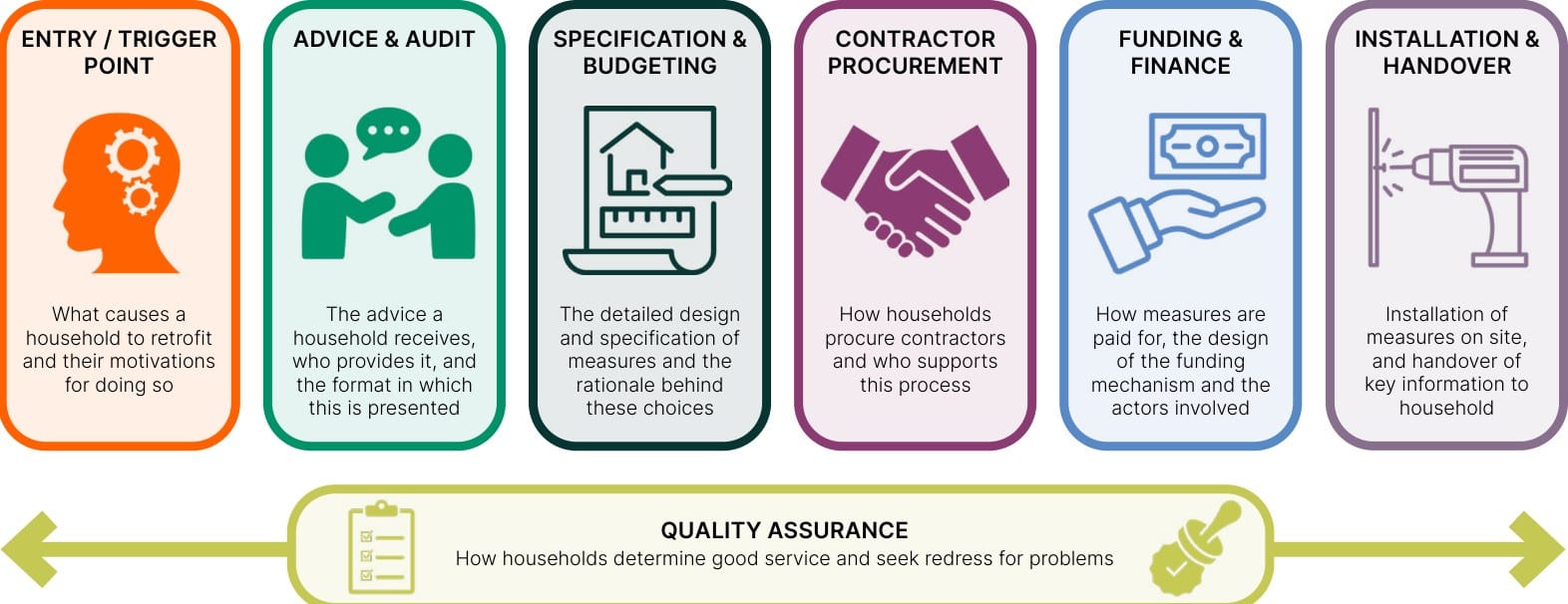
Customer and resident journey mapping
What follows is a summary of the challenges and policy environment implications Q1 & 2 below. Q3 suggests a need to establish or signpost to case studies.
01. What are the challenges being faced at this stage in the customer/ resident journey in this programme?
02. How are the policy environment, or other factors, helping or hindering this phase of the journey?
03. What are the best practice examples of how this phase of the customer/resident journey is being delivered and by who?
This includes a summary of the experiences of our task & finish workshop participants. The source information can be found and reviewed in these Miro boards hyperlinked below:
Grant-funded private housing
(T&F1A)
T&F1A focused on major retrofit grant programmes for private housing over the last decade which have retrofitted over 2 million homes, although delivery rates have slowed since the late 2010s. They are generally targeted at low-income households and delivered by specialist contractors.
Our research included three workshops on the following programmes:
Energy Company Obligation (ECO) UK-wide: ECO places obligations on major energy companies to deliver energy savings via a credit system. These are passed on to contractors who must deliver and verify these savings through retrofit measures to low-income households. The design of ECO has changed several times since its introduction in 2013.
Local Authority Delivery Scheme (LAD) & Home Upgrade Grant (HUG) – England: LAD and HUG devolve funding for retrofit to local authorities, who then target low-income homes in their area. While LAD targets EPC ratings of E, F or G, HUG targets off the gas grid homes between D and G.
Nest & Arbed– Wales: Housing and fuel poverty are devolved issues. Nest is a demand-led scheme providing improvements to low-income and vulnerable households since 2011. Arbed, established in 2009, works on an area basis, in low-income areas identified by social housing providers.
Delivery statistics
The text below outlines the recent delivery profile of these programmes in England and Wales, highlighting a general trend of under delivery due to a range of challenges explored on the following page.
ECO4
- Midway through, only 29% of the 400,000 homes target met
- Average spending £19,900 per home (vs £3,300 in ECO3)
- Need to increase delivery from 7,000 homes a month to 11,700 to meet total target of 400,000 homes
- At current rate, funding will exhaust before meeting target
HUG & LAD
- LAD Phase 1 £200m in grants to over 136 Local Authorities. ~20,000 homes will be upgraded, Phase 2 £300m in grants to the five Local Net Zero Hubs ~30,000 homes across England, Phase 3 £287 million funding to Local Authorities
- HUG Phase 1 £152 million to January 2022 and ending in September 2023, Phase 2 up to £630 million August 2023 until March 2025
- Significant underspending (LAD 40%, HUG Wave 1 78%)
- HUG2 at 13/24 months, only 3% of funds officially spent
Nest & Arbed
- £90,000,000 budget for Nest for the period April 2018 to March 2023, £46,000,000, Original budget for Arbed for the period May 2018 to May 2021
- 16,042 of homes received free energy efficiency measures in the programme between April 2018 and March 2021
- A recent assessment of these schemes suggest they have largely delivered boiler upgrades rather than decarbonised heating systems
Source: HULA Release June 2024, analysis by James Dyson, E3G
Delivery statistics
At the time of running workshops, the following Scottish schemes were not examined in as much depth due to lower numbers of representation of organisations involved in delivering them. Subsequent desktop research has been carried out to summarise delivery statistics:
Warmer Homes Scotland (WHS)
- Fuel poverty scheme launched in September 2015, helping over 33,000 households with home upgrades and investing over £210 million. Leverages in the region of £750,000 per year.
- Uses a ‘whole house’ approach tailored to the property and household needs, targeting homeowners and private tenants at risk of fuel poverty.
- Initially managed by Warmworks, WHS eligibility criteria were broadened in August 2022. Warmworks will continue to manage the successor scheme launching in October 2023, focusing on heat decarbonisation and energy efficiency.
- Stakeholders praise its customer focus and quality inspections. It achieves extremely high customer satisfaction rates of 98-99%.
- Expanded eligibility criteria allows more households to benefit. Its simplicity is noted a key success factor, though some efficiency opportunities, such as addressing neighboring households, may be missed.
Area Based Schemes (ABS Programme)
- Launched by the Scottish Government in 2013, is delivered by local authorities with partners and energy companies, targeting high fuel poverty areas and the least energy-efficient properties. Over £546 million has been invested, benefiting over 104,000 households.
- Targets fuel poverty, particularly in deprived areas, but faces process and funding issues limiting its potential.
- High participation and success rates are noted, but data gaps and local authority priorities can leave some areas behind. Areas without council stock but high fuel poverty risk being underserved.
- Is moving towards ‘whole house’ retrofits and a ‘zero emissions first’ approach, though new ECO funding rules create uncertainty and impact feasibility as currently it can be blended with ECO funding.
- Short-term funding cycles hinder long-term planning and efficient delivery.
Challenges and policy landscape
Entry or trigger point
- Complex eligibility requirements makes identifying suitable households difficult
- Verification is time consuming and can be intrusive for households
- Limited public engagement means many are unaware schemes exist
- Cyclical nature of grant landscape and evolving scheme design reduces visibility and familiarity with programmes
- Vulnerable people can miss out due to complex needs
Advice and audit
- Limited knowledge of existing stock and lack of comprehensive audits can lead to surprises onsite
- Lack of engagement with households can make relationship and access difficult
- Lack of a central government campaign impacts confidence. A single source of advice, endorsed by government could improve this
Specification and budgeting
- Policy limits available measures and can lead to shortfall of necessary works
- Funding window can close by the time households get through the selection process
- Technical solutions can lack focus on individual needs, leading to dropout.
- EPC based standards poorly aligned with decarbonisation
- Planning restrictions abound
Contractor procurement
- Accredited skills shortage is pervasive, which has been accelerated by PAS system
- Short grant delivery cycles creates volatility in the supply chain, limiting trust and suppressing the market
- Reactive supply chain is unable to plan ahead for works, leading to an increase in cost and reduced delivery
Funding and finance
- Overall funding envelope too small to address 6m+ in fuel poverty
- Funding often insufficient to fully fund key measures and enabling work
- Cyclic grant funding creates volatile workflow and grant dependency in customers and supply chain
Installation and quality assurance
- While PAS has improved quality, substandard work remains common
- Energy performance outcomes are not measured, and customer satisfaction is variable
Grant-funded social housing
(T&F1B)
T&F1B examined the recent social housing retrofit programmes in England, Wales and Scotland. In general, social housing has been the front runner of the UK’s housing retrofit agenda, having the highest average SAP score/EPC rating of any tenure type. However, challenges remain with many housing providers, who are required to match public funding, struggling to finance the full cost of works, and costs of delivery increasing substantially in the 2020s.
The programmes investigated were:
Social Housing Decarbonisation Fund (SHDF) – England In 2019 the UK government announced a 10-year £3.8 billion social housing decarbonisation programme for England. The scheme, now in its third wave operates on a competitive bidding basis and is therefore not allocated based on need.
Welsh Housing Quality Standard (WHQS) – Wales The Welsh Housing Quality Standard (WHQS) was introduced in 2002 to ensure that all social housing meets a common standard. Since the end of 2021, all social housing in Wales must meet an SAP score of≥ 65 (a high EPC D rating). By 2034 WHQS mandates all homes must be SAP ≥ 92 (EPC A).
Social Housing Net Zero Heat Fund – Scotland The £200 million Social Housing Net Zero Heat Fund was launched by the Scottish Government in 2021 to support social landlords to install zero emissions heating systems and energy efficiency measures in their existing stock.
Delivery statistics
The picture for social housing delivery has been better, although there remain challenges in the rate of deliver, as exemplified by the slow delivery of recent SHDF waves.
Social Housing Decarbonisation Fund (SHDF)
- Facing significant underspending and ongoing challenges
- SHDF Wave 1: 35% underspent
SHDF Wave 2 (SHDF2)
- At 14 months into a 30-month delivery window
- Officially reported spending: only 3% of allocated funds
- Actual spending likely higher due to reporting and delivery lags, but still likely to underspend
WHQS
- As of 2022, 56,150 homes had been raised to SAP >65 (EPC D), meaning that the vast majority of the ~220,000 Welsh social housing units meet the WHQS SAP target, set 2011
- By 2034 WHQS mandates all homes must be SAP ≥ 92 (EPC A)
Social Housing Net Zero Heat Fund
- At May 2023, the fund had spent £63 million of its £200 million budget, supporting 55 projects across Scotland
- 10 out of 65 applicants rejected for requiring additional information suggesting lack of clarity at application stage
Source: SHDF Release May 2024, analysis by James Dyson, E3G
Challenges and policy landscape
Entry or trigger point
- Housing providers/RSLs must bid for funding allocation, leading to allocation based on fundraising capacity rather than need
- Increased levels of administration making the schemes increasingly complicated deters organisations from applying for funding
Advice and audit
- Household engagement remains challenging with multiple defects and issues often being a higher priority than retrofit
- Access to homes can be restricted by residents where there is a lack of trust in the process
- Limited understanding of stock condition due to numerous property transfers
Specification and budgeting
- Details of policy can limit available measures & can lead to shortfall, leading to deeper fabric measures being dropped
- Technical solutions can lack focus on individual needs, leading to dropout
- EPC based standards poorly aligned with decarbonisation
- ‘Pepper-potting’ of right to buy homes makes planning/ efficiency more difficult
Contractor procurement
- Accredited skills shortage is pervasive, which has been amplified by PAS system
- Short grant delivery cycles creates volatility in the supply chain, limiting trust and suppressing the market
Funding and finance
- Overall funding envelope too small to address all social housing
- Funding often insufficient to fully fund key measures and enabling works
- Cyclic grant funding creates volatile workflow and grant dependency in customers and supply chain
- Very limited data on cost performance available
Installation and quality assurance
- While PAS has improved quality, substandard work remains common
- Limited pool of coordinators
- Energy performance outcomes are not measured and customer satisfaction variable
Privately financed private housing
(T&F1C)
T&F1C aimed to capture the range of retrofit measures occurring in the wider renovation market, not funded through government grants or via local retrofit one-stop-shops. This includes everything from DIY loft insultation, to architect-led renovation, to architect and building physics expert-led retrofit, working to standards such as Enerphit or AECB.
Much of this work happens alongside wider Repair Maintenance and Improvement (RMI) works, such as loft extensions or when installing a new kitchen or bathroom.
We see this market as having three tiers, outlined below. These approaches tend to increase in scale and complexity. Only the final approach would likely include specialist retrofit design advice.
1. Small scale DIY or contractor RMI: Normally loft insulation, replacement windows, maybe floor insulation, or draft proofing. No design or plan. Low hanging fruit.
2. Architect led renovation, residual retrofit: Works undertaken as part of a designer-led home improvement that hasn’t been traditionally called retrofit. Would include consequential improvements, balancing of overglazed extensions, etc. Designed but normally without specific expertise and understanding of unintended consequences. Very much a tick box exercise. Energy and carbon savings very difficult to quantify.
3. Architect & building physics expert led retrofit:
Distinguished from above as having a specific retrofit purpose and probably identified as such. AECB, LETI, Passivhaus Trust, Passivhaus Stepwise retrofit, Enerphit, although generally unlikely to certify. Hard to find data on these projects as lack of standard database.
Delivery statistics
Understanding the scale of this market is very difficult as few databases or estimates exist which track this activity, given much of it happens informally, indicated by the gulf between the certified deep retrofit projects and the wider RMI market.
Repair, Maintenance, and Improvement (RMI) Market
- Annual value: £29 billion (2022)
- Average household spend: £1,000
Certified Deep Retrofit Projects in the UK
- Annual Enerphit-certified projects: 20
- Total Enerphit-certified units: 150
- Annual AECB Retrofit Projects: 20
- Estimated annual deep retrofits: 800-1,000 (experience suggests less than 5% of deep retrofit projects seek certification)
Retrofit Costs
- Deep retrofit: Additional £650/m² over non-retrofit works
- Shallow retrofit: Additional £350/m² over non-retrofit works
- Cost per dwelling to reach carbon zero ready: £30,000
Source: ONS via Travis Perkins
Challenges and policy landscape
Entry or trigger point
- Limited retrofit information in popular RMI media, mostly from advertising and features
- Conflicting information due to energy bills crisis, requiring active interest to navigate
- Lack of trust in direct service providers due to poor past delivery and perceived sales tactics
- Lack of clarity and implementation in policy and standards landscape
Advice and audit
- Low awareness and utilisation of retrofit plan services as part of RMI work
- Conflicting advice across the industry, often piecemeal and from various sources
- Relative high cost of quality retrofit advice where the value is not yet understood
Specification and budgeting
- Risk of inadequately trained designers in the growing retrofit space
- Greenwashing and misleading manufacturer information, requiring experienced designers to navigate
- Preoccupation with house values as assets, overshadowing the value of performance improvements
Contractor procurement
- Low appetite for risk among sufficiently skilled contractors
- Poor past retrofit scheme outcomes lead to trust issues
- Lack of early career training in technical colleges, resulting in trades with minimal retrofit awareness
- Government grant schemes without proper regulation and oversight leading to increased costs and underqualified contractors
Funding and finance
- Limited “self-build retrofit” finance options, although Green Finance & BuildStore are actively developing in this space
- VAT on retrofit but not on new builds sends the wrong message, potentially encouraging demolition over retention
Installation and quality assurance
- Cost concerns, with certification seen as an unnecessary expense
- PAS 2035 can improve quality assurance but is not required for private projects
- Lack of clarity over the QA landscape and who is responsible
One stop shops
(T&F1D)
T&F1D drew on findings from a recent piece of research led by the UK Green Building Council (UKGBC) and the MCS Foundation to map current providers of retrofit facilitation services (aka one-stop shops). These models aim to provide an end-to end service for households considering a retrofit, handholding them through the different stages of the customer journey. However, some programmes are more focused on providing advice and then signposting to contractors, while others also help arrange the works and even financing.
This included desk-based research into 39 different Retrofit Facilitation Providers (RFPs) across England, Wales and Scotland.
This research covered all types of Retrofit Facilitation Providers, from ‘one-stop-shops’ to home energy advice community-led services. 11 of these providers were selected for interviews to get a more detailed understanding of their offer.
Although data is lacking, it is estimated that this market is at most currently delivering around 1000 retrofits a year.
Challenges and policy landscape
Entry or trigger point
- The able to pay market is small, with few organisations offering services and difficulty dedicating resources to marketing
- Most OSS don’t have issues finding customers, but struggle with non-sale inquiries
- Lack of clear policy drivers and uncertainty about return on investment hinder market growth
Advice and audit
- Shortage of accredited and experienced retrofit assessors and coordinators
- Inconsistency in assessment software and lack of customer awareness about standards
- Tension between whole-house approach and customers wanting minimal measures
Specification and budgeting
- Some providers have in-house design teams to ensure quality, while others end with a plan submission
- Lack of consistent advice providers and risk of relying on potentially inaccurate EPCs are concerns
Contractor procurement
- Finding qualified and experienced installers is a challenge
- Most providers leave contracting to homeowners, which may be a barrier
- Lack of insurance products hinders providers from taking on contract liability
- Capacity and quality issues are partly due to poor historic policy and aging supply chain, which an apprenticeship policy could help
Funding and finance
- Few providers offer funded work due to administrative challenges and complications with grant schemes
- Dedicated finance offers are rare, as able to pay numbers are sufficient for growth and FSA compliance is a deterrent
- Securing funding for service provider setup is difficult, particularly for PPR/Retrofit Works and finance schemes like Lendology
Installation and quality assurance
- Most providers don’t perform detailed quality assurance beyond accreditation due to lack of customer demand
- Lack of policy to raise awareness of standards’ benefits and expand the existing standards base
Discussion: where we are today and where we should be
Entry or trigger point
Where we are today
- Awareness of retrofit schemes is very low due to policy changes and lack of national government leadership.
- Short funding periods and limited grant coverage further reduce visibility.
- Retrofit policy design incorrectly assumes energy consumers are primarily motivated by cost savings on bills, failing to account for other key drivers like aesthetic improvements, increased comfort, damage repair, and expanded space/functionality.
- Major life events like renovations, moving homes, broken appliances, births, deaths, or new disabilities present underexplored opportunities to promote retrofitting.
Where should we be tomorrow
- Drive uptake through public campaigns, tax incentives, regulations and outreach activities which leverage existing trigger points and work with community ties.
Advice and audit
Where we are today
- Quality energy advice remains inconsistent, with EPCs providing limited insights and a lack of an effective national advisory service.
- ‘Whole house’ tools are increasingly common but often present information solely focused on cost savings and payback periods, failing to account for specific household needs and plans, leading to disengagement after audits.
- Rather than seeking specialist advice, households more often rely on trusted family, friend, neighbor, and community networks when undertaking renovations, where relational factors like gender, ethnicity, age, and religion heavily influence decision-making on who to consult.
Where should we be tomorrow
- Retrofit advice must better align with existing informal advice networks.
- A National Advisory Service with consistent messaging supported by a range of industry partners should be developed
Specification and budgeting
Where we are today
- Grant funding tends to be prescriptive about eligible measures and budgets, causing many households to drop out due to lack of funding for desired work or enabling projects.
- Households struggle to convert general advice into technical specifications, and specialist design is often unaffordable except for deep retrofits.
- In the renovation market, energy measure selection is linked to broader motivations like aesthetics or functionality, so households don’t view energy and non-energy work as separate.
- Even when energy savings are a goal, payback periods are rarely the primary consideration in assessing viability.
Where should we be tomorrow
- Retrofit assessments must factor in non-cost motivations beyond payback periods, including non-energy and nonfinancial factors in recommendations.
Contractor procurement
Where we are today
- Accredited skills shortage is pervasive, which has been amplified by the PAS system.
- Short grant delivery cycles create volatility in the supply chain, limiting trust and suppressing the market.
- Grant-funded programmes often demand quick completion, pressuring procurement processes and contractors to commit to high-risk works.
- Technical college training lacks retrofit fluency, and the supply chain is reactive, unable to plan ahead, leading to increased costs and reduced delivery. Funding could be better allocated to create supply chain readiness.
Where should we be tomorrow
- Encourage in-house provision and aggregate demand regionally.
- Encourage qualified SMEs to join frameworks, supplier networks, and increase collaboration.
- Promote new training and qualifications.
- Commit to a national skills strategy for retrofit to develop and coordinate the supply chain.
Funding and finance
Where we are today
- Current programmes have limited scope, do not cover rising costs or remedial/enabling expenses, and the overall funding envelope is too small to address fuel poverty and retrofit all social housing.
- Competitive bidding processes and unrealistic spend timeframes in current programmes create a false sense of scarcity, add pressure to administration, and potentially impact the quality of retrofit works.
- Most funding and finance options are tenure- or income-specific, making comprehensive place-based approaches challenging.
Where should we be tomorrow
- Scale up emerging solutions such as retrofit credits, equity release models, pay-what-you-can approaches, and owner-occupier incentives.
- Promote phased finance concepts and specialised mortgage products.
Installation and quality assurance
Where we are today
- PAS2035 ensures correct installation but can be costly and complicated, with a skills gap in delivering compliant works, overstretching the limited labour pool and impacting quality.
- Household aftercare needs improvement, including methods for lodging complaints and educating residents about new technologies.
- Changing standards and processes applied to funded programmes mid-project can cause confusion among grant recipients and contractors regarding delivery requirements.
- Current programmes lack monitoring of real impact, with EPC uplifts not capturing energy usage reduction and limited measurement of broader outcomes.
Where should we be tomorrow
- Implement data-driven feedback and monitoring requirements to assess work quality and develop improvements.
- Promote quality assurance initiatives and certifications and comfort as a service approaches to ensure homes provide appropriate comfort levels following retrofit interventions.
Conclusion: how should we rethink delivery?
The findings from this research suggest there are some overarching issues with the UK’s retrofit delivery programmes:
Scale
Over the last 10 years, around 3 million UK homes have received retrofit measures. Most estimates suggest that over 20 million homes will need to be retrofitted by 2035. This means a significant increase in the rate and scale of delivery is needed. Conservative estimates for the cost of this programme are over £100bn. Moreover, many homes that have already had some retrofit measures – especially those with new gas boilers – will require additional interventions. This will require a vastly more ambitious programme and funding allocation over the coming years.
Consistency
Retrofit policy has been plagued with constant changes, short term delivery horizons and stop start funding. This has harmed public visibility and been damaging for the retrofit supply chain. Only with long term consistent funding programmes and policy commitment can the industry have the confidence to invest in the required skills and capacity. By setting clear signals about the direction of travel and the importance of this agenda, we can also build a national retrofit conversation and start to socialise this with the public.
Scheme design
Many programmes have unhelpful design features and make outdated assumptions. For example, the competitive bidding process for social housing grants does not work based on highest need and is a very time consuming for the applicant. The “means testing” and complexity of fuel poverty programmes has not always helped those who need it most. Moreover, the separation of retrofit measures from wider renovation works represents a huge missed opportunity. Meaningful engagement is critical to success and retrofit programmes could do more to effectively build partnerships with trusted community partners, and other organisations who could support retrofit delivery.
Furthermore, the assumption that households are only motivated to save money through retrofit measures ignores a range of other factors which could be leveraged when communicating the benefits of retrofit, such as improved health and wellbeing impacts, aesthetic or comfort improvements, and climate adaptation and resilience.
Following this research phase, analysis on the findings was carried out to determine where to focus the next phase of activities for this group.
Part 4: Objective mapping and next steps
For the next phase of WG5 activity a further exercise of distilling recurring themes was carried out. In collaboration with WG5 participants we have identified four areas that we intend to examine further with Task & Finish groups.
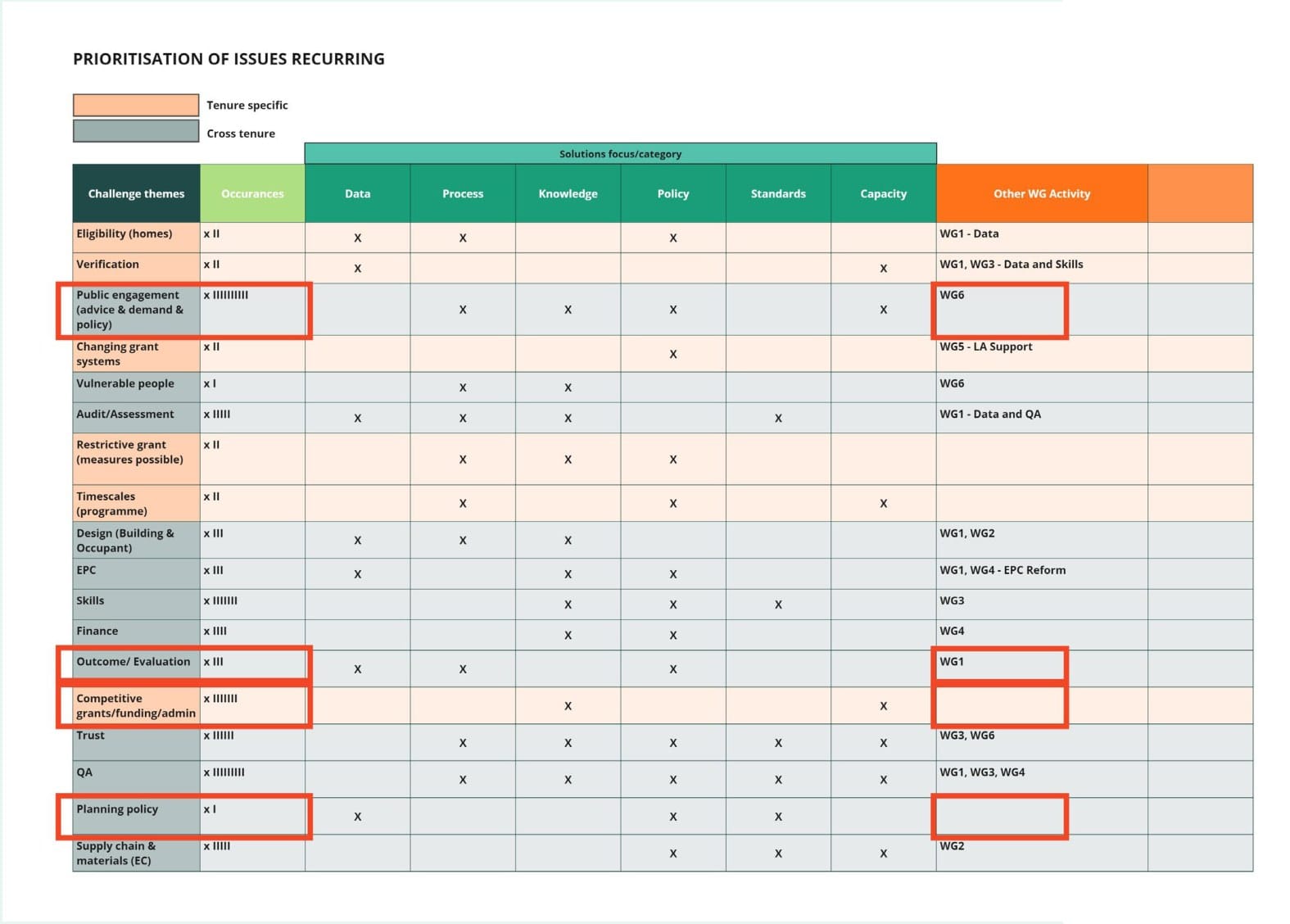
Next phase Task and Finish groups
- Public Engagement
- Grant Systems
- Measuring Outcomes
- Planning Policy
If you would like to join one of these Task & Finish groups please email info@nationalretrofithub.org.uk Alongside an analysis of what the role of the NRH will play in these areas we will use three horizons thinking to identify opportunities for outputs from WG5
- Horizon 1: What are the signs that the pattern or system we have today are no longer fit for the future?
- Horizon 2: What innovations are already disrupting things and how can we help them grow?
- Horizon 3: What visions of the future are there?
Appendix: grant-funded housing in detail
Grant-funded private housing: customer journey
Entry or trigger point
- Supplier obligations like ECO, use lead generators to find customers
- Complex eligibility assessment based on income or means-tested benefits
- Contractor may market scheme locally
- Third party such as council or community energy provider may also provide referrals
Advice and audit
- EPC and RdSAP used to assess property
- Site survey not always conducted beforehand
- Limited engagement with the household prior to installation
- Some advice via fuel poverty organizations
Specification and budgeting
- Typically, only a small number of specific measures are eligible
- Household has limited or no role in choosing measures
- Historically many have acted as “boiler replacement schemes”
Contractor procurement
- Lengthy and complex procurement frameworks
- Energy companies or local authorities procure Tier 1 contractors
- Subcontractors must meet PAS 2035
- Sub-contractor has little or no engagement with household
Funding and finance
- Measures are provided for free or heavily subsidised
- Supplier obligations funded by energy companies which recover costs from electricity bills
- Other schemes devolve funding to local authority
Installation and quality assurance
- PAS 2020/2035 requires retrofit coordinator to provide QA
- Energy performance not measured, although EPC improvement may be checked
- Limited aftercare, post occupancy evaluation
Grant-funded social housing: customer journey
Entry or trigger point
- Policy targets drive ambition to retrofit social housing
- In England housing providers must develop bids for funding via SHDF
- In Wales, the WHQS required SAP >65 by 2020, new policies are targeting SAP 92 /zero carbon by 2034
Advice and audit
- Desk based assessment of properties often used to develop strategies and bid for funding
- Detailed site surveys may occur after bids are developed
- Household engagement led by landlord & contractor
Specification and budgeting
- Initial budgets often developed at bid stage, with limited understanding of stock and defects
- Repairs & enabling works not typically covered by funding (Wales different)
- Detailed design undertaken by professional design team
Contractor procurement
- Tier 1 contractors are often engaged early via detailed procurement process
- Under-pricing to win tender then value engineering commonplace
- Tight delivery deadlines create bottlenecks and perverse incentives in supply chain, driving up costs
Funding and finance
- Funding allocation is fixed and typically leads to shortfall, reducing scope of works
- Some landlords make up shortfall with reserves or RMI budget
- Private capital plays limited role, due to balance sheet constraints and debt covenants
Installation and quality assurance
- PAS 2025 & retrofit coordinator plays key role in QA
- Issues and defects often discovered late in process leading to delays and cost overruns
- Energy savings not measured or verified
- Delivery delays very common
Entry and trigger point
Challenges
Improving Trust: Previous retrofit programmes, delivered by direct service providers, have come under scrutiny for quality of works and created issues of low trust channels. Confidence amongst homeowners needs to be raised through trusted intermediaries delivering quality advice to increase future uptake.
Poor Information and Marketing: Retrofit information is lacking in popular home improvement media like TV shows and magazines, which tend to focus on aesthetics rather than energy efficiency. There is also conflicting information circulating, especially since the energy bills crisis, and finding trustworthy retrofit guidance requires active effort.
Policy landscape
Policy Stability: Short-term policy and programmes hinder confidence in preparing for strategic programming of retrofit. A nationwide strategy, coupled with streamlined monitoring and evaluation, could increase trust amongst local authorities, housing associations and other delivery bodies.
Streamlined Administration: Administration procedures for grant recipients restricts their ability to deliver the projects, slowing down delivery, and in some cases deterring applicants from bidding. Streamlined and aggregated administration procedures could unlock faster delivery of retrofit works.
Improved Public Awareness: For all programmes, a better approach to marketing and outreach could drive uptake. An objective public messaging campaign could lead to increased market participation, from residents to housing providers.
Best practice
Political Advocacy: Multifaceted retrofit policy and funding design should be prioritised amongst political leaders to deliver results. Embedding an energy and retrofit discourse widens public awareness of the requirement and benefits of domestic retrofit. SEAI Ireland.
Community Advocacy: Collective mobilisation, drawing upon the idiosyncrasies of a community to galvanise support, with the aim of unlocking latent capacity in places and use existing trust channels. Retrofit Balsall Heath.
Resident Engagement: Understanding that all properties will require some form of adaptation over the coming decades, engage a wider pool of residents of interventions and outcomes.
Retrofit Show Homes: Develop an energy saving show home in your communities to test and demonstrate a range of measures. This can help residents, landlords, officers and housing providers better grasp the practicalities and benefits of interventions. London Boroughs of Walthamstow and Westminster
Advice and audit
Challenges
Cost of Quality Audits: Bespoke audits are rarely affordable for fuel poor homes that are most in need. National schemes rely on EPC data to generate scale however EPC data is not comprehensive enough to ensure the most effective audit process to determine works required.
Conflicting and Inadequate Advice Across Industry: There is a lack of consistent knowledge and expertise across the industry. This can confuse residents and deter action being taken. Given the range of housing typologies, the appropriateness of interventions differ from home to home.
Resident Education and Empowerment: Audit advice could be improved by incorporating resident discussions on the implications of different measures and cost-benefit analysis of technologies. This could empower residents in the co-design process, ensuring retrofit is done with the people, not to them.
Policy landscape
Lack of Government Advice: There is currently no government-backed homeowner advice for the owner occupier sector, and limited support for other residents. A single source of truth developed by central government could instill greater confidence amongst owner occupiers to undertake retrofit and provide a positive signal to the market.
Emerging Specialist Retrofit Guidance: WG1 is working on collating advice, guidance and training on retrofitting (in the form of archetypes/pattern books/ data) WG3 (qualifications/skills)*** older and traditionally constructed buildings. Further support on domestic properties could be developed, across a range of archetypes.
Audit Skill Requirement: Across a variety of programmes, it has been reported that those involved in the audit process don’t have the necessary skills to provide effective advice. This can lead to issues down the line with qualified retrofit coordinators. Upskilling auditors is required to provide effective advice.
Best practice
Trusted Local Support: Trusted community groups and organisations provide a range of support and advice to help homeowners better understand energy efficiency measures in their homes. Identifying these networks and embedding them within processes from the outset can increase awareness and boost engagement in the long-term as new technologies and schemes emerge. Groundworks
Embracing digital solutions: Digitalised retrofit technologies and online services are emerging, providing end-to-end solutions to landlords, mortgage lenders, financial institutions and homeowners. End-to-end services can offer digital Building Passports that assess the home, outlining a planned pathway to net zero that best suits the homeowner/property owner’s preferences. Sero
Collaborating with experts: Explore partnerships with consultants and academic institutions to support grant bid exercises and develop business cases for schemes. City-Redi, University of Birmingham
Specification and budgeting
Challenges
Driven by minimum viable product: In terms of cost against outcome, the approach to retrofit is often driven by the minimum viable product, rather than the optimal solution for the household. This is due to retrofit works often being undertaken as part of a wider remodel, and cosmetic works often take priority amongst owner occupiers.
Aligning retrofit investment with planned strategies: It can be difficult to align discrete retrofit programmes with long-term investment plans for housing stock. A strategic approach to distribution of grant funding that can be structured around long term maintenance plans could elevate delivery.
Challenging to determine and deliver optimal specification: EPC data is considered referential and incomprehensive, underscored by a focus on ‘low hanging fruit’ solutions that are cost efficient against current monitoring processes.
Policy landscape
Measure Limitations: Some policies and programmes allow for only approved measures. This can lead to sub-optimal solutions being installed in homes as interventions are restricted by policy. This is underscored by schemes being delivered by value-for-money, rather than delivering best outcome solutions for the homes.
Conflicting Policy Goals: The specification of retrofit works is impacted by the policy goals, driven by fuel poverty and energy efficiency. This has led to drives in boiler installations in Wales, having little impact on long-term carbon reduction.
Planning Policy Restrictions: Inflexible planning policy can limit the specification of retrofit, requiring costly considerations in conservation areas, for example. Bespoke retrofit guides to archetypes that consider the local vernacular could pave the way for better solutions.
Best practice
Cost Transparency: Across many schemes, cost of delivery on a measures basis is required to be reported. This provides a national understanding of costs to better guide bidding and budgeting. ORP (Wales), SHDF
Standardised Retrofit Packages and Services: Retrofit packages, a suite of standardized measures, are being developed with transparent pricing. This can simplify the decision-making for homeowners, making it easier to budget for projects. These tools can help homeowners estimate the cost of their preferred measures.
Contract or procurement
Challenges
Skills shortage: There is an evident skill shortage in sufficiently qualified delivery managers, designers and contractors across the UK. This impacts the quality of work undertaken, and limits the ability to scale. Lack of whole system providers complicates procurement process, slows delivery and increases cost.
Low appetite for risk amongst contractors: Retrofit interventions are inherently higher risk due to the required measures, intrusiveness of works and uncertainty. Contractors may therefore price themselves out of the market to mitigate risk.
Short delivery timeframes: Grant funded programmes are typically required to be delivered across short timeframes, putting pressure on conducting a comprehensive procurement process and the ability for contractors to commit to high-risk works.
Policy landscape
PAS2035 Benefits and Limitations: Whilst beneficial for wider schemes and individual projects in ensuring quality and driving trust with residents, PAS2035 requirements have been reported to drive increased specialist resource requirements and slow delivery across time-pressured programmes, deterring contractors in the process.
Reactive supply chain: Frameworks and methods of procurement are overwhelmed with influxes of competitors, aligning with funding lifecycles. The supply chain is therefore reactive and is unable to plan ahead for works, leading to an increase in cost and reduced delivery.
Policy and programmes neglect skills: Programmes create pressure in the supply chain to commit to fast delivery when there is a shortage in qualified commissioners, designers and contractors. Funding could be better allocated to create readiness in the supply chain.
Best practice
Net zero sector skills consultation: We are seeing national governments making progress on considering skill requirements to adapt to net zero pathways. It is hoped that this will influence skills drive, upskilling and increased focus on improving the skills shortage in the market. (Wales)
Developing in-house skills: In-house provision is considered to drive quality up and costs down in the long-run, developing resilience amongst local authorities and other delivery bodies. (City Building, Glasgow)
Demand aggregation in procurement: There are examples of aggregating demand regionally through frameworks to allow the bulk purchase of certain materials, ultimately driving cost down. (Fusion 21)
Platforms to increase SME participation: A drive to encourage qualified SMEs to join frameworks, supplier networks and increased collaboration has had successes. (WL/Ealing Coalition, The Green Register – SW England, SW Net Zero Hub)
Funding and finance
Challenges
Insufficient and limited funding: It is generally accepted that current funding programmes do not cover the rising costs of retrofit and are limited to approved interventions. To meet retrofit targets, more funding with greater scope is required.
Restrictive spend timeframes: Current funding programmes have unrealistic spend timeframes. This can drive a false sense of scarcity in the market, adding pressure to the administration of programmes, driving up the cost of retrofit and potentially impacting quality of works.
Remedial and enabling cost not covered: Current funding programmes do not cover the remedial and enabling costs to deliver retrofit interventions. This impacts the ability to budget and assess affordability for applicants and residents.
Policy landscape
Accessible support: Financial incentives across the UK are in place to help kickstart the retrofit drive, subsidising the cost of interventions. It has been reported however that access to funding is complicated for applicants can deter applications.
Imbalanced bidding processes: Current policy requires bidding for funding. Successful bids typically favour applicants who have the necessary commissioning skills to submit competitive bids. Where funding can be applied for directly by residents, it has been reported that existing application procedures can deter residents who do not have the time or knowledge of how to secure funds. This can limit funding being directed to residents most in need in retrofit interventions.
Tenure restrictions: Existing policy and programmes adopt tenure-specific approaches, leading to prioritisation of single-tenure estates. Future schemes could be more equitable and effective if a community, place-based approach is taken.
Best practice
Emerging funding and finance solutions show promise: There are emerging finance solutions that show promise, increasing the viability of retrofit across tenures.
PNZ Carbon / HACT: Offering a retrofit credit, enabling housing providers to receive payments for the energy: reduction secured through retrofit.
SERO: Exploring equity release models to enable retrofit for owner occupiers and fuel poor householders.
City of Leeds Council: Identifying priority neighbourhoods and applying a pay-what-you-can approach to enable: works.
Development Bank Wales: Exploring a pilot to incentivize owner occupiers to retrofit their homes. This will embed: effective working practices from the Innovative Housing Programme.
Installation and quality assurance
Challenges
PAS2035: Whilst it is generally accepted that the PAS2035 process can ensure quality works are carried out correctly, there are challenges that have arisen through its application. Our findings indicate that the cost of PAS2035 can be prohibitive in delivery, especially within delivery timeframes of programmes. This is underscored by a skills gap in delivering PAS2035 compliant works, overstretching the limited labour pool and impacting quality. Where residents are interacting directly with retrofit programmes that require PAS2035, the process can be overcomplicated and raises questions about the intrusiveness of multiple surveys and assessments.
Resident aftercare: Methods to lodge complaints, communicate timeline of works and educate residents of new technologies require further attention across UK retrofit programmes.
Policy landscape
Changing standards: Evolving standards and processes are being applied to funded programmes mid-project, causing confusion amongst grant recipients and contractors in delivery requirements.
Lack of monitoring and evaluation: Current policy programmes do not have monitoring and evaluation procedures to measure the impact of retrofit interventions. EPC uplifts, a metric for SHDF and other programmes, does not capture energy usage reduction in a property. Changes to policy design to capture the carbon impact of interventions could be improved.
Outcomes measurement is limited: Current programmes are seldom designed to measure the wider outcomes that can be achieved from successful retrofit. Nest and Arbed have limited health outcome measurement, a measure that could be widened across all retrofit programmes.
Best practice
Data-driven feedback: The South West Net Zero Hub are exploring how can they can data from their HUG programme to assess the quality of works undertaken with an intention to development improvements to future activities.
Monitoring Requirements: The Optimised Retrofit Programme (ORP) in Wales requires social landlord applicants to commit to monitoring and evaluation procedures, notably the installation of Environmental Sensors.
Comfort as a Service: SERO and Energiesprong have developed a range of services and toolkits as part of their comfort as a service approach, ensuring homes provide appropriate levels of comfort following retrofit interventions.
Appendix: privately financed private housing in detail
Customer journey
Entry or trigger point
- There is a lack of retrofit information in popular home improvement media, meaning that retrofit is not at the forefront of householders minds, and ‘trigger points’ for works get missed.
- Conflicting information and a lack of trust with the sector also leads to a lack of demand for retrofit.
- The National Retrofit Hub Working Group 6 are exploring these themes, and more on uptake, in further detail.
Advice and audit
- High cost of advice, requiring active interest and value recognition, with limited independent advice available
Specification and budgeting
- Driven by minimum viable product, making it difficult to prioritise deep retrofit during wider remodel works
Contractor procurement
- Large market of contractors/trades with general lack of knowledge on best practices and unintended consequences
- Increased likelihood of DIY with potentially even less skill/awareness
Funding and finance
- Financing typically tied to current house value through high-street mortgages or cash, rather than future improved value
Installation and quality assurance
- Little incentive for high-quality installation apart from client awareness and vigilance
- Lack of skills among most architects, building control, and surveyors in high-quality retrofit, often specifying measures with risks of unintended consequences
Entry and trigger point
Challenges
Lack of Information in RMI Media: Retrofit information is lacking in popular home improvement media like TV shows and magazines, which tend to focus on aesthetics rather than energy efficiency.
Conflicting Information and Lack of Trust: There is conflicting information circulating, especially since the energy bills crisis, and finding trustworthy retrofit guidance requires active effort to connect to small groups of interested professionals.
Marketing is often done by direct service providers who are tainted by poor past delivery and therefore not trusted as: “selling” something.
Policy landscape
Embodied Carbon (Part Z): Embodied carbon calculations (proposed part Z building regulations) would improve decisionmaking on retrofit vs demolition.
VAT: Full VAT on retrofit sends the wrong signals to the market about the value of retrofit.
National Retrofit Strategy: There is no national retrofit strategy led by government and therefore no direct campaigning to improve retrofit uptake and outcomes.
Best practice
LETI and AECB
Retrofit Awards: Architect’s Journal retrofit awards
Retrofit in the Media: Architect’s Journal Retrofit First campaign Retrofit is becoming more frequently positively discussed in consumer-facing self-build magazines and podcasts.
Retrofit Standards: Retrofit standards such as Enerphit are becoming more consumer aspirational.
Community Groups: Community energy and sustainability groups are organising retrofit sessions to help raise awareness and signpost resources.
Advice and audit
Challenges
Lack of Awareness: Homeowners are unlikely to be aware of or choose to access retrofit plan services as part of renovations.
Conflicting and Inadequate Advice: Advice comes from various sources, including DIY stores and builders’ merchants, rather than a centralised authority. The quality of advice is often poor due to a lack of a comprehensive approach and limited understanding of retrofit best practices. Architects frequently rely on manufacturer information when advising clients.
High Cost of Advice: Engaging in the initial stages of advice often comes at a significant cost and requires active interest in retrofit. There is a scarcity of advice from organisations that do not aim to secure design and/or installation work.
Policy landscape
Lack of Government Advice: Currently, there is no government-backed source of advice for households. A single, reliable source of information from central government could instill greater confidence among homeowners to undertake retrofit and provide a positive signal to the market.
Building Regulations: Building Regulations are not currently able to sensibly balance the risk between achieving desired u-values and the risk of interstitial condensation.
Best practice
Retrofit Designers There is an increasing number of retrofit-fluent architects and designers.
Retrofit Research, Guides, and Events Bristol City Council’s 2022 research on the ‘able to pay’ market New RICS guide to retrofit for surveyors New retrofit strategies such as Green Building Store’s 21 Degrees Consumer-facing property events such as HBR, BuildIt, NHBRC Swindon
Specification and budgeting
Challenges
Minimum Viable Product Approach: Retrofits often prioritise the most cost-effective solutions rather than optimal energy efficiency. When retrofits are part of wider remodels, cosmetic considerations tend to take priority especially when the budget for renovations is squeezed.
Training and Risk: Not all of the designers entering the growing retrofit space are properly trained, and experienced designers are needed as manufacturer-provided information is often misleading and conflicting.
Policy landscape
Preoccupation with Property Values: The national obsession with rising property values and the conceptualisation of homes as assets makes the argument for retrofit more difficult as the market doesn’t yet value performance sufficiently to see an immediate return on investment in property values.
Best practice
New Retrofit Guides: New retrofit guides by industry bodies such as RICS and delivery bodies such as Devon County Council and Nottingham Energy Partnership should improve outcomes.
Contract or procurement
Challenges
Skills Shortage: Despite a large pool of available contractors and trades, there is a general lack of knowledge regarding best practices and potential unintended consequences. DIY projects are more common, potentially leading to even lower skill levels and awareness.
Low Appetite for Risk: Skilled contractors often perceive retrofit work as unusual and high-risk, leading them to either avoid such projects or inflate prices to mitigate risk.
Policy landscape
Inadequate Early Career Training: Technical college training often lacks retrofit fluency, resulting in trades with minimal awareness of retrofit best practices.
Grant Concerns: Government grant schemes available to the able to pay market, such as the Boiler Upgrade Scheme, have generally led to increased measure costs and an influx of underqualified market participants.
Best practice
New Training and Qualifications: Passivhaus Tradesman qualification Nottingham Energy Partnership retrofit training Purehaus Retrofit Training
Funding and finance
Challenges
House Value Tied Financing: Retrofit projects are typically financed through high-street mortgages or cash, which are tied to the current house value rather than the future improved value.
Limited “Self-Build Retrofit” Options: There are limited finance options for self-build retrofit projects, although Green Finance & BuildStore are actively developing in this space, with 60 products now available compared to just 3 in 2018.
Remedial and Enabling Costs: Current funding programmes do not cover the remedial and enabling costs to deliver retrofit interventions. This impacts the ability to budget and assess affordability of projects.
Policy landscape
VAT Inconsistencies: VAT is applied to retrofit projects but not to new builds, sending the wrong message and potentially encouraging demolition over retention. Reduced VAT on single energy-saving measures is available, but it is difficult to separate these from non-energy improvements. VAT reduction on solar installations has been implemented.
Best practice
Phased Retrofit and Specialised Mortgages: Passivhaus (PH) Stepwise allows for phased retrofit to accommodate budget availability over time. Ecology Building Society offers Climate Change self-build mortgages
Installation and quality assurance
Challenges
Lack of Incentives: There is little incentive for high-quality installation apart from client awareness and vigilance.
Skills Shortage: Most architects, building control, and surveyors are not fluent in high-quality retrofit, often specifying measures with risks of unintended consequences to meet requirements.
Cost Considerations: Quality assurance depends on certification and/or designer involvement on-site to monitor quality, which can be seen as an unnecessary expense.
Policy landscape
Inadequate Early Career Training: Technical college training often lacks retrofit fluency, resulting in trades with minimal awareness of retrofit best practices.
PAS 2035: PAS 2035 can improve quality assurance but isn’t required for privately funded retrofit.
Best practice
Quality Assurance Initiatives and Certifications: Heat Geeks provide heat pump advice and training. The new RICS retrofit guide for surveyors is expected to improve outcomes. Passivhaus (PH) and AECB certification routes offer excellent quality assurance. PH Tradesman qualification is available.
Further reading and information
- One stop shops: Retrofit Research Update, a report by the MCS Foundation and UKGBC (published soon)
- Place-based integrated delivery: recording of the event
Further information
- Watch the State of the Nation webinar
- Join our working groups by completing this form
- Share any feedback with info@nationalretrofithub.org.uk

