



Making MEES work for tenants and landlords
This report brings together insights across the retrofit sector, with contributions spanning government and civil society. It explores how Minimum Energy Efficiency Standards (MEES) can deliver meaningful improvements in the private rented sector.
Stronger standards, designed and implemented well, can help create healthier homes that are more affordable to live in. They can also reduce the environmental impact of housing.
Drawing on evidence and workshops convened by the National Retrofit Hub, the report identifies the support needed to make MEES work. It examines policy and funding arrangements alongside the practical conditions for effective delivery.
The recommendations address affordability and tenant protection. They also consider enforcement and the skills needed to deliver high-quality improvements.
Published in October 2025, the report aimed to inform decisions about implementing stronger standards in England and Wales. It sets out a pathway to affordable, healthy and robust homes, with recommendations that reflect the policy context at that time.
This work was supported by Impact on Urban Health.
Five conditions for effective MEES implementation
- Rental affordability and security – Energy improvements should benefit tenants. The report explores how to share costs and benefits fairly, with protections against rent increases or eviction linked to improvement works.
- Better treatment of tenants – Residents need support throughout the retrofit process. The report recommends clearer guidance to reduce disruption and ensure decisions reflect tenants’ needs.
- Effective enforcement and compliance – Standards depend on consistent enforcement. The report considers the capacity and information councils need, alongside better awareness among landlords and tenants.
- High-quality work and effective redress – Meeting a standard on paper does not establish whether improvements work in practice. The report calls for stronger outcomes monitoring and accessible routes to resolve problems.
- Stable housing supply across tenures -The report considers how changes in property ownership could affect housing availability. It explores options that support secure homes, including public and community ownership.
Who is this report for?
The report supports policymakers and organisations working to improve privately rented homes. It is also relevant to local authorities and landlords, alongside organisations representing tenants.
Use it to explore how funding and delivery arrangements can support better outcomes. Its recommendations offer a starting point for discussions about the practical conditions needed to make reform effective.
Read the report
Read below or download the full report to explore the evidence and recommendations for making MEES work.
The report’s full title is Improving Health and Housing Outcomes in the Private Rental Sector: Minimum Energy Efficiency Standards and a Pathway to Affordable, Healthy and Robust Homes.
It reflects the policy context in October 2025. Read its discussion of proposed legislation and implementation arrangements in that context.

Understanding the policy context
Government published its response to the 2025 consultation on energy standards for privately rented homes on 21 January 2026.
Read the government response and supporting documents on GOV.UK for the official outcome.
This NRH report records our analysis and recommendations at the time of publication. It does not provide an up-to-date guide to legal requirements.
Read the full report
The full text of the report, section by section.
About this report
This report brings together insights from across the retrofit sector, government, and civil society to explore how the updated Minimum Energy Efficiency Standards (MEES) can drive meaningful improvement in the Private Rented Sector (PRS). It sets out how stronger standards, if designed and implemented well, can deliver homes that are healthier, more affordable, and better for the environment.
Drawing on evidence, workshops, and cross-sector collaboration convened by the National Retrofit Hub, the report identifies the policy, financial, and delivery mechanisms needed to ensure that MEES works for tenants, landlords, and local communities alike. It highlights where action is required, on affordability, enforcement, skills, and tenant protection.
The analysis and recommendations presented here are designed to inform decision-makers as MEES moves from consultation to implementation, ensuring the policy fulfils its potential to create fair, resilient, and low-carbon homes across the country.
Acknowledgements
The National Retrofit Hub would like to thank all the organisations, working group members and collaborators who participated in workshops and one-to-one interviews on this topic. Your insights were fundamental to shaping the recommendations within this report.
Date of publication
16.10.25
How to reference
National Retrofit Hub, ‘Improving Health and Housing Outcomes in the Private Rental Sector’, October 2025
Executive summary
This report explores how the updated Minimum Energy Efficiency Standards (MEES) can be leveraged to create a fairer, healthier, and more affordable Private Rented Sector (PRS) while supporting the UK’s transition to Net Zero. MEES represents a once-in-a-generation opportunity to improve tenant wellbeing, reduce fuel poverty, and strengthen housing resilience, if accompanied by the right policy design, financial mechanisms, and enforcement structures.
Context and purpose
One in ten private rental homes in England have a serious health hazard, and over one in five private renters live in fuel poverty. Poor housing quality causes ill-health, higher public costs, and instability for both tenants and landlords. Strengthened MEES could deliver major social and environmental benefits by improving energy performance, reducing bills, and tackling the root causes of damp, mould, and cold homes. However, without careful implementation, the policy risks exacerbating affordability pressures, increasing evictions, and worsening housing inequality.
The report identifies the enabling conditions needed for MEES to succeed across five key themes:
- Rental Affordability and Security
MEES should reduce bills, not increase rents. Rising rents and insecure tenancies could undermine the benefits of energy efficiency upgrades. The Renters Rights Bill will improve protections by abolishing Section 21 “no-fault” evictions and strengthening rent tribunal processes, but further measures are needed. Achieving this balance will require targeted action to safeguard tenants and ensure that savings are passed on fairly:
- Design MEES metrics to guarantee bill savings for tenants.
- Provide targeted grants for low-income and fuel-poor tenants.
- Classify grant-funded upgrades as tenant-led improvements to prevent rent increases.
- Close loopholes that allow eviction during or after retrofit works.
- Improve tenant awareness of rights and access to advice.
- Better Treatment and Support for Tenants
Tenants often feel disempowered to request improvements, with many fearing eviction or rent increases. Retrofit work must therefore be designed around tenant needs and comfort, and routes that allow landlords to pressure tenants into refusing consent must be closed. This will mean:
- Introducing clear guidance on an “ideal renovation process” that minimises disruption for tenants.
- Tightening evidence requirements for landlords using the “Third-Party Consent” exemption.
- Enforcement and Compliance
Existing housing standards are poorly enforced: only 39% of councils actively enforce MEES, and many lack the capacity, skills and data to enforce effectively. Without a step change in enforcement, even the best-designed regulations will fail to deliver meaningful outcomes. Change must include:
- Strengthening the statutory duty for councils to enforce MEES.
- Increasing fines and ring-fencing revenues to fund enforcement activity.
- Upskilling enforcement teams and investing in institutional knowledge.
- Designing an effective national PRS Landlord Database linked to EPC and exemption data.
- Requiring estate agents to check compliance before marketing properties.
- High-Quality Work and Effective Redress
Poor-quality retrofit work can worsen housing conditions and damage public trust. For the private rental sector, policy and delivery must:
- Set MEES at a robust enough level to ensure meaningful fabric upgrades.
- Mandate outcomes monitoring through sensor and smart meter data.
- Integrate a health metric into EPCs to enable actions that improve indoor air quality and thermal comfort.
- Strengthen redress mechanisms so tenants can easily seek remedy for substandard work.
- Improve competence within the retrofit workforce, through the development of a national retrofit workforce strategy, which may include contractor licensing.
- Stable Housing Supply Across Tenures
Some landlords may exit the market in response to rising costs or regulation. Managed correctly, this could help rebalance the housing system. Effective mechanisms to ensure equitable tenure shift include:
- Enabling local authorities to purchase or lease PRS homes for social use.
- Supporting tenants who wish to buy their homes, and expand shared and community ownership models.
- Ensuring investors, who do buy into the PRS, are governed by strict social and environmental standards.
Conclusion
If implemented well, MEES can catalyse a fairer, more sustainable private rented sector, reducing bills, improving health, cutting carbon, and rebuilding trust in climate action. Success depends on aligning regulation with affordability, empowering tenants, supporting landlords, and resourcing enforcement. Done right, MEES can demonstrate and highlight the positive benefits Net Zero policy can bring for all.
Report structure
This report explores how MEES can create the conditions for:
- Rental affordability and security
- Better treatment of, and support for, tenants
- Effective housing standards enforcement and high levels of compliance
- High quality work and effective redress routes
- Stable housing supply, across tenures
For each of these conditions, the report explores:
Context: The current state, including the existing issues and what risks will be created through poor regulation implementation.
Progress: Existing and emerging policy protections and how components of the existing system help to achieve the outcomes we need to see.
Recommendations: A set of solutions pathways that should be implemented to ensure that the outcomes we need to see are delivered.
The following recommendations are proposed and explored in detail:
Rental Affordability and Security
- Design MEES to realise bill savings
- Promote financial solutions where costs and benefits are shared fairly, including providing grants where tenants are underheating or living in fuel poverty
- Classify grants as an improvement contributed by the tenant, not the landlord, at the First-tier Tribunal rent assessment process
- Close routes to eviction
- Provide information, advice and support to increase tenants’ awareness of their rights
Better treatment of, and support for, tenants
- Limit the disruption to tenants by introducing guidance on an ‘ideal renovation process’
- Increase requirements on landlords claiming the Third-Party Consent exemption
- Promote solutions which consider the needs of all tenants
Effective housing standards enforcement and high levels of compliance
- Make clear the statutory duty for landlords to enforce MEES
- Upskill enforcement teams
- Support councils to utilise selective licensing and fines to help resource enforcement activities
- Design effective landlord databases
- Reduce the number of MEES exemptions
- Place requirements on Estate Agents to improve compliance
- Improve landlord awareness
- Improve tenant awareness
High quality work and effective redress routes
- Set MEES at a high enough level to ensure the right fabric upgrades for all homes that need them
- Embed outcomes monitoring within MEES legislation
- Introduce a health metric within EPCs
- Provide clear redress routes for tenants
- Implement effective policy to increase competence and skills in retrofit
Stable housing supply, across tenures
- Bring some PRS homes into social ownership
- Enable tenants, who want to, to buy a home
- Support shared and community ownership models
- Ensure any remaining homes sold are to responsible investors
Introduction
Minimum Energy Efficiency Standards (MEES) represent a significant opportunity to transform homes in the private rented sector and improve the lives of tenants across the country. The social, financial and health benefits of stronger MEES are significant. At present, 1 in 10 private rental homes has a category 1 health hazard1, this means occupants are likely to seek medical assistance within the next year because of the conditions they live in. According to official estimates, 9% of PRS homes have problems with damp, an issue often exacerbated by tenants’ struggling to keep their homes warm. When interviewed, a far higher proportion (44%) of private renters reported problems with condensation, damp and mould1, and this issue is much more likely to impact lower income households2. More than 1 in 5 private renters live in fuel poverty3.
Poor quality homes increase risks for landlords too, from higher maintenance costs to greater chances of tenants falling into arrears when ill-health or fuel poverty takes hold. Research by the Cambridge Institute for Sustainability Leadership4 highlights the increased insurance costs, and risk of un-insurability, posed by climate change and non-resilient homes, due to floods, droughts and subsidence.
In this report, we will analyse the supporting infrastructure and relevant protections that are required to make MEES a success and make clear recommendations to ensure the policy delivers sufficient support for landlords and better outcomes for tenants.
Methodology
This report specifically considers policy in England and Wales. It builds on, and should be read alongside, the NRH’s previous work on the Private Rental Sector:
This work is produced with thanks to the many NRH working group members, collaborators and organisations who participated in workshops to help identify and co-design solutions pathways.
Policy context
The proposed update to Minimum Energy Efficiency Standards in the Private Rental Sector is part of a wider Government ambition to improve the quality and stability of both the private and social rented sector. Current and proposed regulatory changes include:
Renters Rights Bill (RRB)
Due to come into force later this year, this bill will strengthen rights for private renters. Key changes brought forward within the bill include:
- Abolition of “no-fault” Section 21 evictions
- A ban on rental bidding wars
- Extension of the Decent Homes Standard to the PRS
- Introduction of Awaab’s Law to the PRS
- A new landlord database
- A new PRS Ombudsman Awaab’s Law
Awaab’s Law considers home health hazards, and will initially focus on addressing damp and mould. It will come into force for social housing on 27 October 2025, and be applied to the PRS by the RRB. The law will mandate that landlords investigate and repair hazards, including damp and mould, within specific timeframes.
Decent Homes Standard
A consultation on the updated Decent Homes Standard recently closed. These updates will introduce MEES for social rented housing for the first time. The standard currently applies to the Social Rented Sector (SRS) but will also apply to the PRS following the RRB, bringing greater consistency across rental housing.
EPC Reform
At the start of 2025, the government consulted on reforming Energy Performance Certificates. The proposed MEES regulation is based on this new EPC framework, making the outcome of the consultation critical for the future of rental housing. NRH resources and insights on EPC reform can be accessed here.
1Rental affordability and security
Context
Renters are being pushed further into poverty. In the 12 months to June 2025, average rents increased by 6.7%, on top of an increase the year before of 7.1%.5 This outstrips annual growth in average earnings, which was 5.0% in March to May 2025.6
The ONS deem rent to be affordable if it is less than 30% of a household’s income, yet the median household spends 36.3% of their income on rent, well above that threshold.7 Research from Citizens Advice also found that over the 12 months leading up to July 2024, 11% of tenants faced rent increases of more than £200 per month.8
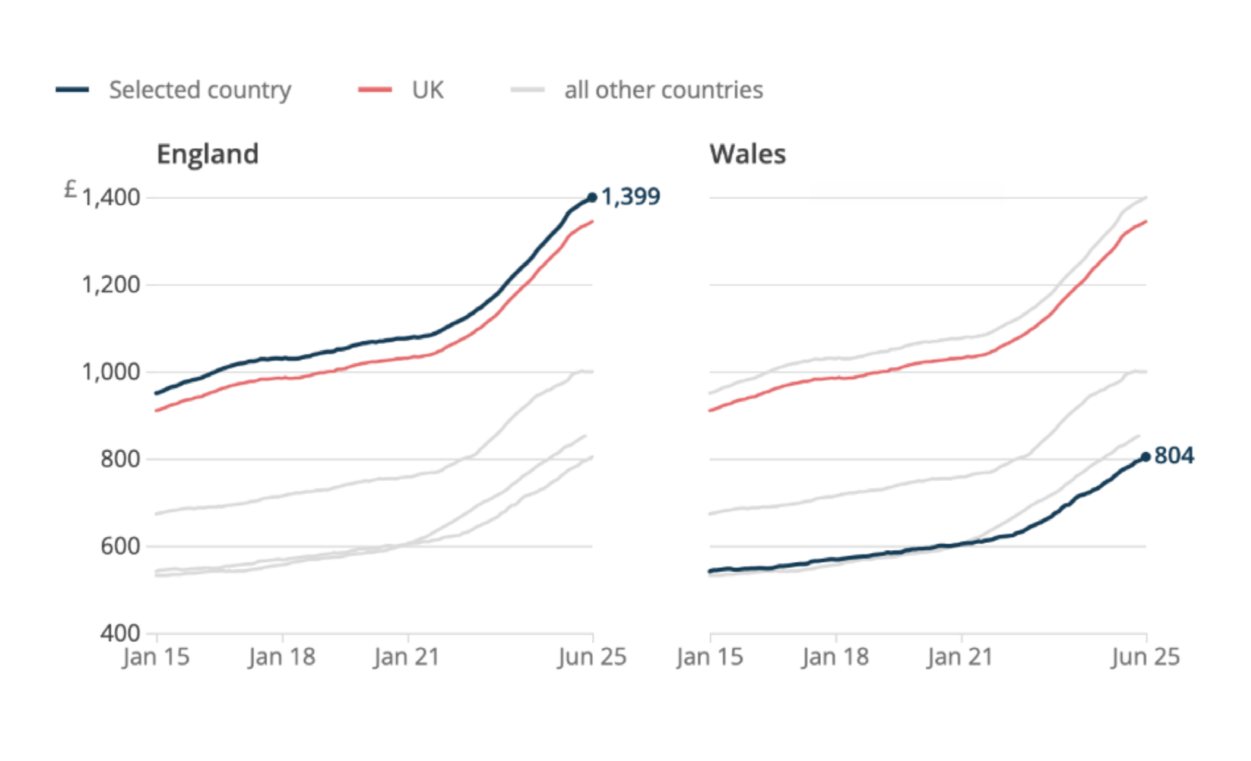
Average private rent, January 2015 to June 2025, ONS
The government estimates that MEES compliance will cost landlords an average of between £6,100 and £6,800 per home and is proposing a cost cap of £15,000. Landlords may seek to recoup this investment by raising rents. The National Residential Landlords Association has linked energy efficiency compliance to rental values9, while the Department of Business, Energy and Industrial Strategy in 2017 found that “EPC rating(s) exert a small but significant influence on quoted rental prices”.10 Evidence from Generation Rent also suggests that energy efficiency upgrades can be utilised by landlords as a catalyst for increasing rent.11
A primary objective of MEES in the PRS is to reduce fuel poverty. But if landlords increase rent by as much, or more than, associated bill savings, that goal will not be realised. Faced with higher rents, tenants may choose to further under-heat their homes exacerbating thermal discomfort and increasing damp and mould issues.
An associated risk is that landlords evict existing tenants after works to then re-advertise homes at a higher rent.
Progress
The most common form of tenancy in the PRS in England is an Assured Shorthold Tenancy (AST), particularly if the tenancy was entered into after 1997. These either include a fixed term (eg: 6 or 12 months) or are ‘periodic’ running month by month with no fixed end date.
Housing Security
Within an AST, after the fixed term has ended or after the first 4 months of a periodic tenancy, the landlord may serve a Section 21 notice if they want the property back by giving 2 months’ notice. This is known as a ‘no fault eviction’ and the landlord does not need to give a reason for asking the tenant to leave.
The Renters Rights Bill, due to be introduced in late 2025 or early 2026, will remove fixed-term assured shorthold tenancies, and all tenancies will become periodic, with tenants able to leave at any time by providing 2 months’ notice. Section 21 evictions will be abolished, and new grounds for repossession will be introduced. These grounds can only be used when a tenant has lived in a home for more than a year. Grounds relevant to the PRS include:
- If the landlord wants to move back into the home (and they used to live there), they want to sell, or where the landlord’s lease is under a superior tenancy and is coming to an end. The landlord must give 4 months’ notice.
- If the landlord wishes to “demolish or substantially redevelop the property which cannot be done with the tenant in situ”. The landlord must give 4 months’ notice.
- If the landlord is subject to enforcement action and needs to take possession to become compliant. The landlord must give 4 months’ notice and may be required to pay compensation.
- The tenant is convicted of severe anti-social or criminal behaviour. No notice is required.
- If tenants do not have a right to rent under immigration law, and the Secretary of State has given notice to the landlord of this. 2 weeks’ notice is required.
- If the tenant has 3 months of rent arrears (both at the time the notice is served and at the possession hearing). 4 weeks’ notice is required.
The abolition of Section 21 evictions will protect some tenants from eviction where the landlord wishes to seek a higher rent after carrying out works to meet regulatory requirements. However, where substantial works are required, the landlord may still be able to seek repossession.
Housing Affordability
Landlords can currently raise rents at the end of a fixed-term tenancy, or once per year for a periodic tenancy. If a tenant agrees, the landlord can raise rents more frequently than this. Rent increases need to be “fair and realistic, which means in line with average local rents”.12 Landlords must give one month’s notice of a rent increase.
Tenants can dispute rent increases by taking the case to First-Tier Tribunal. The tribunal consider ‘market rents’ in the area, and compare these with the new rent proposed. This process creates several problems for tenants:
- Polling by Generation Rent found that only 10% of tenants have a good level of knowledge on the first-tier tribunal process, and 7 in 10 renters having never heard of the process.13
- If the rent is increased using a rent review clause in a contract, which says when and how much rent can increase by, then a tenant cannot use the tribunal process, even if the new rent does not fairly reflect market conditions.
- Tenants must apply before the new rent is due to start – giving only a narrow one-month window in many circumstances.
- Landlords can currently serve a section 21 eviction notice if the tenant takes the rent increase to tribunal.
- The tribunal could decide that the rent stays the same, is reduced, or is increased14, putting tenants who take rent increases to tribunal at a risk of paying even more rent than was originally demanded.
- The tribunal uses ‘market rents’ – the price a home could be rented at if it was newly marketed, rather than an ‘affordable rent’ to determine whether a rent increase is fair and acceptable.
- The tribunal considers the condition of the home when deciding a reasonable rent. This means that if the home is improved the rent can go up, even if improvements to the home had been enabled by government grant funding based on the tenant’s eligibility, or to meet regulatory compliance.
- Rent increases can be back-dated to the time the landlord originally intended the increase to start from.
The Renters Rights Bill will make some improvements to this system by:
- Removing the option for rent review clauses in tenancy agreements, ensuring all rent increases can be taken to tribunal if the tenant sees fit.
- Increasing the notice period for rent increases to 2 months.
- Ensuring the tribunal cannot increase rent beyond what the landlord initially proposed.
- Ending the process of back-dating increases, so new rents apply from the date of tribunal decision, and in the case of hardship, can be delayed by 2 months.
The bill also attempts to improve rent affordability by making it illegal for landlords or lettings agents to accept rent higher than the advertised asking price, in an effort to stop ‘rental bidding.’
‘Market Rents’
The Renters Rights Bill may have a limited impact on improving rent affordability, as it does not break the reliance on ‘market rents’ to set fair prices. Generation Rent describes market rents as “a metric that drives up prices for renters based on speculative price-setting”.15 The PRS has become the “tenure of last resort for many households”.16 Current trends show rent increases consistently outpacing wage growth, meaning that unaffordability is effectively built into protections that remain linked to the market.
Change is underway to make private rent more affordable and secure. However, our research and industry engagement has concluded that more needs to be done to ensure all private renters are adequately protected from un-affordable rents and evictions. Alongside the Renters Rights Bill, the following actions would help secure rental affordability and security in the context of the updated MEES regulation.
Recommendations
- Design MEES to realise bill savings
Energy bills must be reduced as a result of MEES, to fulfil its policy objective. In our report Delivering for Tenants we consider how the Heating System and Smart Readiness metrics should be designed to reduce running costs. We highlight the risk of a policy that could incentivise the switch from gas to direct electric, rather than heat pumps or low-carbon heat networks, finding that direct electric could make a tenant in a Victorian mid-terrace £924 worse off per year. These metrics must be designed to incorporate running costs, and real-world data on energy performance and equipment efficiency, to ensure bill savings for all tenants are delivered.
- Promote financial solutions where costs and benefits are shared fairly, including providing grants where tenants are underheating or living in fuel poverty
Tenants who are living in fuel poverty and underheating their homes need access to grants so that their homes can be upgraded without their rents being increased. Existing grants available to landlords with inefficient homes and tenants on lower incomes include: ECO, GBIS and Warm Homes: Local Grant. Continuity and improved accessibility of this type of grant funding will be critical. The NRH’s State of the Nation report includes an analysis of grant funding schemes, with recommendations for improvement.
Targeted support is also required for those currently under-heating their homes, who are more at risk of damp and mould, and will face additional cost-challenges associated with the transition to low carbon heat.17 Organisations such as Switchee already support Housing Providers to identify social housing tenants at risk of fuel poverty and underheating their homes, using smart meter and other data.18 This is a more complex challenge in the PRS, given the limits on how much data tenants might want to share with their landlords. The recommendations in our Delivering for Tenants report on remote monitoring could help local authorities identify PRS tenants for grant funding eligibility.
Where grant funding is not available many landlords will not be able to fund upgrade works directly from their savings. Our report Raising Standards in the Private Rental Sector explores different finance options, and landlord’s attitudes towards these. Low interest or interest free loans, heat as a service (on bills schemes)19, and property linked finance20 may all be useful mechanisms, so long as the costs and benefits can be shared equitably between tenant and landlord.
- Classify grants as an improvement contributed by the tenant, not the landlord, at the First-tier Tribunal rent assessment process
If a landlord makes improvements to a rental home these can be used as justifications for rental increases, even if these were funded through government grants linked to tenant eligibility. Currently, landlords utilising the Warm Homes: Local Grant must make a declaration that they do not intend to raise rents as a direct result of upgrades made under the scheme. Local Authorities will receive and monitor this information, however tenants will not be able to see the declarations. This weak protection should be replaced by a more direct and enforceable rule. Generation Rent, Independent Age and Bell Riberio Addy21 have all proposed that these grants should be classified as improvements made by the tenant, to prevent rents being increased in conjunction with grant-funded improvements.
- Close routes to eviction
Protections must be put in place for tenants to ensure that they do not face evictions as a result of construction work triggered by MEES. The government should put in place checks and protections to ensure that the following two grounds for repossession are not used unless necessary:
- If the landlord wishes to “demolish or substantially redevelop the property which cannot be done with the tenant in situ”.
- If the landlord is subject to enforcement action and needs to take possession to become compliant.
Landlords should be required to provide evidence from a retrofit coordinator or another qualified expert detailing the works proposed, the less disruptive options considered, and the reasons these were deemed unsuitable. A better and stronger protection would be to require landlords to provide tenants with alternative accommodation during the works, however this might be challenging for non-professional single property landlords.
- Provide information, advice and support to increase tenants’ awareness of their rights
Tenant’s awareness of the first-tier tribunal process is low, and 41% of renters do not know where to go to get help with housing condition issues.22 Part of ensuring the successful implementation of the protections included within the Renters Rights Bill will be ensuring that tenants know what they can expect from their landlords, and how to access redress. Citizen’s Advice has produced detailed recommendations on how tenant awareness could be improved.23
Advice and support will be critical for both tenants and landlords. Landlords should be provided with advice on their duties, the routes to high quality retrofit, and the finance options available. The LetZero project24, led by the South Yorkshire Mayoral Combined Authority, is creating a vehicle that will provide guidance, practice support and access to funding and finance for landlords within the PRS.
2Better treatment of, and support for, tenants
Context
Currently, landlords do not need to meet MEES if their tenant does not consent to the works needed to upgrade the home. ‘Third Party Consent’ is an existing exemption within MEES regulations, which means landlords do not need to conduct upgrade works if they cannot gain consent from the tenant, superior landlord, planning department, or anyone else legally required to give consent before works can take place. The 2025 MEES consultation proposed keeping this exemption. Currently, landlords are only required to provide minimal evidence that tenant consent is needed, typically the relevant section of the tenancy agreement and a letter from the tenant refusing consent. This low burden of proof creates a loophole that is open to misuse, undermining the effectiveness of the exemption.
Tenants facing problems with damp, cold and mould are already disempowered to ask for improvements, due to fear of evictions or rent increases.25
Underreporting of poor housing conditions
A range of underlying factors can lead tenants to remain in poor housing conditions. These include limited awareness of their rights, uncertainty about available support, and fear of retaliation from landlords, such as rent increases or eviction.
Over 1 in 3 renters experiencing problems with damp, cold or mould haven’t made a complaint 38% didn’t complain because of worries about rent increases 21% didn’t complain because they were worried about being evicted
Given this dynamic, there is a risk that landlords put pressure on tenants to refuse works. Tenants, particularly those most vulnerable, may fear rent rises or evictions if they do not agree to refuse works.
Tackling this risk will require a balanced approach, because tenants must also be empowered to control what happens in their homes and some retrofit work can be disruptive.
Proposals put forward in the MEES consultation included ambitious timelines for compliance – with all homes being required to comply by 2030. The average private renter has been in their current home approximately 4 years26, meaning that, if landlords start making plans for compliance once legislation is laid, many will need to conduct works with tenants in place.
Work by Independent Age27 identified that older people may be more impacted by retrofit work, both by the works themselves and by the changes that might be needed afterwards to operate new systems. Older people stay longer in their home, and it’s therefore even more likely that works will not be carried out between tenancies10, but while tenants are in place. Without engagement, support and flexibility from a landlord the disruption and change associated with retrofit could have negative impacts on tenants.
The introduction of the Decent Homes Standard in the Private Rental Sector, proposed in a consultation which closed on 12th September 2025 will place additional requirements on landlords to make upgrades and repairs. Works will need to be well combined, scheduled and coordinated around tenant needs to limit disruption.
Progress
Tenants are open to the upgrade of their homes, with data from Citizens Advice showing 82% of renters are interested in having energy efficiency measures installed.28 However, initial analysis suggests that the third-party consent exemption, which includes a lack of tenant consent, is already commonly (and perhaps overly) used to justify landlord non-compliance.29
Recommendations
- Limit the disruption to tenants by introducing guidance on an ‘ideal renovation process’
Independent Age has developed an ‘ideal renovation process’ in partnership with ACORN, Generation Rent and Age UK.30 Their recommendations include the provision of clear information from the landlord to the tenant on the nature and timing of the work, the expected impact on the tenant, and how to seek independent advice. Independent Age is also calling for the Government to provide clear standards and requirements on the notice period for works, the negotiation of suitable times for work take place, and arrangements for tenant relocation where required.
- Increase requirements on landlords claiming the Third-Party Consent exemption
Landlords applying for an exemption based on tenant consent should be required to procure a retrofit plan, produced by a qualified professional in line with PAS 2035, and show how they plan to phase the necessary works to meet minimum standards in line with tenant needs. This plan should set landlords on a pathway to compliance, even if this cannot be completed within the statutory timescales.
- Promote solutions which consider the needs of all tenants
During our industry engagement, participants emphasised the importance of upgrade solutions that cater to a wide range of tenants while allowing for future flexibility. This might mean considering the accessibility and ease of use of controls and displays and thinking about different tenants’ abilities to flex their energy use, to the suit smart technology installed, like renewables, batteries and heat storage. It might also mean installing ventilation systems that can ramp up and down to work for different levels of occupancy within the home.
Particular care is needed for tenants who are older or who have additional health or accessibility needs. Handing over the right information, providing in-person support on how to use new systems, and connecting with appropriate aftercare will be crucial to achieving good outcomes for tenants, and ensuring systems are optimised. Landlord support, advice and one-stop-shop offers should embed advice on this topic, building on research from the Centre for Sustainable Energy’s Smart and Fair research programme.31 This will support landlords to understand and cater for the needs of their tenants and provide relevant information to help tenants manage any new systems within the home.
3Effective housing standards enforcement and high levels of compliance
Context
Regulations already exist to protect tenants from poor housing conditions, but they are not being effectively enforced.³²
The proposed MEES changes and the Renters’ Rights Bill will significantly increase the enforcement burden on local authorities. Despite multiple legislative frameworks, housing quality in the PRS remains poorer than in other tenures. A complex regulatory landscape and a lack of reliable housing data make it difficult for tenants to understand their rights and for authorities to act on anything beyond the most serious breaches.
Only 39% of local authorities are proactively enforcing MEES regulations and 25% are not enforcing the standard at all32 Only 1 in 3 housing complaints are responded to by local authorities33
Research and in-depth stakeholder engagement by E3G34 found that barriers to effective enforcement of MEES included:
- A lack of funding in local authorities, meaning they “focus their capacity on fulfilling statutory duties and on only the most serious infringements”.
- Revenue funding from fines related to MEES non-compliance are in-sufficient and un-predictable. Fines take a lot of work to re-coup, and the maximum levels associated with the current standard are too low to make this worthwhile.
- Statutory duties associated with energy efficiency are weak and unclear.
- Enforcement responsibilities within a council can be split between different departments – Trading Standards and Housing Standards.
- Landlords can currently self-register an exemption, meaning the register contains many invalid exemptions, which many local authorities do not have the capacity to review.
- The lack of a landlord database makes the enforcement process much more time consuming. While some datasets that exist may give a partial coverage of PRS homes, often these are not accessible to Local Authorities.
- Local Authorities struggle to recruit Housing Standards teams, with the Chartered Institute of Environmental Health acknowledging the workforce shortage of those with Environmental Health qualifications.35
Our industry engagement also identified additional barriers to effective enforcement:
- High staff turnover and a lack of systems to create institutional knowledge within Local Authorities.
- A lack of standardisation and appropriate data collection within databases that already exist.
Without increasing compliance and enforcement capacity, new MEES regulations are unlikely to deliver meaningful benefits for tenants. This increased capacity does not, however, need to come solely from local authorities.
Progress
Non-profit organisations and local authorities have been trialling different approaches to improve enforcement capacity and effectiveness. Examples include:
The Centre for Sustainable Energy supported seven local authorities to develop and test approaches to MEES enforcement, between 2018-2020.36 These pilot studies developed approaches for:
- Accurate data collection, which was identified by participants as a significant challenge.
- Team structures and processes.
- Engaging landlords.
- Promoting awareness of MEES, and encouraging compliance.
They produced a toolkit which is available to all local authorities that contains case studies, templated resources, learning modules and recommended processes.
Local Authorities participating in the pilots expressed concerns that without continued additional resourcing “there would be a tendency to resort to reactive enforcement rather than the proactive approach enabled by the project.” Even with the right processes, tools and competence developed within the team, enforcement takes time!
ACE-R37, with support from the MCS Foundation in 2023, supported Local Authority officers and landlords with training and guidance on MEES regulations, energy efficiency measures and low carbon heating options. They found a clear need for upskilling and awareness raising within Local Authorities. However, resource and funding challenges, combined with unclear duties to enforce, provided the primary barrier to effective enforcement. Upskilling on building, energy and heat related topics alone, while useful, would not be enough to improve enforcement. ACE-R also identified a need for protocols and procedures, with clear roles and responsibilities, within Local Authorities to support enforcement.
Justice for Tenants38 have contracts in place with 135 Local Authorities to support their Housing Act (HHSRS) enforcement activity through the effective use of civil financial penalties. JFT provides a model financial penalty policy, reviewing and redrafting of the councils’ own policy and notices, support in creating Community Protection Notices, procedural precedents, training, regulatory reviews and ongoing support to help Local Authorities enforce more proactively. Currently, the organisation does not support with MEES enforcement, as fines are too small to support enforcement resource, and the duties placed on LAs to enforce MEES are less clear than the statutory duty to protect tenants from Category 1 HHSRS hazards.
Selective Licensing is a scheme Local Authorities in England can choose to implement to help ensure that homes in the PRS meet minimum standards. Introduced by the Housing Act 2004, the Local Authority can designate all or part of its area as being subject to selective licensing.39 Since the end of 2024, Local Authorities do not need to seek approval from the Secretary of State before introducing the scheme, but they must consult with stakeholders, in the area. All private landlords in an area covered by selective licensing must obtain a licence and agree to comply with conditions of the scheme. Fees are charged to landlords to obtain a licence, and fines of up to £30,000 can be levied for non-compliance with the scheme.
The London Borough of Newham introduced selective licensing in 2013, with an aim to drive out rogue landlords from the sector. The borough uses income from the scheme to resource property inspections and enforcement work. In 2023, the standard fee was £750 and 10,470 PRS properties were inspected, leading to 426 enforcement notices and 109 financial penalty notices – resulting in £335,000 of financial penalty income. Newham also provides a forum, a landlord information page, and an e-bulletin for landlords, helping to upskill and raise awareness of standards. MEES enforcement is also funded through the scheme, with 76 EPC F&G homes subject to enforcement in 2023.41 E3G’s research found that the scheme in Newham has practically eliminated MEES non-compliance.
Selective licensing can only be used when an area is experiencing problems such as low housing demand, anti-social behaviour, poor housing quality, high levels of deprivation and crime. Therefore, this solution cannot be applied universally to support MEES enforcement. A more comprehensive, national strategy is needed.
The Renters Rights Bill will introduce a ‘Private Rented Sector Database,’ which, if designed correctly, could mitigate issues Local Authorities face on collecting EPC and landlord data on PRS properties. All landlords would be legally required to register on the database, which will also provide advice and information for landlords. If the database is to be an effective tool for MEES enforcement, it must:
- Include EPC information for each property registered.
- Be linked to the MEES PRS Exemption Register.
- Be easily and freely accessible by Local Authorities for enforcement purposes.
Recommendations
- Make clear the statutory duty for landlords to enforce MEES
Under section 5 of the Housing Act 2004 Local Authorities are given the statutory duty to take action against Category 1 health hazards in the private rental sector. It says: “If a local housing authority consider that a category 1 hazard exists on any residential premises, they must take the appropriate enforcement action in relation to the hazard.” It then goes on to describe what this enforcement action would entail. The act also sets requirements for Local Authorities to review housing conditions and conduct inspections to identify hazards.
The Housing Act does not explicitly mention MEES enforcement, instead The Energy Efficiency (Private Rented Property) Regulations 2015 place a responsibility on Local Authorities to enforce MEES. It says: “An enforcement authority (the local authority) must enforce compliance with the requirements of this Part in relation to properties in its area.”
Local authorities view the MEES enforcement duty as weaker, and less clear than those contained in the Housing Act, and therefore spend their limited resource on enforcing the worst health hazards, rather than MEES. E3G have recommended that the government “Clarify and strengthen the statutory duty for MEES enforcement.”42 A stronger, more specific and prescriptive duty place on Local Authorities to enforce MEES would ensure that more resource is allocated to this task.
- Upskill enforcement teams
Building on the insights from CSE and ACE-R, more should be done to build knowledge and skill within local authority enforcement teams. The skills required are diverse: beyond building and energy knowledge, enforcement teams need to develop effective skills in understanding legal procedures, engagement, communication, relationship and data management. Local Authorities should also be supported with the appropriate infrastructure to build institutional knowledge and memory with shared training models, accessible resources and clear handover processes.
National guidance and support would be beneficial, but this should be provided alongside local guidance. Non-profits could be funded to continue supporting Local Authorities. Local Authority forums and events could also be used for officers to share best practice advice.
- Support councils to utilise selective licensing and fines to help resource enforcement activities
Appropriate councils should be supported to utilise selective licencing, particularly in areas of poor housing quality and high non-compliance risk. Councils like Leeds and Newham should be encouraged to share their experiences of utilising the scheme. Research and non-profit organisations such as the Institute for Health Equity and LSBU should be supported and funded to work with Local Authorities to make the best use, and monitor the impact, of these schemes.
Licensing should also be used to support landlords to make MEES upgrades, with the provision of advice and practical support, so that everyone benefits. Services provided by projects such as LetZero could be partially funded through selective licensing.
MEES fines could also be an effective source of Local Authority income to support enforcement. The PRS MEES consultation proposed increasing these fines, and organisations such as Justice for Tenants should be supported to help Local Authorities navigate and make the most of this process.
- Design effective landlord databases
The Private Rented Sector Database should be designed to enable effective enforcement. The database should be populated as quickly as possible, with few barriers put in place to registration. Our industry engagement highlighted a series of strategies to ensure high levels of landlord registration:
- The registration experience should be clear and seamless, with evidence and information required kept to the necessary minimum.
- Link the database to service offers for landlords, for example advice on MEES and housing standards compliance, to ensure there is a mutual benefit.
- Allow properties with non-compliant EPCs to be registered.
- Work with other actors within the private rented sector: estate agents, accountants and mortgage providers, to increase awareness of the requirement to register.
- Identify landlords or properties not registered through existing systems: the electoral register, council tax and the tenancy deposit scheme.
- The PRS Database should be designed and operated for maximum effectiveness, with:
‐ A forward-looking and interoperable data architecture, to both maximise potential for outreach, and to coordinate with existing and future sources of data.
‐ Provision of high-level information to landlords on relevant legislation and their responsibilities.
‐ Automated reminders to landlords if they are, or are soon to be, non-compliant.
‐ Automatic flagging of non-compliant homes to Local Authorities.
‐ A seamless link with the exemption register.
There should be requirements for any exemptions logged to be submitted with detailed, third party, evidence. Our workshop participants also suggested that there may be a useful role for Artificial Intelligence to review exemption data and identify invalid submissions.
- Reduce the number of MEES exemptions
The exemption register is a particular challenge for Local Authority enforcement, with a lack of capacity to assess the exemptions submitted. Our report Delivering for Tenants recommends reducing the number of exemptions to a minimum, to increase the impact of MEES policy and streamline enforcement. We detail how the government could resolve the existing blockers in the system rather than writing them into regulation.
- Place requirements on Estate Agents to improve compliance
Lettings agents already have access to the information needed to ensure that the properties they advertise are compliant with MEES. They are already obliged to confirm that an Energy Performance Certificate (EPC) has been commissioned before marketing a property, and the recent EPC reform consultation included a proposal to make it mandatory for all properties to have a valid EPC in place at the point of marketing. The MEES Exemption Register is also in place, and property-specific data will increasingly become available to agents. With these systems already established, there is no justification for delay: clear requirements should be placed on lettings agents now to ensure they are not marketing or managing non-compliant properties.
- Improve landlord awareness
The new PRS Landlord Database, along with support and communications from estate agents and councils, can help improve landlords’ awareness and understanding of their duties under MEES and other housing standards. The messaging around MEES should also emphasise the benefit to landlords. Improving the performance and quality of a rental home will likely:
- Reduce the landlord’s maintenance burden, and improve the resilience and longevity of the property.
- Increase tenant satisfaction, encouraging tenants to stay for longer, reducing admin costs, estate agent fees and void periods.
- Improve tenant resilience, and therefore reduce the risk of rental arrears, by reducing tenant bills and improving tenant health.
- Increase the value and saleability of a home, should the landlord look to sell in the future.
- Improve tenant awareness
In an ideal world, tenants would not need to be aware of MEES and housing standard requirements, with proactive landlords, estate agents and enforcement teams ensuring issues are addressed before tenants are impacted. However, some properties are likely to slip through the net, and therefore good levels of tenant awareness will be an effective fail-safe. The most important elements for tenants to be aware of are:
- The duties the landlord has to them, including requirements to have an EPC in place.
- The health risks that a poorly performing home can pose.
- Who they can speak to for advice, support and redress.
Estate agents, local authorities, non-profits and national government can all play a role in increasing tenant awareness. The EPC itself could also help raise awareness of standards, having potential positive impacts on the valuation of homes relative to their performance. These simple flags could be used to allow consumers to easily assess where a home meets minimum standards:
This property meets minimum standards and can be legally rented This property does not meet minimum standards, but has a valid exemption registered, so can be legally rented This property does not meet minimum standards and could not currently be legally rented
4High quality work and effective redress routes
Context
Retrofitting a home will only reduce energy bills and improve occupant health and comfort when works are designed and installed correctly. Faulty installations and badly designed works can lead to ‘unintended consequences,’ such as condensation, damp and mould.
In January 2025, widespread cases of poor-quality retrofit work were identified through routine inspections. The Minister for Energy Consumers announced the government’s plans to protect consumers by enabling remedial action and reforming the retrofit quality assurance system to prevent further failures.43 In February 2025, the Energy Security and Net Zero Committee heard evidence from those who had experienced poor quality solid wall insulation installations and learnt about the impact this had on their homes and lives.44 Current protections and redress routes are not performing effectively to eliminate and remediate poor quality work. One citizen told the committee,
“I have been told by a specialist that mushroom growth and dry rot can spread at six-plus inches per month, and it can eat through brick, wood, carpet…Essentially I have just been on the mother of all wild goose chases over the last two years, trying to get this resolved.”
Medact, and organisation that brings together health workers to fight for health justice, found that, even when repair works are specifically targeted at tackling damp and mould, they can often be poorly designed and ineffective. On one social housing estate where they have worked, they found that only 3% of tenants who had experienced repairs to fix damp and mould had their issues fully resolved45.
Progress
In 2015, the Each Home Counts review was launched to tackle issues of design and installation quality within the sector. The review published a series of recommendations that led to the creation of components within a quality assurance framework:
- PAS 2035 and PAS 2030: The two key retrofit standards currently in use in the UK, mandated on some grant funded schemes.
‐ PAS 2035 sets out the whole-house retrofit process and the roles involved. It focuses on assessing buildings, designing appropriate retrofit plans, and avoiding unintended consequences.
‐ PAS 2030 sets out the installation requirements for energy efficiency measures. It’s aimed at contractors and specifies how work must be carried out to meet quality standards.
- Retrofit roles: PAS 2035 led to the creation of new retrofit roles and responsibilities, with training requirements: Retrofit Advisor, Assessor, Coordinator, Designer, Installer and Evaluator.
- Quality Mark: TrustMark operates as the Quality Mark for the sector, and businesses operating under the TrustMark must comply with their Code of Conduct, Code of Practice (PAS 2035 and 2030) and Customer Charter.
- Data Warehouse: Operated by TrustMark, this portal is where information on energy efficiency upgrade works is ‘lodged’ and stored.
The government (DESNZ), and the sector, are aware of gaps and insufficiencies in the current Quality Assurance Framework and are working together through a Retrofit System Reform Advisory Panel46 to “support the development of options to reform the retrofit consumer protection landscape.”
This paper will not explore in-depth all the issues associated with quality in retrofit, however there are three challenges faced in the private rented sector that should be considered:
- The framework detailed above is only mandated on some government grant funded retrofit projects. With grant funding often only available to a small proportion of tenants, landlords are currently unlikely to choose to follow these standards for the majority of works conducted to meet MEES. Without general competence requirements for builders, homes may be at risk of poorly designed and installed works, and no route to redress.
- Where the PAS process is followed, the already complex and multi-layered process of seeking remediation would be exacerbated for tenants, who would first need to go through their landlord to start the process and make a complaint if something goes wrong.
- The MEES consultation sets ambitious timelines, which the NRH welcomes to urgently tackle poor housing quality and fuel poverty within the PRS. However, the supply chain already faces challenges, with a lack of competent workers in the sector.
Recommendations
- Set MEES at a high enough level to ensure the right fabric upgrades for all homes that need them
Our report Delivering for Tenants analysed the level at which the MEES consultation considered setting the fabric rating standard, and found that this was not high enough to deliver meaningful thermal and condition improvements. Victorian terraces could be left with uninsulated walls and floors, and single glazing, creating the conditions for damp, mould, condensation and poor thermal comfort. The fabric metric must also be designed to consider fabric condition, moisture and condensation risk, and thermal bridges, if MEES are to deliver healthy homes for all renters.
- Embed outcomes monitoring within MEES legislation
Poor quality and ineffective retrofit work must be identified quickly to protect tenants from high bills and issues such as damp and mould that may develop if remediation does not take place. Remote monitoring of a home’s performance can be used to understand if works are delivering the outcomes expected47, and to help identify homes in need of remedial works.
Our report on Delivering for Tenants includes stakeholder feedback on the use of remote monitoring, and recommends that this is incorporated within MEES requirements to confirm the achievement and maintenance of target performance standards. Remote monitoring could be introduced in phases, through the ‘Smart Readiness Metric,’ or by prioritising areas with a high HHSRS risk or high levels of fuel poverty.
The home’s thermal performance can be assessed pre and post retrofit with a calculated-HTC (heat transfer coefficient) based on smart meter and temperature data. Remote monitoring can also be used to identify health risks associated with indicators known to be linked to occupant health, such as internal humidity, PM2.5, VOC or CO2 levels.
The uptake of Smart Meters will need to increase to ensure remote monitoring is possible. Smart Energy GB produce resources, campaigns and engagement strategies to encourage homeowners to have smart meters installed.48 Campaigns focusing on private renters, and how they can engage with the Smart Meter rollout, could be effective and useful.
Remote monitoring can play an important role in driving high quality retrofit delivery, as outcomes associated with retrofit will be measured, and poor-quality installs identified easily. This could create a positive feedback loop, as contractors will be conscious that their installations will be monitored.
- Introduce a health metric within EPCs
When retrofit is badly designed and installed the most immediate impacts are on resident health. Many in the sector, including members of the Healthy Homes APPG49, advocate for a health-first approach to building upgrade, understanding that this often leads to the right works for the building, occupants and the wider climate. However, the EPC methodology, and therefore MEES legislation often does not reward action, such as improving ventilation and using breathable materials, that can create a healthier home. Our reports The Future of Energy Performance Certificates: A Roadmap for Change and Delivering for Tenants recommend the development and introduction of a health metric into EPCs, that can identify specific risks and provide recommendations to improve the building’s indoor air quality and thermal comfort, and reduce damp and mould.
EPC assessors can also play an important role in ensuring the health of rental homes. They should be upskilled, and better valued, to identify health hazards, provide recommendations on remediating Category 2 hazards, and take the appropriate action if any Category 1 hazards are identified. As the health hazard fines landlords will face increase, EPC assessors could play a valuable role in helping landlords identify and remediate hazards, before Local Authority enforcement teams are engaged.
- Provide clear redress routes for tenants
DESNZ and the Retrofit System Reform Advisory Panel should consider appropriate quality control and consumer protection mechanisms suitable for all tenures. In particular, they should consider the route that a tenant might take to access redress. Advice and support, available for the whole retrofit process for both landlords and tenants, on what a consumer should expect and how they are protected, will be a critical element of an effective consumer protection landscape.
- Implement effective policy to increase competence and skills in retrofit
Adequate competence and skill within the retrofit workforce are critical to ensuring high quality work is conducted. The NRH’s report Policy Recommendations for a National Retrofit Workforce Strategy sets out a clear path to improving retrofit skills and bringing more people into the retrofit workforce.
Mechanisms are also needed to ensure that competent professionals are working on retrofit projects. The PAS process mandates certain roles with specific training requirements, but not all roles need to be qualified, and many projects do not follow the PAS process at all. Currently, anyone can become a contractor and conduct construction work on a home. Organisations such as the Federation of Master Builders are calling for the introduction of a contractor licensing scheme50, to ensure competence, professionalism and high standards.
5Stable housing supply, across tenures
Context
Smaller private landlords are already selling homes and leaving the sector, either to fund their retirement, or because the financial incentives for being a landlord have been reduced due to tax changes and increased costs51. Some of our workshop participants raised concerns that MEES will increase the number of landlords selling and therefore reduce supply in the PRS. The government’s research on the impact of MEES from 2019 suggests the regulation, as proposed at the time, could cause between 3-6% of landlords to leave the sector, however other market forces were likely creating a stronger push52. A high percentage of landlords (80%) favour stricter energy efficiency rules for their properties53 and our own landlord interviews suggested that landlords would appreciate the certainty and level-playing-field created by MEES.
While there is mixed evidence that MEES could directly cause landlords to sell, market trends, and the ageing profile of landlords will likely mean the sector does shrink. If badly managed, this could see an influx of properties to the market, and a reduction in the supply of rental homes, compounding the risks previously discussed on rental affordability and security. This challenge should be seen as a potential opportunity to strengthen and make equitable the housing system.
Progress
There is a role for the PRS, with 14% of renters not intending to buy a home at all in their lifetime. Some do not want to take on the burden of property repairs and maintenance, while others need the flexibility of being able to move more easily. 45% of renters want to buy but can’t and 6% would like to switch from private to social renting.
14% of people said they do not like anything about renting, with 18% of renters saying they would have bought already if they could, and a further 40% aspiring to buy in the next 5 years.54
Right-sizing the PRS
NLRA’s modelling concludes that, if 30 is the right average age for first time home ownership, and 23 is the right average age for leaving home, then the PRS is currently sized correctly. However, some renters feel trapped in the rental cycle and would like to progress to homeownership faster.55 56 Considering the aspirations of renters it could be argued that the PRS could shrink by 20-50% if home ownership was more accessible and affordable and there was adequate provision of social housing. Some studies show that 45% of renters would like to buy their current rental home.57
Our paper Raising Standards in the PRS discusses the shrinking PRS, and identifies existing solutions that can support Local Authorities to bring PRS homes into social rented use. In Wales, Local Authorities can lease private rental homes from landlords for between 5 and 20 years: “Properties leased by the scheme must have an EPC rating of C, with funding available of up to £25,000 to bring them up to this standard.” However, more could be done to enable Local Authorities to purchase homes for social use, and to ensure there are other effective ways landlords could sell without creating market instability.
Recommendations
- Bring some PRS homes into social ownership
There are 1.33 million households on social housing waiting lists58 and 24% of privately renting households received housing support.59 Bringing some existing private rental homes into social ownership could help meet social housing needs, and reduce council spend on housing benefits. It is most likely that social housing providers would want to buy ex-council right-to-buy homes, where these are pepper-potted within their estates. This should be supported. The Joseph Rowntree Foundation60 has produced in-depth recommendations on how this tenure shift could take place, and how to manage the risks associated with access to housing for private renters.
- Enable tenants, who want to, to buy a home
Home ownership is the goal for many tenants. Where possible, tenants should be supported to buy homes being sold out of the PRS. Enabling home ownership is complex, with many potential levers available, from help with savings, affordability and shared ownership models. This report will not investigate this challenge in detail but instead signpost to the work of organisations such as The Building Societies Association61 and Joseph Rowntree Foundation62 who have published in this space.
The Warm Homes Stamp Duty Incentive, proposed by UKGBC and the EEIG63 could make it more affordable for first time buyers to buy and upgrade poorly performing homes, that may be sold by private landlords. The proposals suggest that, for first time buyers buying lower cost homes, the incentive could be in the form of a grant to support upgrade works.
- Support shared and community ownership models
Housing cooperatives enable multiple individuals or families to buy and manage homes collectively.64 Community Land Trusts are models that can take ownership of buildings and land for community benefit.65 Organisations such as East Marsh United and Homebaked CLT are developing models to bring underused and poorly performing buildings back into positive public and social use. Policymakers should explore how they can support the growth of these types of collective and community-led ownership models, to improve the equitable and just distribution of homes.
- Ensure any remaining homes sold are to responsible investors
Some homes sold by private landlords may be bought by private investors and ‘Build to Rent’ organisations. There are risks associated with, what can be seen as, a growing financialisation of housing. Researchers such as Stuart Hodkinson and Michael Janoschka warn against the potential rise of ‘Global Corporate Landlords’, highlighting issues faced in the USA, Spain, Ireland and Greece which include poor treatment of tenants, centralisation of the housing market and suppression of home ownership potential66, for example, where big actors like Blackstone buy large amounts of ‘distressed housing’ in an area and thereby both control the rental market and limit the ability for locals to buy housing.
However, private companies can be easier to regulate than lots of small non-professional landlords. If companies are to be encouraged to take on more of the supply of PRS housing, they will need to be governed by effective regulation and comply with robust codes of conduct.
The Shift publishes Investor Guidelines67, which help real estate investors align their strategies and actions with human rights and social value requirements. Better Society Capital is a social impact investor, and alongside Resonance and St Mungo’s, they operate a Real Lettings Property Fund68, which invests in homes and then rents these affordably to individuals and families experiencing homelessness.
Build to Rent is a sector that attracts institutional investment, such as from pension funds. £5.1 billion was invested in the sector in 2024.69 Although many BtR investors focus on new build, which might play a role in making up any PRS shortfall caused by increased sales by private landlords, some are developing business models that incorporate retrofit and adaptive reuse.70 The Association for Rental Living (ARL) publishes a Code of Practice and Customer Charter for the Build to Rent sector, setting standards for professionalism, transparency, quality and responses to the climate crisis.
Conclusion
This paper sets out clear recommendations to ensure MEES delivers tangible benefits for tenants, landlords, and the environment. However, some media outlets are already building negative sentiment towards MEES, with headlines such as “Landlords can force tenants to pay for insulation demanded by Miliband” (The Telegraph71). It is critical that the positive impacts outlined in this report are realised if we are to build public confidence in Net Zero policies. DESNZ tracks public attitudes towards Net Zero72 and their surveys show that public concern about climate change is decreasing; between 2021 and 2025 the proportion of people concerned fell from 85% to 77%. More people now believe the transition to Net Zero will have a negative short-term impact on both the UK economy and their living expenses, although long-term expectations remain more positive.73
Organisations such as Climate Outreach74 and The Big Issue75 have been warning against a ‘Net-Zero Backlash.’ Researchers from The University of Manchester describe this as “a breakdown of pro-climate consensus since 2021”.76 One well-known example of this sentiment playing out was the controversy surrounding the expansion of London’s Ultra Low Emission Zone (ULEZ). The policy intended to improve outdoor air quality and prevent circumstances like the tragic death of nine-year-old Ella Adoo-Kissi-Debrah in 2013. It was criticised, however, for the financial burden it could place on poorer families who were more likely to own older more polluting cars, during a cost-of-living crisis. The policy was implemented in 2023, but not without vandalism of ULEZ signage and cameras by those opposing the scheme. We might speculate that, real or perceived, negative consequences of this type of policy have had a lasting impact to shift the Overton Window on climate and Net Zero, with current Conservative Party leader Kemi Badenoch vowing to scrap Net Zero commitments and repeal the Climate Change Act77, a law introduced by the conservative government just 6 years ago.
We know that Net Zero can bring positive benefits for all citizens, with an estimated 79% of the benefits of the Net Zero transition being social. Local and national government should actively collect and share real stories that highlight the benefits of MEES. Showcasing examples of tenants living in warmer, healthier homes, and landlords improving their properties through collaboration and support, can build public confidence and momentum. Visible, human-centred narratives are essential to counterbalance negative coverage and inspire further action.
When designed and implemented well, these policies can improve tenant health and wellbeing, reduce fuel poverty, raise the quality of rental homes, and cut emissions. These are outcomes that resonate widely: creating a Private Rented Sector that is more stable, affordable, and fair, while contributing to national Net Zero goals.
By getting MEES design and protections right, government has a major opportunity to strengthen public support for climate policy. Positioning MEES as a policy that improves lives, as well as reducing carbon, can help turn the tide on the Net Zero backlash and rebuild a shared sense of purpose around the transition and strengthen the link between human health, wellbeing and prosperity and the planet.
References
MHCLG, English Housing Survey Chapter 1, January 2025
Institute for Fiscal Studies, Housing quality and affordability for lower-income households, June 2023
DESNZ, Annual Fuel Poverty Statistics in England, March 2025
Cambridge Institute for Sustainability Leadership, The Business Case for Integrated Retrofit, June 2025
ONS, Private rent and house prices, UK, July 2025
ONS, Average weekly earnings in Great Britain, July 2025
ONS, Private rental affordability, England and Wales, 2024
Citizens Advice, Through the roof: rising rents, disrepair, and evictions, July 2024
NRLA, Worried by MEES?, October 2024
University of Cambridge for BEIS, Do House Prices and Rents in the Private Rented Sector Reflect Energy Efficiency Levels?, September 2017
Generation Rent, Energy Efficiency in the Private Rented Sector, accessed August 2025
Gov.uk, Private renting, accessed August 2025
Generation Rent response to the MEES 2025 consultation, accessed August 2025
Propertymark, Tribunal decisions reflect increasing rental prices, August 2023
Generation Rent, The Renters Rights Bill: Our Verdict, September 2024
Joseph Rowntree Foundation, Is the private rented sector shrinking?, September 2024
National Energy Action, Making heat pumps work for fuel-poor households, October 2022
Switchee, Supporting at risk residents with Switchee’s energy voucher service, accessed August 2025
Energy Systems catapult, E.ON leads consortium to pilot heat and energy as a service, May 2023
Green Finance Institute, Property Linked Finance, accessed August 2025
UK Parliament – Early Day Motions, Impact of upgrading the energy efficiency of private rented homes, June 2025
TDS Charitable Foundation, The Voice of the Tenant Survey, 2025
Citizens Advice, Tenants Voice submission to the Renters Reform Bill, 2022
LetZero, accessed August 2025
Citizens Advice, Through the roof, July 2024
English Housing Survey, English Housing Survey 2022 to 2023: rented sectors, July 2025
Independent Age, Turning the dial, April 2025
Citizens Advice, Window of Opportunity, 2025
Katherine Brookfield, It’s complicated: Why private landlords can fail to improve the energy efficiency of their properties, Energy Research & Social Science, Volume 127, 2025
Independent Age, Improving the energy performance of privately rented homes: Independent Age’s response to the consultation, April 2025
Centre for Sustainable Energy, Smart and Fair Programme, accessed August 2025
MCS Foundation, One-in-four councils unable to enforce legal standards in private-rented homes, accessed August 2025
LocalGov, Councils only respond to third of housing complaints, June 2024
E3G, Energy efficiency standards in the private rented sector, fair and effective local implementation, March 2025
Chartered Institute of Environmental Health, Workforce Shortages, accessed August 2025
Centre for Sustainable Energy, Compliance & Enforcement of MEES in the Private Rented Sector, July 2022
ACE Research, Upskilling for Low Carbon Heating in the PRS, 2023
Justice for Tenants, Local Authorities, accessed August 2025
MHCLG, Selective licensing in the private rented sector: a guide for local authorities, December 2024
Institute of Health Equity, Selective Licensing in Leeds, June 2025
Newham, PSH Service- Progress update Jan 2023- Dec 2023 for Year 1 of licensing scheme, accessed August 2025
E3G, How to improve living standards for millions of private renters in England and Wales. Designing a fair and effective enforcement strategy, March 2025
DESNZ, Action taken to protect households with poor-quality insulation, January 2025
Energy Security & Net Zero Committee, Retrofit failures: How do we move forward on warm homes?, February 2025
Medact, Nags Head Estate: Tenants’ Experiences of Unhealthy Homes, 2025
DESNZ, Retrofit System Reform Advisory Panel: terms of reference, July 2025
Mineral Wool Insulation Manufacturers Association (MIMA), Making Performance-led Home Retrofit a Reality, February 2025
Smart Energy GB, Homepage
The Healthy Homes And Buildings All Party Parliamentary Group, What We Do, accessed August 2025
Federation of Master Builders, License to Build, May 2025
NRLA, Why are landlords exiting the PRS?, November 2021
BEIS, Evaluation of the Domestic Private Rented Sector Minimum Energy Efficiency Standard Regulations, 2019
Social Market Foundation, 80% of landlords want stricter energy efficiency rules on their properties, November 2023
Chamberlain Walker. A Housing Market that Works for Everyone, September 2024
West Brom Building Society, 44% of private renters say homeownership is about escaping the rental trap and achieving a better quality of life – survey, April 2025
Building Societies Association, Generation Stuck: Majority of 25-44 year old renters thought they would own a home by now, July 2025
Property Investor Today, Half of UK renters want to buy out their landlord – study, January 2022
MHCLG, Social housing lettings in England, tenants, February 2025
MHCLG, English Housing Survey 2023-24: rented sectors, July 2025
Joseph Rowntree Foundation, Bringing private homes into social ownership can rewire the housing system, March 2024
Building Societies Association, First-time buyers, April 2024
Joseph Rowntree Foundation, Making a house a home: Why policy must focus on the ownership and distribution of housing, July 2022
UKGBC, Warm Homes Stamp Duty Incentive, September 2025
Cooperatives UK, Co-operative Housing: A Better Way to Live, Work and Build, accessed August 2025
Community Land Trusts Network, Homepage, accessed August 2025
Beswick, J., Alexandri, G., Byrne, M., Vives-Miró, S., Fields, D., Hodkinson, S., & Janoschka, M. (2016). Speculating on London’s housing future: The rise of global corporate landlords in ‘post-crisis’ urban landscapes. City, 20(2), 321–341.
The Shift, Investor Guidelines, October 2024
Better Society Capital, Real Lettings Property Fund, accessed August 2025
Savills, UK Build to Rent Market Update – Q4 2024, February 2025
G2MGroup, The Preservation and Protection of Existing Housing in Established Communities, accessed August 2025
The Telegraph, Landlords can force tenants to pay for insulation demanded by Miliband, May 2025
DESNZ, DESNZ Public Attitudes Tracker: Net Zero and climate change, July 2025
DESNZ, DESNZ Public Attitudes Tracker: Net Zero and climate change, October 2024
Climate Outreach, Net zero ‘backlash’ – why public engagement is so urgently needed, November 2023
Big Issue, The UK is careering toward a net zero backlash – or ‘greenlash’ – unless Labour acts quickly, February 2025
Matthew Paterson, Paul Tobin, Holly Brazier-Tope, Charlotte Burns, Caroline Kuzemko, Matthew Lockwood, Sean McDaniel, Jamie Peters, Chantal Sullivan-Thomsett, and Rebecca Willis, Navigating the Backlash: The Future of British Climate Strategy, August 2024.
The Guardian, Kemi Badenoch vows to repeal Climate Change Act, October 2025
Frequently asked questions
What does MEES mean?
MEES stands for Minimum Energy Efficiency Standards. This report considers how stronger standards for privately rented homes in England and Wales can support better outcomes for tenants.
Why does the report look beyond energy efficiency?
A home improvement can reduce energy demand without resolving every issue residents face. The report therefore considers housing affordability and security alongside the quality of the work and support for tenants.
Why are tenant protections important during retrofit?
Improvement works can disrupt everyday life. The report considers how clear guidance and suitable safeguards can help residents benefit from better homes without avoidable hardship.
Does the report describe current law?
The report reflects the policy context in October 2025 and includes recommendations for reform. Check current official guidance when making decisions about legal duties or compliance.
Explore our related work on the private rented sector
Raising Standards in the Private Rental Sector
Explore the barriers to improving rented homes and recommendations for supporting landlords while protecting tenants.
Read Raising Standards in the Private Rental Sector.
MEES consultation response
Read NRH’s contribution to the 2025 consultation on improving the energy performance of privately rented homes.
Read our MEES consultation response.
Delivering for Tenants
Explore recommendations on the standards and outcomes monitoring needed to deliver meaningful improvements for renters.

