


An introduction to digital building logbooks and how better access to building data can support retrofit.
Digital building logbooks bring together information about a building in a digital record. They can help people access information about its condition and keep track of improvements.
This page introduces digital building logbooks and their role in retrofit. Download the guide or explore the UK building data matrix below. You can also watch a webinar explaining how better access to building information can support retrofit at scale.
Read the digital building logbooks guide
What are digital building logbooks, and how can they support retrofit? This introductory guide explains the concept and outlines work to develop logbooks. It explores how more detailed building information, alongside renovation plans, could support the local delivery of good-quality retrofit.
Read the guide below or download a PDF copy.
DATA MATRIX
The data matrix brings together information about sources of building data across the UK. Use it to find out who holds the data and how it can be accessed or used.
The matrix was compiled by Louis Daillencourt in his role as Technical Lead for NRH Working Group 1. The original work was funded by ClimateXChange (CXC) and the Scottish Government.
How to use the data matrix
Browse the entries below to explore sources of UK building data. Use Filter on the left to narrow the results, or Sort next to it to change their order.
Select the search icon in the top-right corner to search by keyword. For a larger view of the matrix, select the icon in the bottom-right corner.
Suggest a data source
Do you know of another source of UK building data? Help us expand the matrix by emailing info@nationalretrofithub.org.uk with the details.
Read the full guide
The full text of the guide, section by section. Diagrams are included as images.
Introduction
This is an introductory document on digital building logbooks for the retrofit industry. It sets the scene for why the National Retrofit Hub is engaging in logbooks, and how we think that they could play an important role in scaling up good quality, locally delivered retrofit across the UK. Read on to find out about: work already done on digital building logbooks within the industry, how logbooks could be expanded to facilitate retrofit and their potential to overcome barriers to retrofit at scale.
A Digital Building Logbook is a secure online tool, that brings together information on a building. Data is integrated, added and updated through a variety of sources. The logbook aims to make everything you might need to know about a building accessible in one place.
Data: informing effective retrofit plans
The creation of good quality, contextual and effective retrofit plans requires information and data from a variety of sources. Designers often do not have the access or capacity to make effective use of this information.
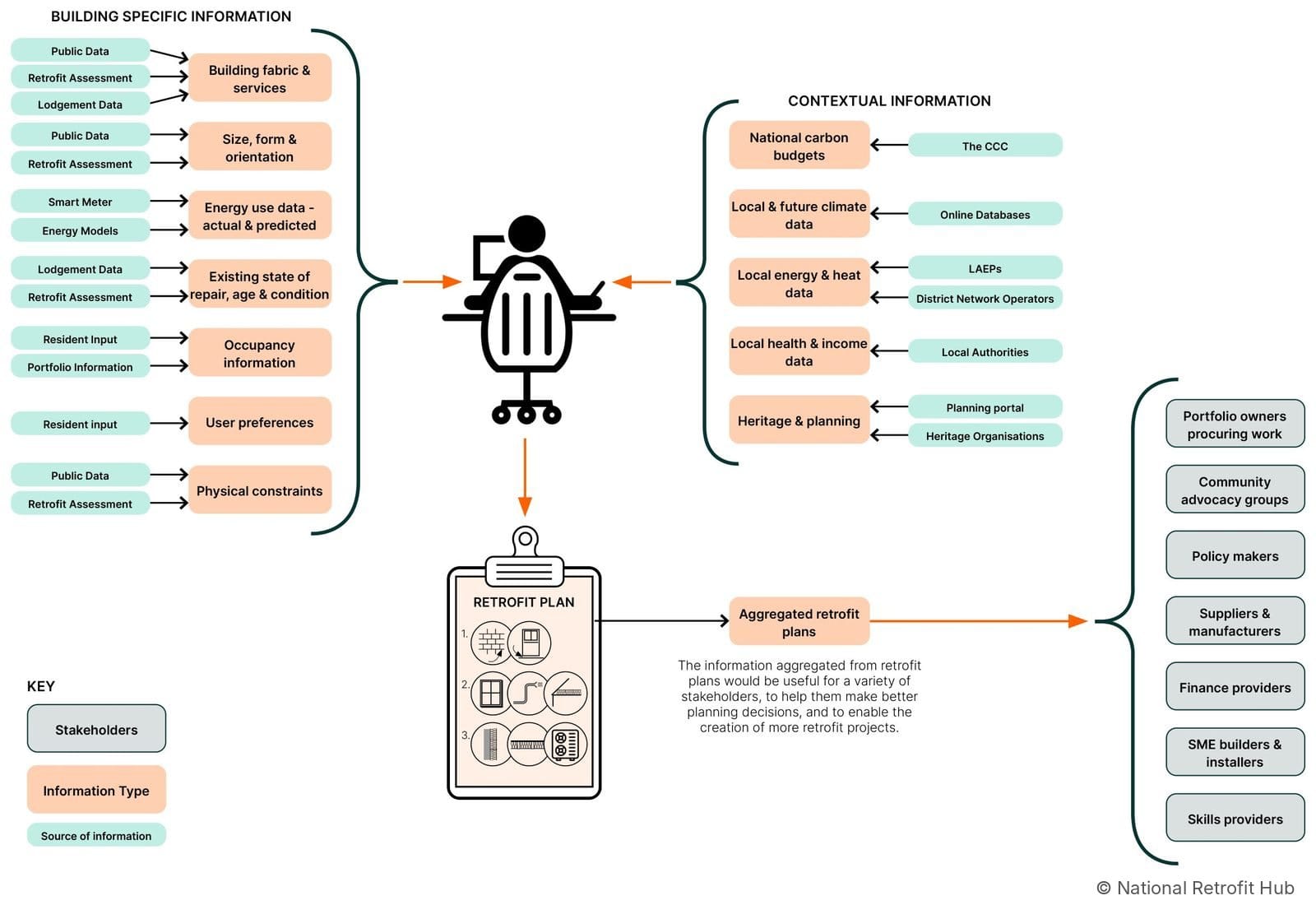
Building specific information
- Building fabric and services: public data, retrofit assessment, lodgement data
- Size, form and orientation: public data, retrofit assessment
- Energy use data, actual and predicted: smart meter, energy models
- Existing state of repair, age and condition: lodgement data, retrofit assessment
- Occupancy information: resident input, portfolio information
- User preferences: resident input
- Physical constraints: public data, retrofit assessment
Contextual information
- National carbon budgets: the CCC
- Local and future climate data: online databases
- Local energy and heat data: LAEPs, District Network Operators
- Local health and income data: Local Authorities
- Heritage and planning: planning portal, heritage organisations
Aggregated retrofit plans
The information aggregated from retrofit plans would be useful for a variety of stakeholders, to help them make better planning decisions, and to enable the creation of more retrofit projects:
- Portfolio owners procuring work
- Community advocacy groups
- Policy makers
- Suppliers and manufacturers
- Finance providers
- SME builders and installers
- Skills providers
Data: dynamic, interoperable and accessible
Digital building logbooks have the potential to enable simplified and instant access to the up-to-date information and data produced and available for a building. These digital repositories could help store information produced as part of a retrofit assessment, including the retrofit plan, and through building performance evaluation and monitoring, so that it is easily available later and for others. Digitally capturing this information could also allow for it to be aggregated, to better inform retrofit stakeholders and decision-makers operating at a strategic level.
A standardised framework for data capture does not exist yet, but would not only make information transferable and interoperable, but help structure and inform retrofit guidance such as pattern books.
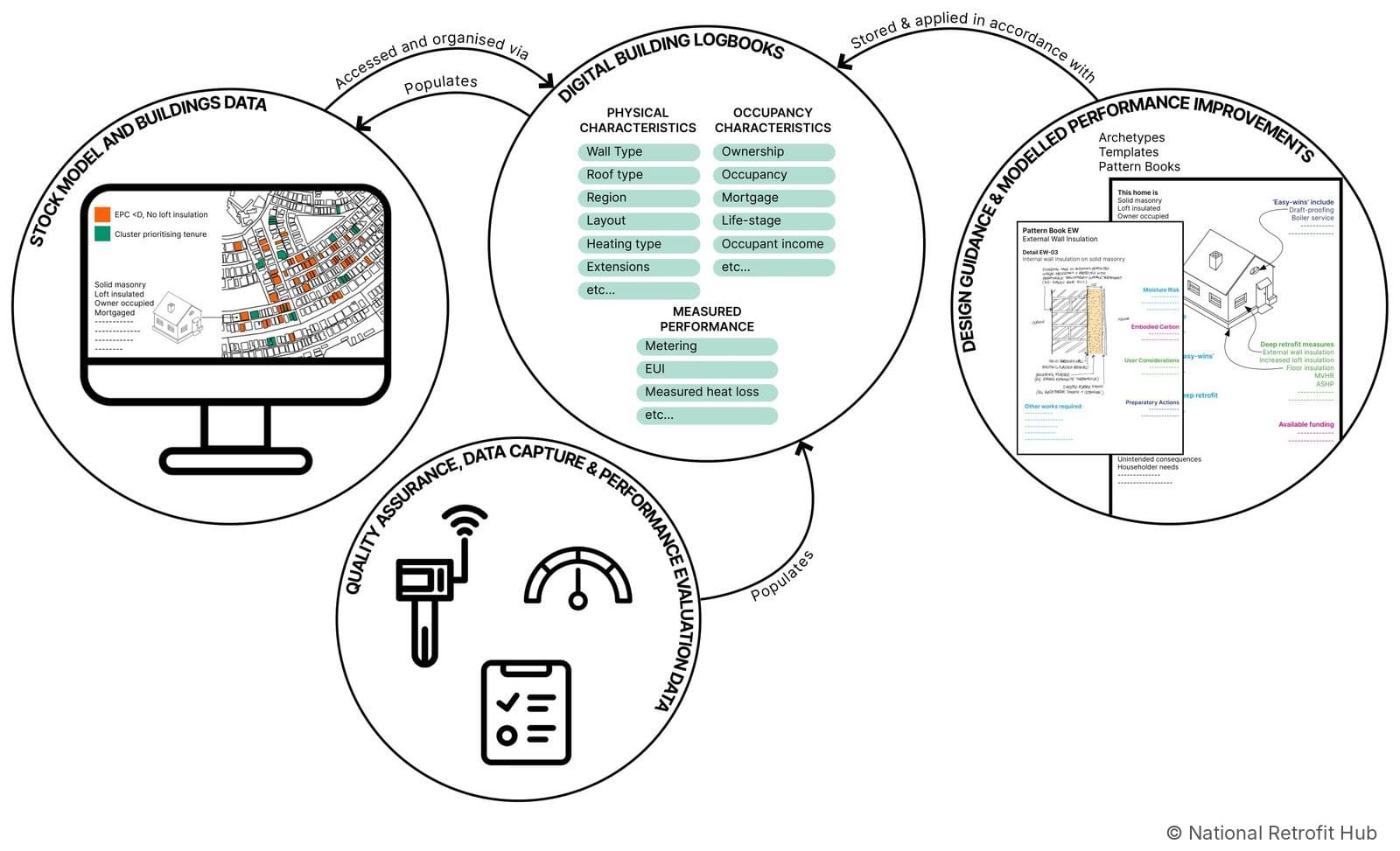
The diagram shows the digital building logbook holding:
- Physical characteristics: wall type, roof type, region, layout, heating type, extensions
- Occupancy characteristics: ownership, occupancy, mortgage, life-stage, occupant income
- Measured performance: metering, EUI, measured heat loss
UK industry progress to date
The following organisations are working on defining the scope, understanding the use cases, enabling the uptake and setting the standards for digital building logbooks:
Residential Logbook Association
Trade body representing 6 logbook providers
- Encouraged by DLUHC to develop a self-regulatory process to create a set of standards for the property logbook industry.
- Led to the creation of the Digital Register for Logbooks to provide better verification around property transactions.
- Currently working on widening the scope of data held to support retrofit projects.
- Working with the legal industry and law commission to help digitise building information, and make property logbooks a legal asset.
- Working with the DLUHC/Ministry of Housing to test logbooks with their First Homes (Help To Buy) Initiative.
- Support for lettings and rentals.
- Incorporating new-build digital handover packs.
- Collaborating with mortgage and loan providers to better integrate information on available finance.
Home Buying & Selling Group
Group of property, legal and finance professionals
- Set-up in 2016 by DLUHC in partnership with the property industry to drive digitisation of property transactions.
- Coordinate the Property Data Trust Framework.
- Collaborated with the RLBA, RICS and others to create standards for the collection, storage, and transfer of data included in the property logbooks.
Green Finance Institute
Forum for innovation in green finance
Published Building Renovation Passports: Creating the Pathway to Zero Carbon Homes, in collaboration with the RICS, the RLBA, and others. The document provides recommendations on:
- Data to be included
- Data collection, ownership and accessibility
- Roles and responsibilities
- Sector-by-sector benefits and opportunities
Climate X Change
Scotland’s centre for expertise connecting climate change research and policy
Reviewed barriers and opportunities to the implementation of property logbooks in Scotland.
“There is significant hope (based on extensive stakeholder engagement, development and testing) that this enhanced building data availability (and its transparency for relevant stakeholders) will have a major impact on scaling up retrofit activity.”
iBRoad
EU Horizon Fund project
- Designed, developed, and tested the creation of Individual Building Renovation Roadmaps for single-family houses.
- Currently supporting national and regional authorities, agencies, and other organisations across the EU to adopt these roadmaps.
Read the RLBA digital building logbook primer for more information.
Potential use in retrofit
There is the potential to enhance, augment and develop logbook information to enable good quality retrofit at scale. Existing and new data inputs could be collected into new logbook sections as follows:
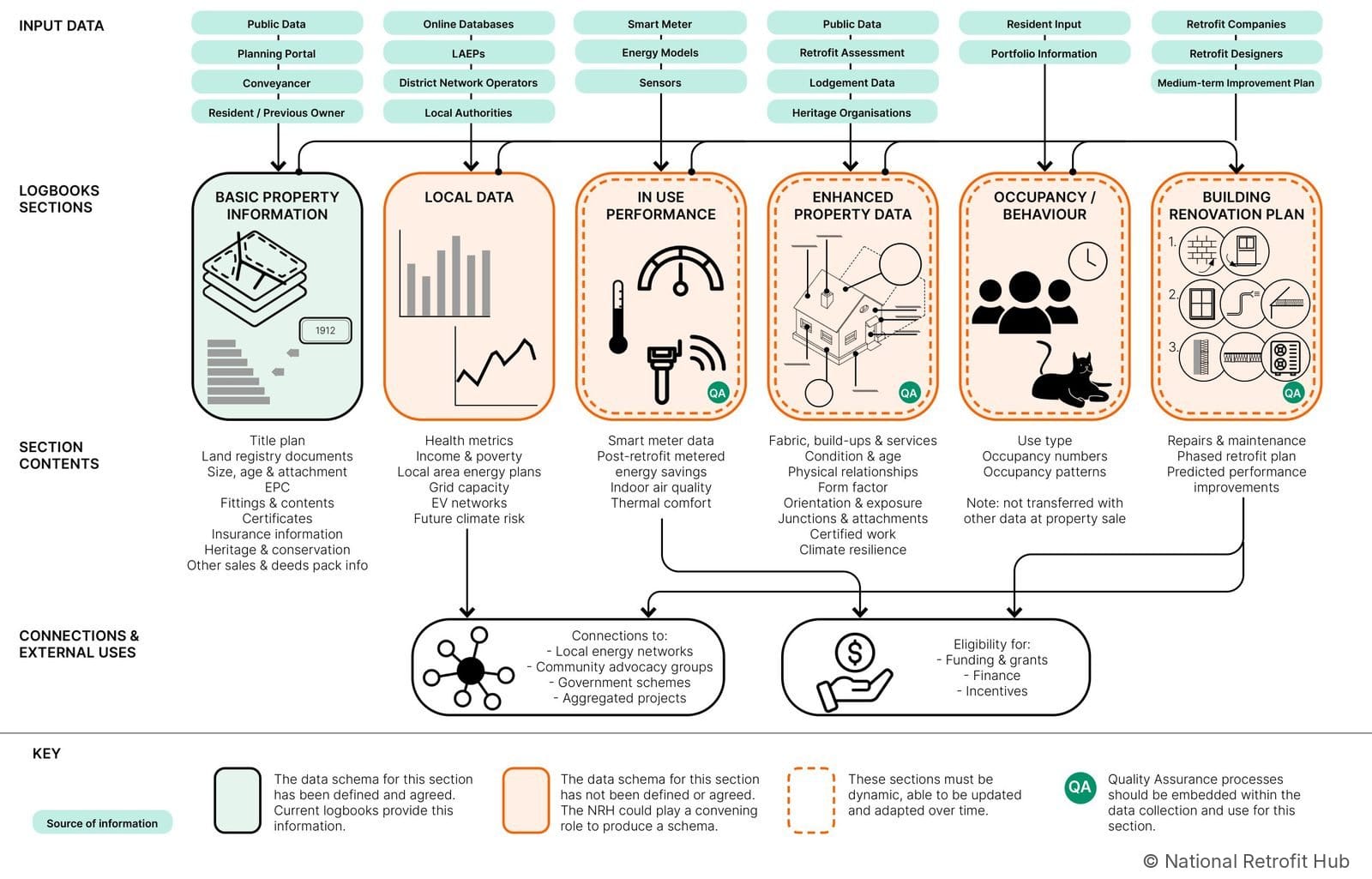
Basic property information
- Input data: public data, planning portal, conveyancer, resident or previous owner
- Section contents: title plan, land registry documents, size, age and attachment, EPC, fittings and contents, certificates, insurance information, heritage and conservation, other sales and deeds pack info
- Status: The data schema for this section has been defined and agreed. Current logbooks provide this information.
Local data
- Input data: online databases, LAEPs, District Network Operators, Local Authorities
- Section contents: health metrics, income and poverty, local area energy plans, grid capacity, EV networks, future climate risk
- Status: The data schema has not been defined or agreed. The NRH could play a convening role to produce a schema.
In use performance
- Input data: smart meter, energy models, sensors
- Section contents: smart meter data, post-retrofit metered energy savings, indoor air quality, thermal comfort
- Status: No agreed schema yet. Must be dynamic, and quality assurance should be embedded.
Enhanced property data
- Input data: public data, retrofit assessment, lodgement data, heritage organisations
- Section contents: fabric, build-ups and services, condition and age, physical relationships, form factor, orientation and exposure, junctions and attachments, certified work, climate resilience
- Status: No agreed schema yet. Must be dynamic, and quality assurance should be embedded.
Occupancy or behaviour
- Input data: resident input, portfolio information
- Section contents: use type, occupancy numbers, occupancy patterns. Note: not transferred with other data at property sale
- Status: No agreed schema yet. Must be dynamic, and quality assurance should be embedded.
Building renovation plan
- Input data: retrofit companies, retrofit designers, medium-term improvement plan
- Section contents: repairs and maintenance, phased retrofit plan, predicted performance improvements
- Status: No agreed schema yet. Must be dynamic, and quality assurance should be embedded.
Connections and external uses
- Connections to: local energy networks, community advocacy groups, government schemes, aggregated projects
- Eligibility for: funding and grants, finance, incentives
The aspiration
The logbook is a secure, online tool providing access to building information. The aspiration is for these to be connected to various data sources, organisations and stakeholders, drawing live information in, and providing information back out. The interface might look different depending on the user, for example, a homeowner might see a streamlined, more user friendly version, and a surveyor might be able to find out detailed information on data provenance.
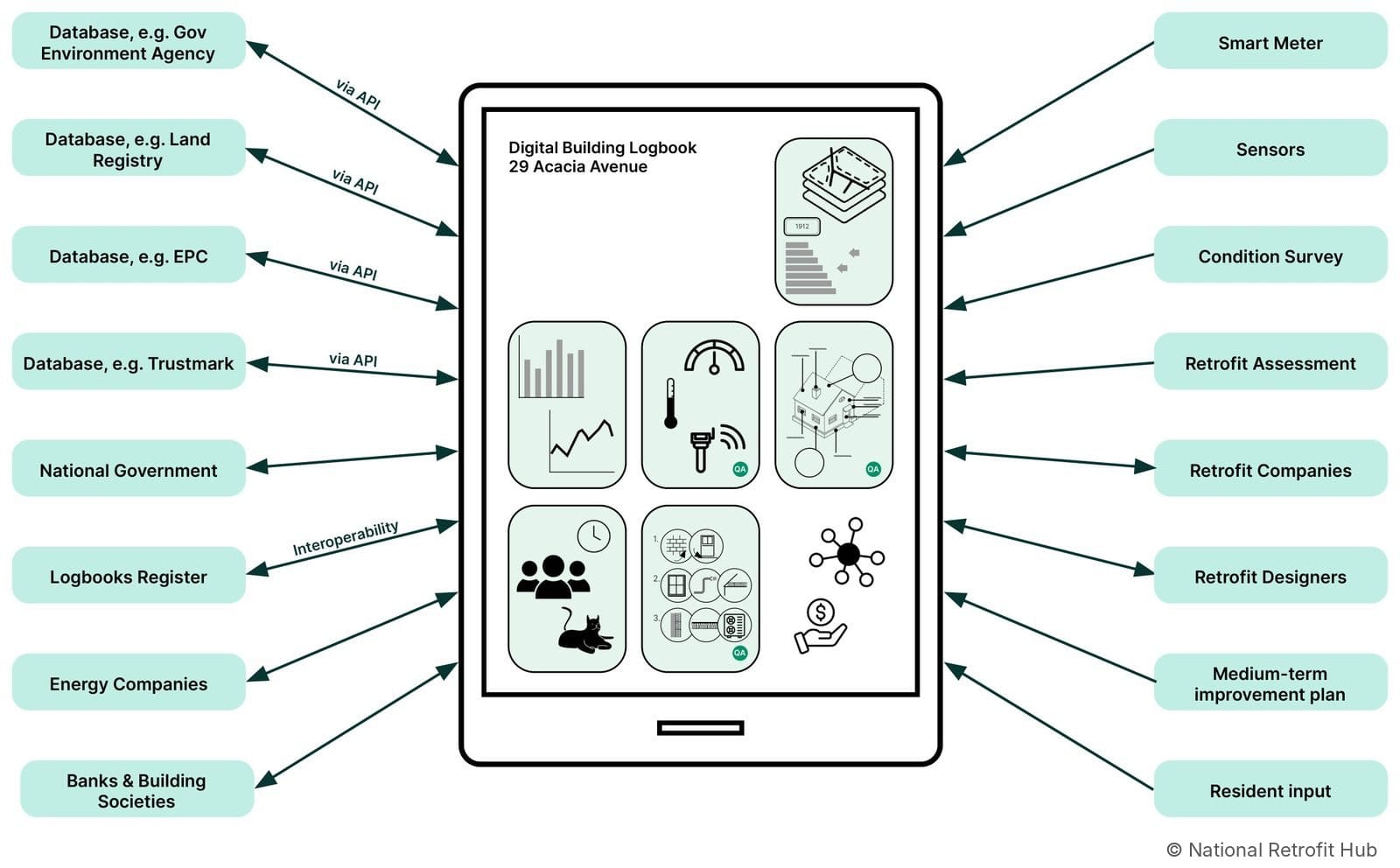
Connected to, via API and interoperability
- Databases, e.g. Gov Environment Agency, Land Registry, EPC, Trustmark
- National Government
- Logbooks Register
- Energy Companies
- Banks and Building Societies
Information drawn in from
- Smart Meter
- Sensors
- Condition Survey
- Retrofit Assessment
- Retrofit Companies
- Retrofit Designers
- Medium-term improvement plan
- Resident input
The UK building data matrix on this page lists the data sources currently available.
Helping overcome barriers to retrofit at scale
Digital building logbooks have the potential to help overcome barriers that have been identified by the National Retrofit Strategy and by the National Retrofit Hub’s working groups.
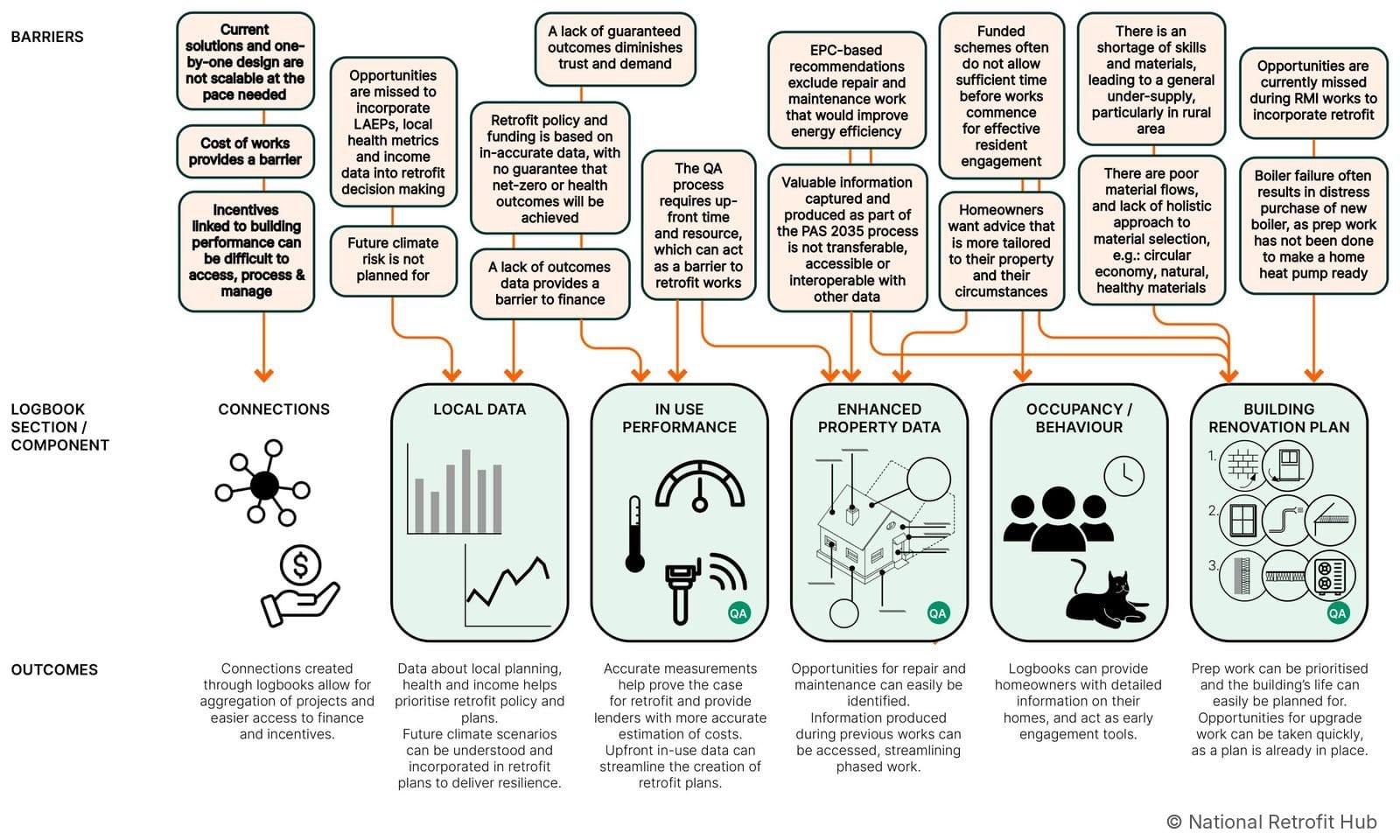
Barriers
- Current solutions and one-by-one design are not scalable at the pace needed
- Cost of works provides a barrier
- Incentives linked to building performance can be difficult to access, process & manage
- Opportunities are missed to incorporate LAEPs, local health metrics and income data into retrofit decision making
- Future climate risk is not planned for
- A lack of guaranteed outcomes diminishes trust and demand
- Retrofit policy and funding is based on in-accurate data, with no guarantee that net-zero or health outcomes will be achieved
- A lack of outcomes data provides a barrier to finance
- The QA process requires up-front time and resource, which can act as a barrier to retrofit works
- EPC-based recommendations exclude repair and maintenance work that would improve energy efficiency
- Valuable information captured and produced as part of the PAS 2035 process is not transferable, accessible or interoperable with other data
- Funded schemes often do not allow sufficient time before works commence for effective resident engagement
- Homeowners want advice that is more tailored to their property and their circumstances
- There is an shortage of skills and materials, leading to a general under-supply, particularly in rural area
- There are poor material flows, and lack of holistic approach to material selection, e.g.: circular economy, natural, healthy materials
- Opportunities are currently missed during RMI works to incorporate retrofit
- Boiler failure often results in distress purchase of new boiler, as prep work has not been done to make a home heat pump ready
How each logbook section helps
- Connections: Connections created through logbooks allow for aggregation of projects and easier access to finance and incentives.
- Local data: Data about local planning, health and income helps prioritise retrofit policy and plans. Future climate scenarios can be understood and incorporated in retrofit plans to deliver resilience.
- In use performance: Accurate measurements help prove the case for retrofit and provide lenders with more accurate estimation of costs. Upfront in-use data can streamline the creation of retrofit plans.
- Enhanced property data: Opportunities for repair and maintenance can easily be identified. Information produced during previous works can be accessed, streamlining phased work.
- Occupancy or behaviour: Logbooks can provide homeowners with detailed information on their homes, and act as early engagement tools.
- Building renovation plan: Prep work can be prioritised and the building’s life can easily be planned for. Opportunities for upgrade work can be taken quickly, as a plan is already in place.
Use in other sectors
Other sectors are using ‘expansion packs’ to digital building logbooks to streamline transactions and provide a better service to customers. Examples include:
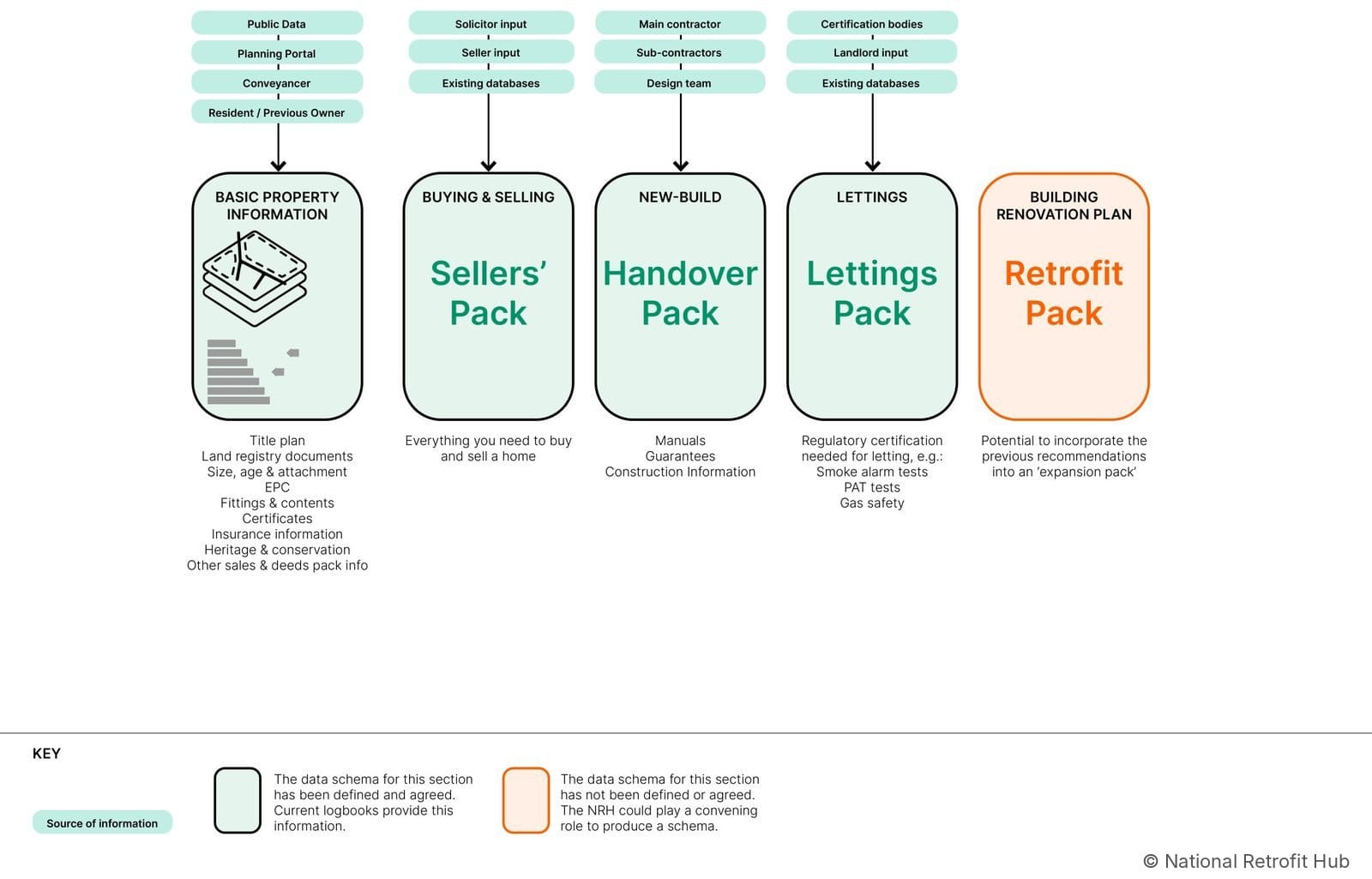
- Buying and selling, Sellers’ Pack: everything you need to buy and sell a home. Inputs from solicitors, sellers and existing databases.
- New-build, Handover Pack: manuals, guarantees and construction information. Inputs from the main contractor, sub-contractors and design team.
- Lettings, Lettings Pack: regulatory certification needed for letting, e.g.: smoke alarm tests, PAT tests, gas safety. Inputs from certification bodies, landlords and existing databases.
- Building renovation plan, Retrofit Pack: potential to incorporate the previous recommendations into an ‘expansion pack’. The data schema for this has not been defined or agreed, and the NRH could play a convening role to produce one.
Key questions from our round table
The National Retrofit Hub held a round table with potential logbook stakeholders, including: surveyors, energy companies, financiers, councils, and building owners, and asked for their views on the following questions:
What could drive the adoption of logbooks within the industry and for homeowners or residents?
Our panel suggested that to enable adoption logbooks should be:
- Easy to use and access
- Free or low-cost
- Interoperable
- Transferable
- Pre-populated
- Government endorsed
- Linked to advice and incentives
- Useful
- Compatible with retrofit data standards
The group also identified the need for:
- Sales routes
- Channel partners
- Better awareness
- Legislation
- Public access
Who should pay for logbooks?
Options include:
- The conveyancer or retrofit agency, bundled with other services.
- The lender, as part of a mortgage deal, or through an incentive from an energy company.
- Property owners, for long-term data access to their property’s maintenance plan
Trigger points in a building’s life, such as a sale, letting, or refurbishment, would provide a good opportunity to deploy a logbook.
Government funding or incentives could have a big impact on uptake. Logbooks could be offered as part of a funding or voucher scheme, particularly where retrofit assessments are required to comply with PAS 2035.
What would be needed so that organisations could offer or provide logbooks?
Our panel suggested that they would need:
- Partners to help them engage with logbooks
- Confidence in the security of data.
- Support with data management internally.
- Clarity on what data to ask for from consultants or contractors.
- For there to be a schema and agreed standards to ensure interoperability across platforms.
- A clear way of sharing logbooks.
- Clarity on data provenance, reliability and the liability associated with using data already contained in a logbook.
- Funding for staff time, ongoing support, concise training and resources.
- Agencies or aggregate organisation that could manage logbooks on behalf of local authorities.
- Agreements to use data linked to current funding streams, e.g.: ECO, SHDF, HUG.
- The ability to retain versioning of data, full update histories and hence improvements made.
How can we ensure the contents of the log-book are accessible and easy to understand for residents?
Different user interfaces for different types of stakeholders are key. A homeowner or resident will need to see less, and simplified information.
Homeowners particularly require information that helps them make decisions.
Graphic displays and dashboards would also improve accessibility and engagement.
Easy search would improve accessibility.
A standardised data schema and format could improve access for people viewing multiple logbooks.
Key questions from our working group
Our working group participants also asked us the following questions:
What level of detail would be captured in log books? Would changing a light bulb be included?
This question should be asked when creating a data schema for each of the sections identified. Logbooks need enough data to be useful when making decisions, but not over-burden the user or surveyor. This will be a careful balance to strike.
How joined up are developing ideas around logbooks with the golden thread and government policy?
Making strong and useful connection between building safety, the golden thread, and material passports should be considered when developing data schemas for each of the sections identified.
How can logbooks consider shared assets, like community energy schemes and heat networks?
These items will be important to incorporate within the data schemas for the local data and connections sections. Logbooks should enable engagement with and connection to shared assets by providing up-to-date information on what systems are locally available.
Will logbooks be reliant on EPC data only?
No, logbooks will contain, and sit alongside EPCs, but provide much more information, drawn from various sources.
How can embodied carbon and whole life carbon be incorporated?
Logbooks have the potential to include information on the materials needed as part of a retrofit plan, and the materials already within a building, via material passports. This should enable whole life carbon to be considered more holistically, and unlock supply chain certainty and the circular economy.
How will user behaviour be integrated to logbook?
This could be from user input, surveys or performance data such as CO2 monitoring. Data protection, security and ownership will be key considerations when thinking about how to manage, store and provide access to this data.
Will the state of maintenance and repair be included in the logbook?
Yes, this is key to inform a retrofit plan.
How can logbooks be used across tenures, by social landlords, private landlords, residents and homeowners?
This is key to enabling the local delivery of retrofit at scale. An agreed data schema, and interoperability could ensure that multiple logbooks are able to be aggregated and read together. Further work is required to ensure this goal is met.
Contributors
This document was created with contributions from: National Retrofit Hub working group 1 technical lead Louis Daillencourt, Working group 1 co-chairs Dr Ahsan Khan and Lizzy Westmacott, Residential Logbooks Association chair Nigel Walley, and working group 1 participants.
Please share any feedback with us at info@nationalretrofithub.org.uk.

