


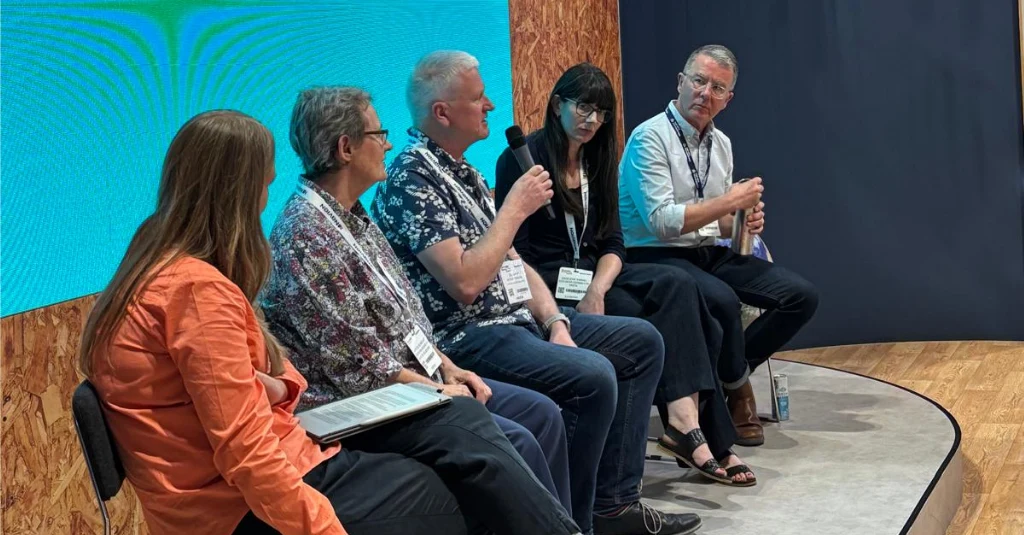
On Wednesday 25th June, the National Retrofit Hub took over the Elemental Arena at InstallerSHOW for a full afternoon of panels and conversation. Together with experts from industry, advocacy, finance and research, we explored three of the biggest questions facing retrofit right now: how to reform EPCs, how to make homes truly heat-pump ready, and how to unlock the right funding and finance for action.
Each session was packed, and the conversations were honest, thoughtful, and refreshingly practical. Across all three, one thing stood out: the need for retrofit policy and delivery to reflect how people actually live. From EPCs that speak to health and comfort, to finance that comes with advice people can trust, we need systems that are not just technically sound, but human-centred and grounded in the real world.
EPC REFORM – CLARITY, CONFIDENCE, AND THE ROLE OF INDUSTRY
Speakers:
- Chair: Sara Edmonds – NRH Co-Director
- Naomi Schraer – Citizens Advice
- Peter McBride – Mixergy
- Andrew Parkin – Elmhurst Energy
- Tom Leach – Nesta
EPCs play a central role in retrofit decisions, but there’s growing unease about how well they work and what we’re asking them to do. Originally designed to be low-cost indicators, EPCs are now expected to shape funding, policy and procurement decisions.
The panel agreed that reform is overdue but also warned against simply making them more complex. We need EPCs that are clearer, more accurate, and more meaningful, without becoming impossible to deliver.
Health came up repeatedly as a critical, missing link, both in policy and in performance modelling. There was strong support for improving the system in a way that supports innovation, including real-world data, helping people make better decisions.
HEAT PUMP READINESS – WHAT WORKS, WHAT DOESN’T, AND WHAT TO BE AWARE OF
Speakers:
- Chair: Rachael Owens – NRH Co-Director
- Kate De Selincourt – Passivhaus Trust
- Richard Hauxwell-Baldwin – The MCS Foundation
- Madeleine Gabriel – Nesta
- Bill Wright – National Energy Foundation
The UK needs to rapidly scale up the transition to low-carbon heat, in order to reduce emissions and improve energy security, but this will require holistic thinking. There is a risk that heat pumps installations can be poorly designed, in homes that aren’t ready, without the right support for residents.
Our panel unpacked what readiness really means, from housing stock to household needs. Understanding how people use heating today, especially in underheated homes, is key to designing systems that actually deliver comfort, savings and carbon reductions.
The conversation challenged assumptions and surfaced practical truths. Heat pumps can perform brilliantly when done well, but they’re not a guaranteed win, and retrofitting them into complex homes needs careful planning. The transition to low carbon heat will also reveal issues already present within the system, that first need addressing, like expreme fuel poverty, home underheating and poor thermal comfort. Smart controls, monitoring, and better education for both installers and residents were seen as essential. This, alongside dedicated support for those unable to heat their homes to a comfortable temperature, is needed. It’s not about selling a silver bullet, it’s about understanding what works, where, and for whom.
GRANTS AND MYTH BUSTING – UNLOCKING FUNDING AND FINANCE FOR RETROFIT
Speakers:
- Chair: Sara Edmonds – NRH Co-Director
- Chloe Timperley – Green Finance Institute
- Emma Lower – Lendology CIC
- Cara Holmes – Citizens Advice
Retrofit finance is often seen as a technical issue, but our panel showed it’s just as much about trust, timing, and communication. The market for green finance is growing fast, but most people don’t know what’s available, or who to ask. Whether it’s a homeowner trying to act, or a council trying to support them, access to funding is too often blocked by confusion and complexity.
Speakers called for better, more integrated advice. The idea of a “single spine” of support, combining financial and retrofit guidance, came up a few times, with Local Authorities seen as having a vital role.
From green mortgages to third-party ownership models like ‘heat as a service’, low interest loans to council-supported financing, the tools are out there. The question now is how we bring them together, communicate them clearly, and offer people the support they need to act with confidence.
KEY REFLECTIONS
What stood out most was the shared recognition that systems, whether regulatory, technical or financial, need to be reshaped around how people actually make decisions, live in their homes, and experience retrofit. We need retrofit systems that are usable, understandable, and built around trust. From what the result of EPC reform may look like, to the accessibility of heat pump installation, to the confusing landscape of grants and finance, the common thread was clarity and confidence. People need to know what’s possible, what’s right for them, and where to turn for help.
Another clear message was the importance of joined-up action. The challenges raised in each panel don’t sit in isolation, they’re part of the same system. Improving EPCs can support better funding decisions. Smarter finance needs clearer metrics and trusted advice. Better retrofit outcomes depend on the right installations, in the right homes, with the right support. That means coordination: across sectors and between national and local action. The opportunity is huge, but only if we move to a more focused, supportive, and collective delivery.

