


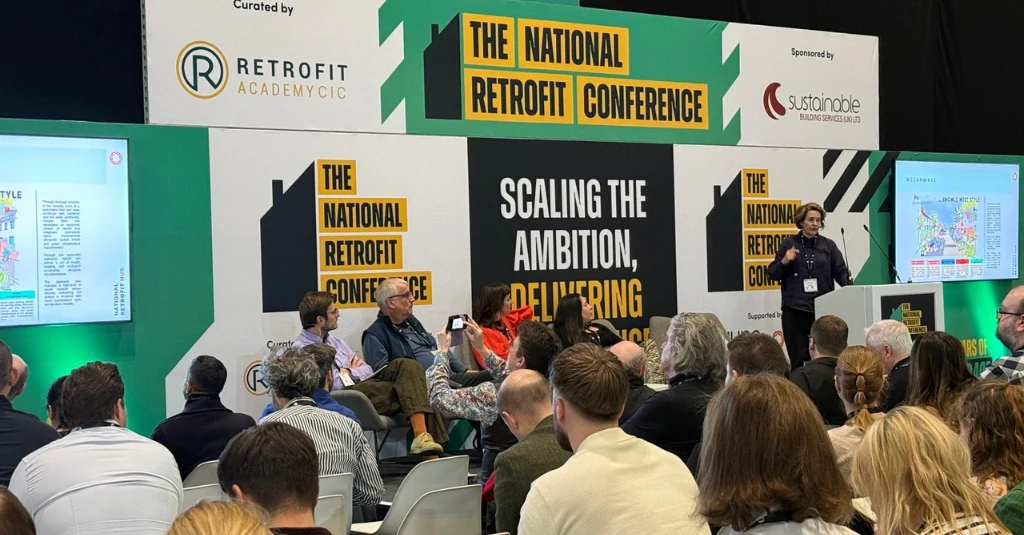
On the 6th of March, the National Retrofit Hub was invited by Futurebuild and the Retrofit Academy to curate and host a series of impactful sessions at the National Retrofit Conference and Expo.
As the retrofit landscape continues to evolve, these sessions provided a platform for exploring the future of energy performance, sustainable housing, and community-led initiatives. The day was filled with inspiring discussions, thought-provoking ideas, and actionable insights from industry leaders who are at the forefront of driving change.
EPC REFORM – “PERSPECTIVES ON CHANGE IN ACTION”
The first session of the day, EPC Reform – Perspectives on Change in Action, delved deep into the ongoing examination of Energy Performance Certificates (EPC) reform. As part of the UK’s drive towards net-zero housing and the elimination of fuel poverty, EPCs are undergoing significant transformation, and understanding the practical implications of these changes is vital for all stakeholders in the housing and retrofit sectors.
During the session, a panel of experts discussed the future of EPCs, exploring what reforms might look like in practice. Rachael opened the floor by asking the panel what they would like to see for the future of EPCs.
Key Takeaways:
Andrew Parkin (Elmhurst Energy) expressed the desire for EPCs to include holistic recommendations, focusing not only on energy efficiency but also on health, carbon reduction and net-zero journeys. He emphasised the importance of telling the story to the consumer to engage them in the long-term journey.
Justin MacMullan (Which?) suggested that EPCs should provide clear links to the next steps in the retrofit process, including trusted sources for reliable installers and information on associated costs. He also pointed out the need for the data to be more locally specific, so consumers can easily find solutions tailored to their circumstances.
Keeran Jugdoyal (MHCLG) talked about the government’s plan to improve data availability and access.He pointed out that at some point, a retrofit professional will often need to get involved in the upgrade of a home, and access to background data within an EPC would streamline and inform their designs and recommendations. Additionally, he suggested that EPCs could connect to other big data sets to create a more comprehensive picture of the building stock across the UK.
Stephanie Landymore (Ecology Building Society) added that she would like to see climate resilience and emboded carbon included within EPCs. She noted the need for more frequent updates to EPCs, ensuring that individuals are kept informed about new opportunities, incentives, and changes in policy. Importantly, she expressed a need from finance providers for the information included within EPCs to more accurately reflect the performance of all different types of homes.
This lively conversation shed light on the critical role EPCs will play in incentivising and enabling retrofit, not only by guiding energy efficiency improvements but by helping consumers take meaningful steps toward healthier, lower-carbon more climate resilient homes.
COMMUNITY-LED RETROFIT – “REDEFINING RETROFIT AT SCALE”
Next, the focus shifted to community-led initiatives with the session Community-Led Retrofit – Redefining Retrofit at Scale. This session challenged the common misconception that community-driven retrofitting efforts are small-scale or limited in impact. By showcasing case studies and real-world examples, the speakers highlighted how grassroots initiatives can drive large-scale, place-based retrofit solutions that are both effective and sustainable.
Key Takeaways:
Melissa Mean (WeCanMake) highlighted the importance of retrofitting both the built and social fabric, using bio-based materials, addressing overcrowding, and implementing moderate extensions to terrace houses. She discussed her work on the street demonstrator project, which will retrofit six mixed tenure homes in June, and emphasised the power of the “street-by-street” approach, which she described as socially contagious.
Jas Tippet, a local resident, shared how she went from not understanding retrofit to becoming a passionate advocate for both retrofit and by extension climate action. Her experience, which included accounts of how top down delivered schemes can leave residents feeling disrespected and vulnerable demonstrates how, through locally driven schemes with an emphasis on codesign and inclusion, residents can become key champions for retrofitting efforts within their communities.
Naomi Rubbra (Footwork Trust), described her alternative approach to place-making, where communities lead the process rather than top-down development. Naomi emphasised that empowering people to shape their communities, a practice delivered through their People in Place programme, is key to scaling retrofit projects and ensuring their success.
Neil Turner (Ecological Building Systems) spoke about their range of customers and collaborators which includes Cumbria Action for Sustainability. The group works with over 100 local community groups, providing homeowners with guidance on grants, thermal image tests, and in-situ retrofit advice, engaging more than 10,000 homeowners. Ecological Building Systems has completed 81 full retrofits and 300 partial measures in Cumbria, with an ever-increasing reach.
Rob Morrison (BE-ST) discussed Retrofit Scotland, an initiative to accelerate retrofit action by platforming retrofit related activity across Scotland through a range of partnerships and events, including in-person “Together Days” at Civic House, a post-industrial building in Glasgow that was taken through a deep retrofit itself by the resident owners, Agile City. He reflected on Glasgow’s history of demolishing buildings and the importance of learning from past mistakes.
GREEN FINANCE INNOVATION – “WHEN INNOVATION BECOMES THE NORM”
The third session, Green Finance Innovation – When Innovation Becomes the Norm, explored the growing role of financial innovation in driving the retrofit agenda. There is money available for retrofit, but unlocking access to finance, and stimulating demand are key challenges innovation can help solve. This session shed light on how innovative financial models, such as Zero Bills schemes, Local Authority partnerships, and Ireland’s credit union approach, are breaking down these barriers and creating pathways for scalable and sustainable retrofit solutions.
Key Takeaways:
Emma Fletcher (Octopus Energy) shared how their technology-driven approach is making green finance more accessible, such as their wind turbine projects that offer local communities up reductions in energy bills, and high performance homes with no energy bills for 10 years.
Emma Lower (Lendology) highlighted their work as a social enterprise that helps people access financial support for retrofit projects, ensuring every £1 invested generates £2.70 in social return. Their focus is on financial inclusivity, helping individuals from all backgrounds access retrofit financing, in partnership with Local Authorities.
Jonathan Atkinson (People Powered Retrofit) discussed finance models for place-based retrofit projects. By combining grants and private funding, they’ve worked with local authorities on retrofit projects, citing best practice examples from Ireland and the USA, and their learnings from a Green Homes Finance Accelerator project which explores the potential for Credit Unions to provide retrofit finance.
Stuart Leslie (National Wealth Fund) discussed their focus on committed guarantees for housing associations for retrofit projects and capital deployment for local authority-led green finance funds.
The session underscored how green finance innovation is becoming more embedded in standard practices, paving the way for greater accessibility and uptake of retrofit initiatives. By embracing diverse financial models and collaborating across sectors, these organisations are helping to make retrofit more affordable, scalable, and impactful for communities across the UK.
RETROFIT SYSTEMS – “NAVIGATING THE COMPLEXITY”
The final session of the day, Retrofit Systems – Navigating the Complexity, tackled the inherent complexities of the system of retrofit. Retrofit involves a diverse range of stakeholders, systems, and solutions, and this session embraced the challenge of navigating this complexity. Featuring insights from academics and practitioners, the session explored how collaborative, place-based responses can address local needs while simultaneously meeting broader retrofit objectives.
By focusing on systemic approaches, the session showcased strategies for overcoming challenges and real-world examples of how complexity can be effectively managed to deliver impactful outcomes at scale.
Key Takeaways:
Polina Pencheva (UCL) shared her experience, emphasising the challenges of managing multiple stakeholders when attempting to map complex systems, such as retrofit. She highlighted that without proper governance, and clarity of understanding the connected nature of the components of the system, retrofit outcomes can become disjointed. Through the Net Zero What Works initiative, UCL bring together stakeholders to collaboratively tackle these issues, concluding that a systems-based approach is key to overcoming the challenges and achieving effective retrofit solutions.
Alastair Mumford (The MCS Foundation) discussed LARA (Local Area Retrofit Accelerator), a systems-based approach designed to navigate the complexities of co-creating local area retrofit plans. By using systems mapping and broad stakeholder inclusion and engagement, LARA intends that all key actors are engaged in a collaborative, co-designed retrofit strategy tailored to local needs. This approach not only fosters local ownership but also de-risks investment by aligning stakeholders and ensuring that retrofit projects are scalable and effective.
Alastair Parvin (Open Systems Lab) discussed the “retrofit payback dilemma,” where projects often go over budget due to misaligned systems. He highlighted the need for a more integrated approach involving professionals, platforms, and people to create a more efficient, de-risked system. He shared examples, like the open-source Wikihouse and Plan-X which are open source tools that anyone can access to encourage collaboration.
A Day of Innovation, Action, and Inspiration
Our sessions at Futurebuild highlighted the importance of collaboration, innovation, and proactive thinking in retrofit. Each session provided a unique perspective on the progress made on some of the key issues of the moment, but also the challenges and opportunities that lie ahead for energy performance, community-led initiatives, green finance, and navigating complex retrofit systems.
As we move closer to our collective goal of scaling retrofit across the UK, it’s clear that these conversations are not just important—they’re essential. By coming together, sharing ideas, and learning from each other, we can move towards a better functioning retrofit system that will allow us all to build a more sustainable, resilient future for our homes, communities, and economy.
Stay tuned for more updates from the National Retrofit Hub here.

