


Introduction by Sara Edmonds – Co-Director, National Retrofit Hub:
As part of our Retrofit Connect programme, spending days together visiting innovative community initiatives is a vital part of the learning. Though related to retrofit, the innovation in these communities is multi-stranded and multi-dimensional; and hard to capture in one single report or profile. What follows is a series of three blog pieces written by Talisa Denny, project coordinator in the NRH, which paint a picture of the beautiful complexity and deep roots of just some of these groups. Read on to hear about the places and people where real change is rooted and has the potential to be transformational beyond their boundaries, but learning for us all.
STORY NUMBER ONE | Kitty’s Launderette, Anfield
By Talisa Denny – Project Coordinator, National Retrofit Hub
A FIELD TRIP TO LIVERPOOL
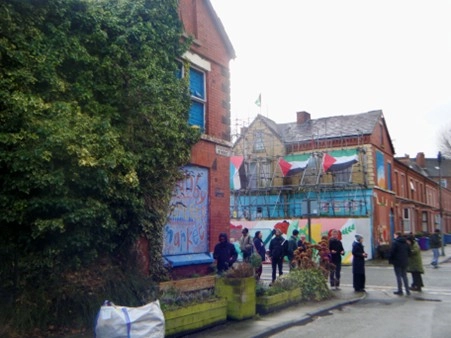
On a cold and wet February day, the Retrofit Reimagined crew brought the sunshine to Liverpool for several days of site visits and knowledge exchange. Kindly and thoughtfully coordinated by CIVIC SQUARE, we were generously hosted by three community organisations – Kitty’s Launderette, Homebaked CLT, and Granby 4 Streets. Equipped with a notebook of fieldnotes, I was lucky enough to absorb their light, and scribble away many observations based on the deep, wonderful and expansive chats which took place in Anfield and Toxteth.
A COMMON THREAD
In the shadow of the Warm Homes Plan, the thread that underlined the trip was a recognition that retrofit is too often dominated by stories of new and innovative energy efficiency technologies. Left behind is a quieter but more urgent reality. Many households and neighbourhoods need care, repair, and basic improvements to make their homes resilient and comfortable.
Telling stories about energy:
Part of a bigger story, the dominant energy story of the past few centuries has been one of an onward march, relentless in the pursuit of expansion and domination. This history has included decisions to privilege certain technologies, such as global and centralised energy systems for their ability to simultaneously centralise political power and control. As Cara New Daggett writes:
“That is why the blossoming of alternative energy stories that counter patterns of domination by fuel, and that feature political innovations that more equitably and sustainably organize energy, will be as important as new energy tools, and perhaps more so.”
Telling stories about retrofit:
Likewise, though new and innovative retrofit technologies have a key role to play in our climate transition, they shouldn’t play into the same old stories which concentrate power and capital into the hands of an elite few. Beyond energy efficiency technologies, we need more and better stories about retrofit which exemplify a culture of care and repair, stewardship, and a new kind of politics which isn’t focused solely on the extraction of value from land and housing. These stories abound, if we’re willing to see them.
“WE ARE THE FUTURE”: MORE AND BETTER RETROFIT STORIES FROM LIVERPOOL
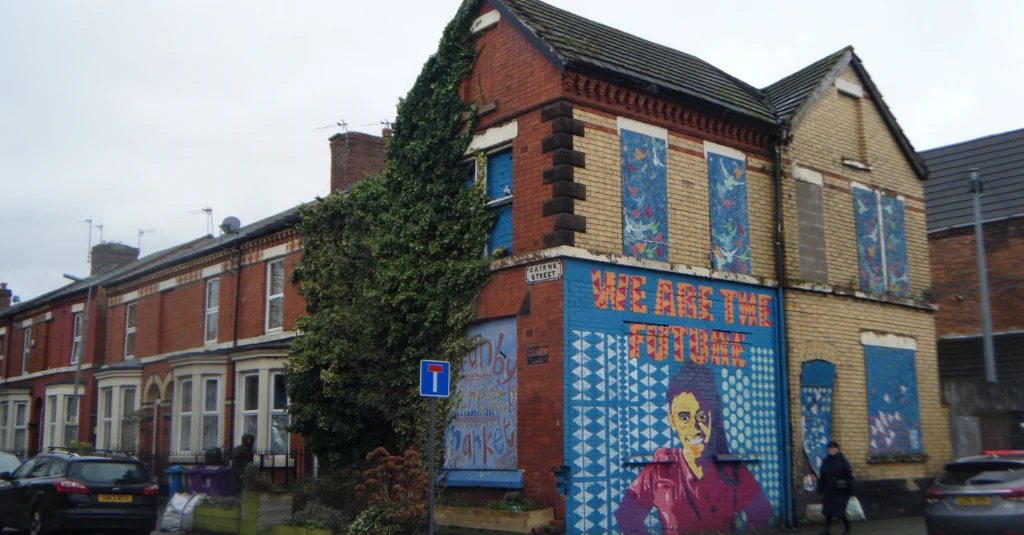
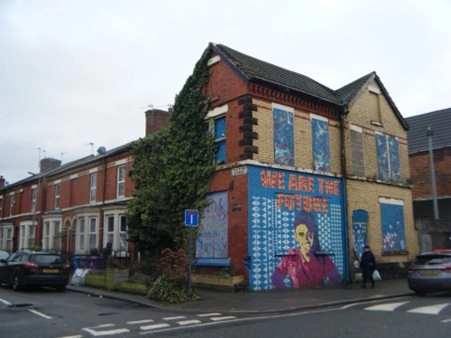
During our visit, stories about the value of memory, conviviality, and a history of cooperation coalesced around two neighbourhoods within Liverpool – Anfield and Toxteth. Local organisations Kitty’s Launderette, Homebaked CLT, and Granby 4 Streets are demonstrating what these better and more powerful retrofit stories are capable of. Their stories are more expansive in every sense, illustrating the possibilities for transformation that community-led social movements and housing justice provide.
‘STAYING WITH THE TROUBLE’ AT KITTY’S LAUNDERETTE, ANFIELD
When things fall apart, we are presented with an opportunity to reimagine. This is true of our homes, buildings and neighbourhoods. Yet, retrofit isn’t just about how we reimagine the future, it’s about how we connect with our past.
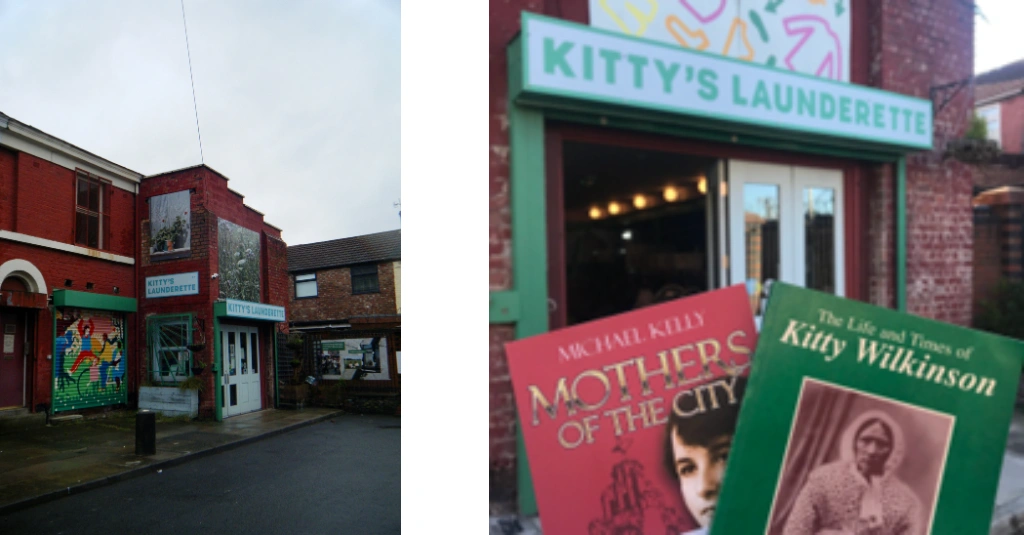
Our first stop was to Kitty’s Launderette, a community-owned third space where all are welcomed to slow down and connect. During Covid, the launderette provided free laundry services to those who were vulnerable and isolated, remaining a backbone of the community ever since. Pieced together through oral histories, the launderette celebrates the life and work of a local Irish migrant, Kitty Wilkinson. Having pioneered the wash house movement in the UK during the early 19th century, Kitty invited her neighbours to wash their clothes and bedding in her home, saving many lives and opening a public wash house 10 years later.
These histories of working class social and public health movements are instructive, illustrating the importance of rooted place-based knowledge. By relearning forgotten histories, we can learn from the social movements of the past:
“This isn’t new, we’re just doing what we’ve forgotten” – Anthony Scott, Kitty’s Launderette
BUILDINGS ARE MORE THAN EMPTY CONTAINERS
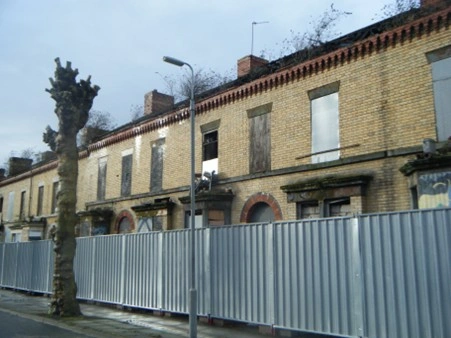
The built environment is not an empty container; stories are held within the fabric of our neighbourhoods, some of which have been lost within our collective and institutional memory. With ongoing threats of demolition and displacement in various neighbourhoods and ‘tinned up’ streets across Liverpool, we face losing the value brought by our heritage. Echoed across the visits, these metallic streets stifle feelings of hope and possibility. However, authors such as Katherine McKittrick and Cindi Katz have often reminded me that despite many attempts throughout history to flatten and erase stories of subversion and solidarity, such stories can only be obscured but not destroyed.
Much like many voided houses in Liverpool, these stories hold latent potential and emergent opportunities to rethink and do differently. They hold power and hope – inactive, but with the potential to transform our neighbourhoods under the right conditions and with careful stewardship. As Dan Hill and Mariana Mazzucato write:
“A building such as a house is essentially a conscious entangling of materials at a single point in time, usually for a particular use, before those materials flow on elsewhere. The material is what persists, albeit shifting form and state over time. The custodianship of these material flows, recognised as both elemental and cultural, becomes the imperative for design just as much as their assemblage as a building in a particular moment.”
Part of the work of retrofit is not only to reimagine, but to use the history of our buildings and social movements as a vehicle to do so. This is about how we stay with the trouble and collectively move through crisis.
SOURCES, MEDIA & READING
- CIVIC SQUARE. Retrofit Reimagined: The Future is Already Here. 2025
- Kitty’s Launderette
- Department for Energy Security & Net Zero. The Warm Homes Plan. 2026.
- Daggett, C., 2021. Energy and domination: contesting the fossil myth of fuel expansion. Environmental Politics, 30(4), pp.644-662.
- Haraway, D.J., 2020. Staying with the trouble: Making kin in the Chthulucene. Duke University Press.
- Katz, C., 2017. Revisiting minor theory. Environment and Planning D: Society and Space, 35(4), pp.596-599.
- McKittrick, K., 2013. Plantation futures. small axe, 17(3), pp.1-15.
Hill, D.P. and Mazzucato, M., 2024. Modern housing: An environmental common good.

