


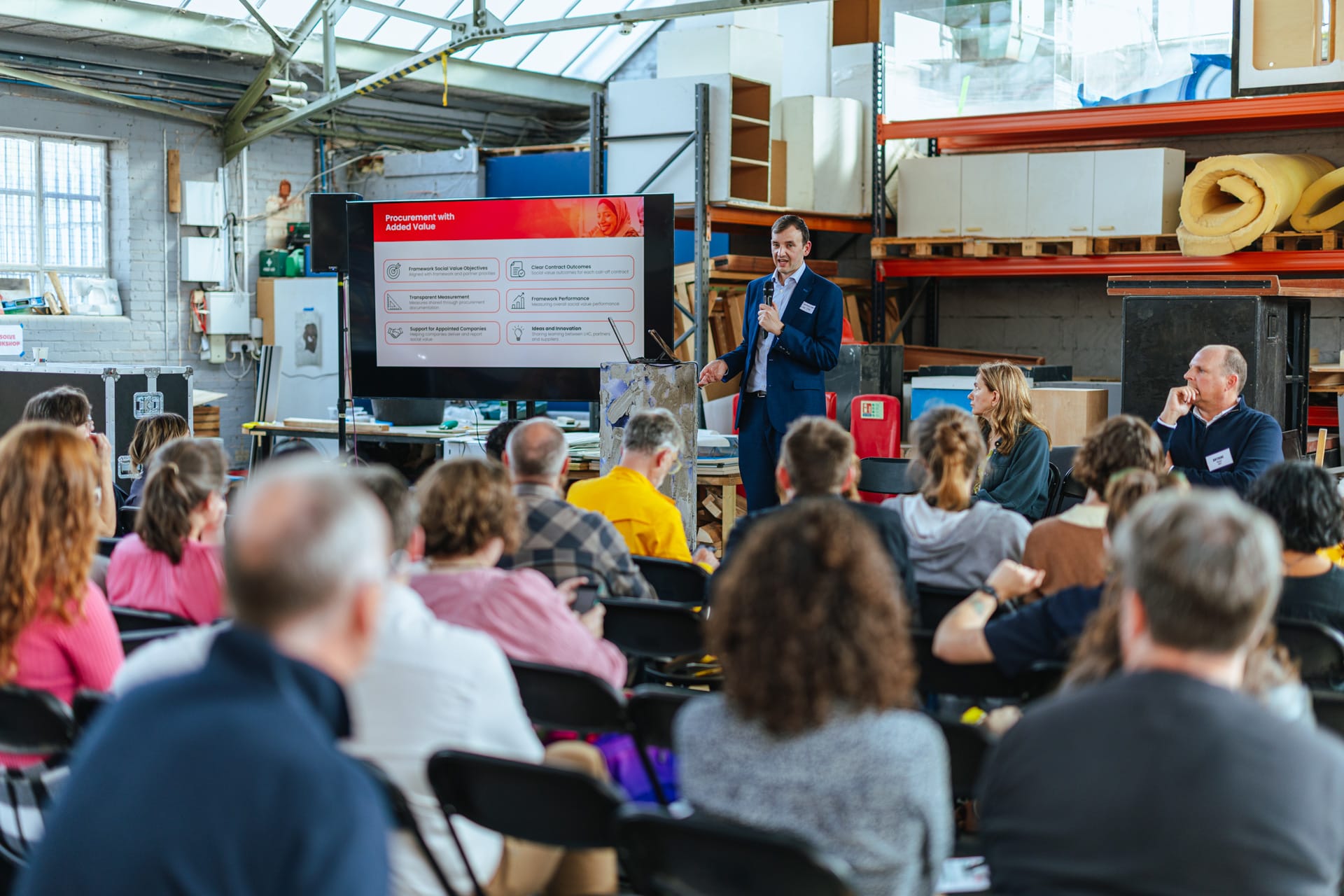
This is the second blog in a series following the progress of a project between The National Retrofit Hub (NRH) and LHC Procurement Group (LHCPG) who have been thinking together about one big question: how can we unlock wider value and long-term term benefits in retrofit by involving communities during procurement?
Foreword by Sara Edmonds:
At the NRH’s Retrofit, Obviously! Summit in September, we intentionally organised two themed panel strands: Health and Homes and Procurement and Social Value. These themes were chosen because our work consistently points to them as critical enablers of a meaningful transition to retrofit at scale.
An overarching takeaway from the procurement focused panels was that procurement should shift from buying retrofit measures to enabling place-based outcomes. That means procuring for quality, resident trust, skills, social value, community leadership, and long-term local capacity, rather than simply procuring installations at the lowest possible cost.
You can expect further insights from the Summit in the coming weeks and months, but here we wanted to share insights from our ongoing collaboration with LHC Procurement Group, specifically around the role of contractors in enabling social value outcomes in retrofit delivery.
Balancing Power in Procurement: Contractors Edition
Understanding how procurement practices can be enhanced to enable citizens to meaningfully influence the delivery of social value could help strengthen partnerships between residents, housing providers and contractors. Community retrofit groups have often expressed interest in taking a more active role during procurement. They have the potential to bring value to the process: building resident trust, improving uptake and opt-in rates, ensuring projects meet community needs, improving the quality of installs, and smoothing relationships between all parties. The barriers to shaping the procurement process, however, are often quite significant.
Our First Workshop
In August, we convened a workshop, with attendees from the networks of both LHC Procurement Group and the NRH, to further understand how we can unlock wider value and long-term benefits in retrofit. We explored how involving communities, and rebalancing power during procurement could achieve this.
Here are several key insights we took away from our first workshop:
- From an early stage, there is a need for more equitable representation within existing engagement channels. A balance of voices within a community should be heard, not just the loudest ones.
- Engagement and partnership-building should ideally begin long before retrofit projects move into delivery, and last long into the future.
- Procurement itself should be used as a tool to empower citizens to make informed decisions about how they’d like social value to be delivered within their neighbourhood.
- Capacity should be built within neighbourhoods, so that residents can make the most out of consultation. This could include citizens assemblies and juries, to unlock the insights that residents already hold.
You can read a full summary of the first workshop here.
Following the first workshop, it was evident that contractors are vital in delivering social value: they are crucial in building trust with residents and are well placed to provide opportunities for citizens to touch, see and feel certain technologies. One example included a company who brought a heat pump to an engagement session. We also explored how the workforce is a community in its own right, but there is currently little incentive to develop measures which bring social value to the contractors themselves. Meanwhile, the construction sector continues to face significant challenges with job security, mental health, and unsafe working conditions.
Our understanding felt incomplete, however. Though there was good attendance at the workshop, the voices of contractors were less well represented.
Our Second Workshop: Contractors Edition
But we still wanted to know more about how contractors can be better supported when delivering social value. So, this September, we went back to our networks to invite contractors to attend a more focused session. Here’s what we learned:
- Contractors face systemic constraints, associated with inflexibility in delivery timelines and limited funding. Contractors are often expected to hit the ground running, with little time to develop relationships with the community. This is compounded by the limited amount of funding which can’t cover what’s required to build the trust that can be achieved through investing in long-term relationship building. These long-term relationships need to be in place to make some of the more complex social value projects deliverable.
“But, given time and budget, to achieve enough planning, identifying the people and all voices that can truly contribute, so that we can get a fair voice on the desired outcomes – It’s just difficult.” – contractor
- Who decides? It was clear that the social value projects to be delivered are often pre-determined without consultation with the contractors. Contractors have expressed their unease, sharing that they might not feel well set up to deliver certain social value initiatives. In these scenarios, if the contractor feels that they are not capable of delivering the social value, they might even outsource it. How could procurement better enable contractors to partner with community organisations to resource and deliver social value? Additionally, contractors shared that they tend to adapt their social value delivery programmes based on the objectives of the local authority or housing association. Meanwhile, others are also working to ensure that all voices are represented – going to the community itself.
“Different people want to engage in different ways and typically there is a certain demographic that will come to a community meeting, and I have tried for a lot of my career to reach out beyond that and it.” – contractor
- Custodianship and Reciprocity. Those in the room were committed to developing a relationship based upon care with the communities that they work within. There was a sense of purpose, given the need to decarbonise and to ensure that homes are comfortable, and that neighbourhoods are liveable.
“I consider us to be custodians of those customers while working in their homes. We aren’t just working directly for the housing providers. We are in and around those communities – whether that’s interrupting people’s lives during works or driving up and down their street.”- contractor
So, what are we taking away from this?
Often, we look towards contractors as the fix. However, the problems that we’re often seeking to redress through social value delivery are systemic, and the solutions are also constrained by the system. We wrapped-up the workshop with a renewed sense of urgency, and a curiosity towards the systemic issues which are limiting contractors’ capacity to partner with communities.
“There’s organisations out their hanging on by the skins of their teeth trying to do the best they can with what they’ve got, but the market and the structures and the system that they’re currently operating within are actually not ideal at all.” – contractor
One response would be to call for systemic change, and for government to steward the economy and legislate to encourage the adoption of social value – in light of significant changes to PPN026 which have gutted the definition of what is included in social value. Alternatively, organisations such as WeCanMake, CIVIC SQUARE, and B4Box are reimagining the relationship between the workforce, communities, and retrofit entirely – building skills from within the community, through neighbourhood trade crews, for example. The long-term, place-based relationship becomes the bones of the project, rather than the addition. Additionally, Retrofit Balsall Heath are pioneering a relationship with Birmingham City Council as a co-client during procurement. Both policy change and grassroots initiatives will be necessary responses to the same systemic problem.
This requires a reorientation, working with new questions as we continue the project, such as, ‘where are the leverage points in the procurement and delivery system that would enable genuine community participation and better outcomes?’
If you’re a contractor, and you resonate this, or would like to provide any further reflections – please do feel free to reach out to us at info@nationalretrofithub.org.uk
Procurement is a theme that has arisen across the NRH’s working groups and network collaboration. Last October, we brought together more than 60 members of our network joined our Procurement Cross Cutting Theme Group to understand where meaningful change could be made. Following that, a partnership was formed between the NRH & LHCPG to examine this crucial topic for retrofit.
LHCPG’s Retrofit and Decarbonisation (N9) framework supports local authorities, housing associations and other public sector organisations to deliver retrofit works. It includes specific social value objectives, with appointed companies expected to work with clients to identify and measure the benefits delivered. Our collaboration explores a related question: how can communities and contractors have a stronger voice in shaping what those benefits should be?
With thanks to the RE:GEN Group, Capital PCC, Sureserve, Synergize, and all those who came to the workshops.

