



About RetroNetZero
The RetroNetZero Regulatory Science and Innovation Network (RSIN) received funding from Innovate UK to explore how regulation could support the adoption of new products and approaches for improving existing homes.
This feasibility study, published in June 2025, examined one of the challenge themes identified by project stakeholders: how regulation could better encourage retrofit innovations that deliver wider benefits for residents.
How can regulation support the wider benefits of retrofit?
Home improvements can achieve more than energy and carbon savings. They can also improve indoor air quality and help homes stay comfortable during hot weather. These wider benefits are often called retrofit co-benefits.
The study explored whether the regulations and regulatory tools reviewed at the time adequately supported these benefits. It also considered how regulatory science, which uses research and evidence to inform regulation, could help innovative products and solutions demonstrate their value.
What does the study explore?
The study considered how regulation could encourage retrofit innovations that deliver wider benefits. Through stakeholder engagement, it identified thermal comfort and indoor air quality as priorities, alongside reducing the risk of damp and mould.
It then examined the regulatory landscape in 2025 to identify gaps and opportunities for further research. This included exploring how evidence about real-world performance could help assess whether improvements deliver the intended benefits for residents.
Who is this report for?
This report is useful for people developing retrofit products and approaches, as well as those working on policy or standards. Researchers and organisations assessing the wider benefits of home improvements will also find relevant insights.
Read the feasibility study
Published in June 2025, the report presents the research findings and regulatory context considered at that time.
Read the study to explore the opportunities it identified for supporting retrofit innovation through regulation.
This report was led by the National Retrofit Hub, as part of the RetroNetZero RS&IN (Retrofit Net-Zero Buildings – Regulatory Science and Innovation Network for unlocking adoption of innovation) project, which is funded by Innovate UK: Regulatory Science & Innovation Networks (Project 10139469).
The consortium, led by BRE includes National Retrofit Hub, Construction Products Association, National Energy Foundation, Constructing Excellence and PlanetMark

Read the full report
The full text of the report, section by section.
1RetroNetZero
Project Objective
To enable the adoption of innovation which facilitates net zero domestic retrofit, by utilising Regulatory Science to help overcome challenges in regulation.
This includes innovation in:
- Products and materials
- Building services
- Process and techniques
One way the project will achieve objectives is by focusing on specific ‘Challenges’ this paper concerns Challenge 3: Retrofit Co-Benefits.
Project Partners
Funded by Regulatory Science Strategies
Supporting regulatory decisions with science
- Identifying and producing the evidence regulators need to keep regulation adequate, relevant and up to date, responding to latest scientific developments.
- Includes:
- Identifying common challenges, and using scientific methods to create solutions.
- Collection and scientific analysis of data & evidence.
- Developing new or improved testing methods.
- Identifying regulatory science capacity gaps.
Helping innovators navigate the regulatory framework
- Ensuring innovation to deliver Net-Zero through retrofit can be brought to market.
- Creating the technical tools innovators need to navigate existing regulations, so they understand what they need to do.
- Includes:
- Building clearer pathways to use existing regulations more effectively.
- Connecting with regulatory science expertise.
- Identifying areas requiring further research.
2Introduction
Retrofit can deliver a wide range of benefits, including reductions in fuel poverty, improved occupant health, increased climate resilience and reductions in whole life carbon emissions. However, regulation does not incentivise the delivery of all these benefits. This feasibility study considers the potential for regulation to support innovative products and solutions that deliver different benefits when applied within a retrofit project.
This challenge considers whether existing regulation, and regulatory tools, are fit to deliver the co-benefits of retrofit. It considers how regulatory science could be used to encourage innovation that provides additional benefits, alongside energy or carbon reductions.
Hypothesis:
Regulation could do more to incentivise and enable retrofit innovations that deliver benefits beyond energy efficiency and net zero.
2Methodology
This challenge was explored through a mixed methodology of literature review, call for evidence, stakeholder engagement and regulatory mapping. We undertook the following steps:
Engagement
With project stakeholders at the RetroNetZero launch event to:
- Introduce the challenge
- Identify types of co-benefit
- Seek initial insights
Call for evidence
For retrofit projects actively targeting and measuring co-benefits, to NRH network and at external events. Information recorded in an AirTable with fields for evaluation.
Identifying co-benefits
- Listing co-benefits possible through retrofit by building on call for evidence, conducting literature review and engaging with project partners.
- Determining in-scope co-benefits.
- Identifying existing regulation which already targets specific co-benefits.
Expert workshop
Interactive workshop with National Retrofit Hub Working Group 2 (Supply Chain, Products, Solutions and Innovation) to:
- Prioritise co-benefits for this study to focus on.
- Identify regulatory science interventions that could support innovation that delivers co-benefits.
Regulatory landscape – oppourtunities and gaps
Mapping the regulatory landscape and identifying existing gaps, weaknesses and opportunities to the incentivisation of co-benefits. Identifying places for intervention, useful precedents and regulatory tools.
Project proposals
Analysing findings to define and design a series of regulatory science led projects to help tackle the challenge identified. Testing of proposals with project partners, stakeholders and regulators.
3Retrofit co-benefits
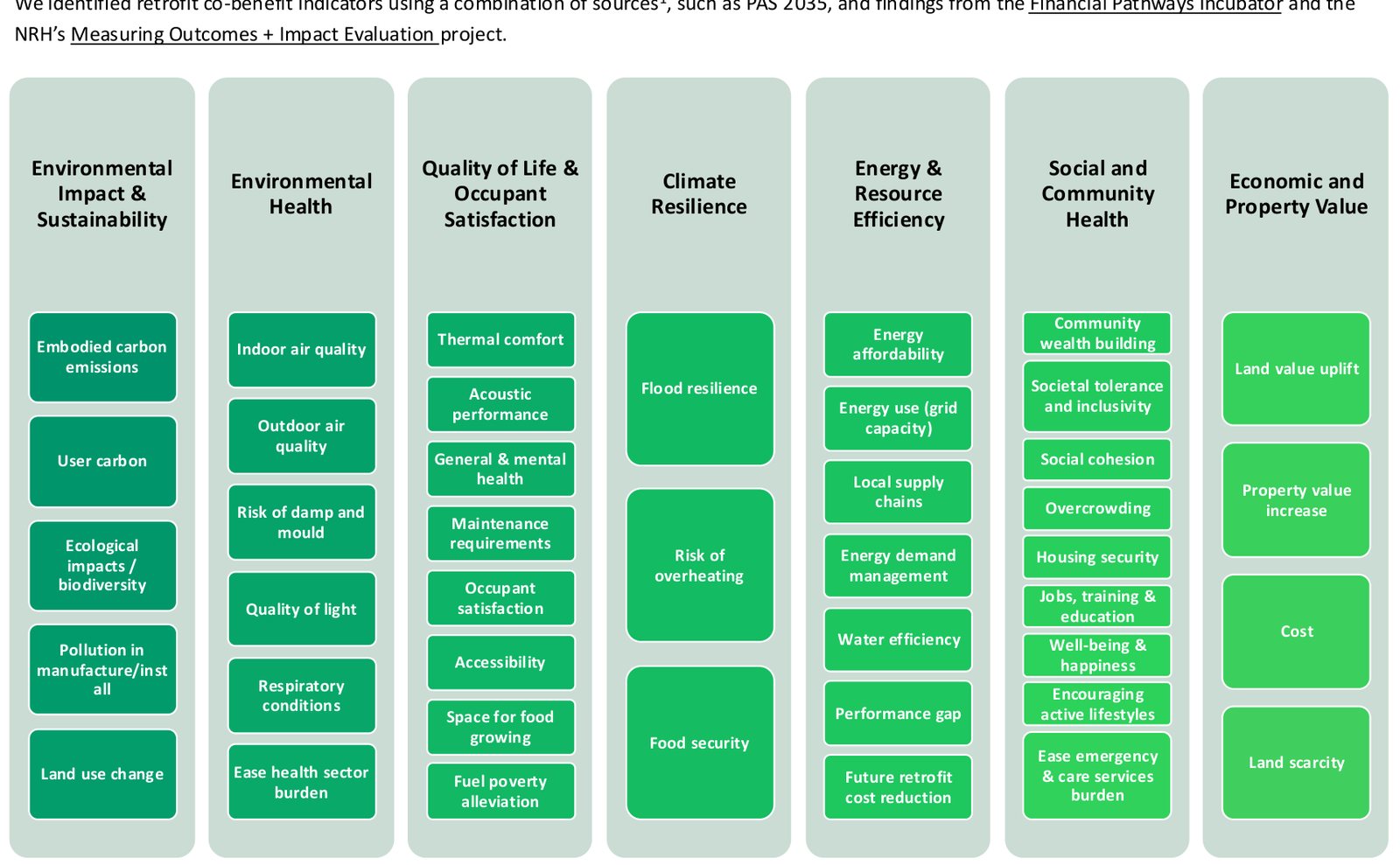
4Scoping & prioritising co-benefits
Project partners identified that co-benefits in scope for this project need to be:
- Achievable through retrofit projects or programmes.
- Achieved by product or technical-system solutions, rather than political or cultural solutions.
- Able to be enabled through Regulatory Science.
- Not already incentivised by the market.
- Not a primary benefit already incentivised by regulation (eg: energy cost).
We also excluded ‘Environmental Impact and Sustainability’ co-benefits as there is another network tackling this subject – Life Cycle Assessment Regulatory Science & Innovation Network.
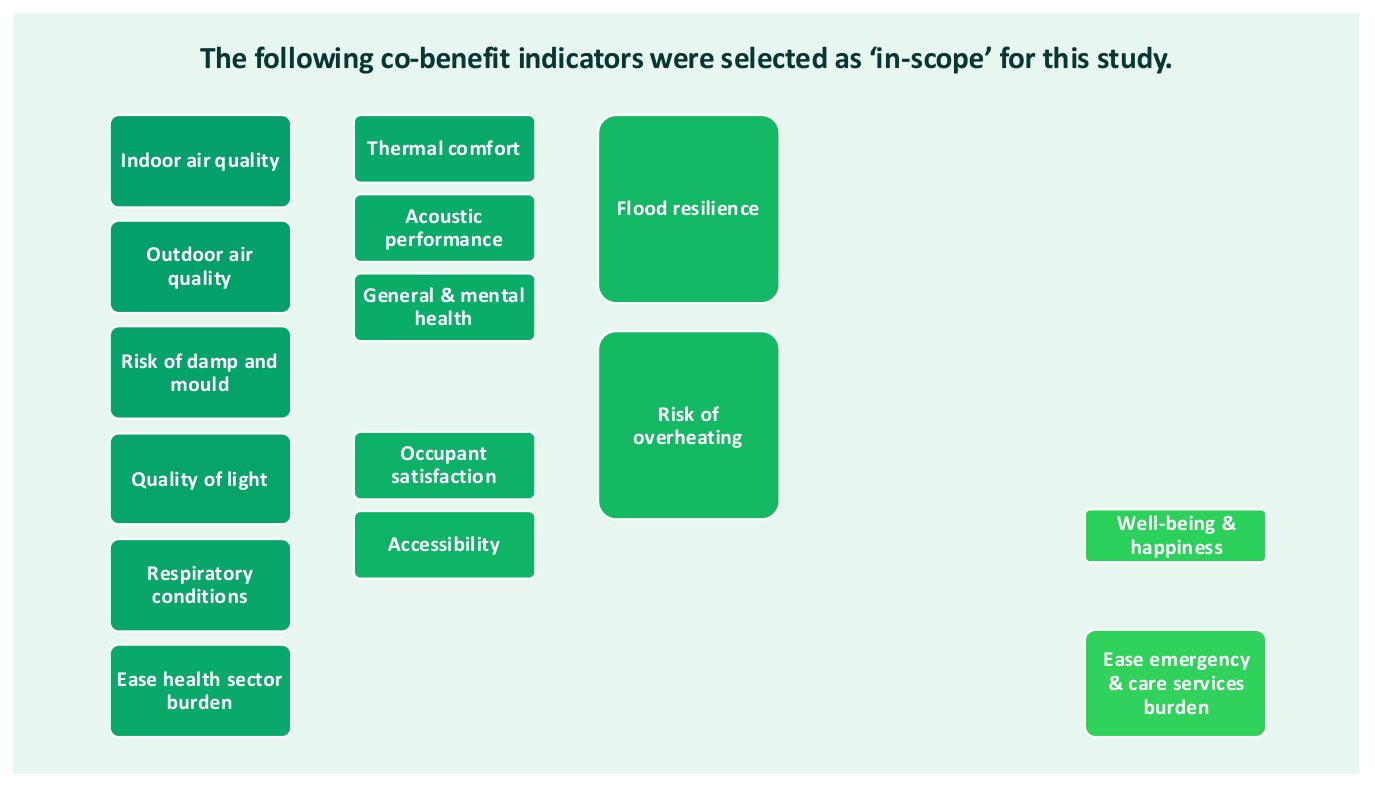
NRH facilitated a workshop within members of its Working Group 2. Stakeholders included: specifiers, innovators, manufacturers, merchants, standards writers and academics. The challenge, and the limits of a regulatory science approach, were explained to participants.
We considered:
- The potential for regulatory science to incentivise the delivery of different co-benefits.
- The overarching impact of each co-benefit, and whether some could lead to more benefits.
- Those co-benefits currently least incentivised by regulation. Three phased voting was used to identify the following priority co-benefits, improvements in:
Risk of damp and mould
Indoor air quality
Thermal comfort
5Initial insights
Participants in the NRH Working Group 2 workshop identified and developed insights and questions within a set of distinct themes. These provided the basis for further exploration and analysis:
Definitions
- What definitions already exist for the co-benefits identified?
- Do these adequately describe the outcomes we want to see?
- How does this account for variations in human experience and expectation?
Linking outputs to outcomes
- Some metrics, or outputs, such as flow rate, or millimetres of insulation are used as a proxy for wider outcomes such as indoor air quality or thermal comfort, but these outcomes aren’t necessarily guaranteed.
- What is the theory of change between specific metrics and the identified co-benefits?
- Can focusing on the outcome rather than the input allow greater options for achieving the same result rather than focusing on specific measures?
- What is the feasibility of an outcomes based regulatory framework?
Real world test data and monitoring
- Need for data that recognises changing conditions and requirements of occupants rather than lab tested or theoretical performance.
- What low-cost monitoring and data-storage solutions are available?
- The potential to use AI to analyse trends.
- How could regulation support better data monitoring and incentivise its use?
- Better guidance is required on HOW to monitor – i.e., where to place sensors, etc.
- How can we consider GDPR and rights of consumers while making the best use of monitoring data – Wales example.
Awareness
- Residents, building owners, designers and installers are sometimes unaware of what regulations exist, the standards we should expect from our homes, and forms of recourse.
6Regulatory landscape
To identify effective regulatory science interventions, based on stakeholder feedback, we first needed to understand the complex regulatory landscape, asking:
What regulations exist to reduce the risk of damp and mould, improve thermal comfort and indoor air quality within homes and buildings?
Do these regulations adequately define the benefits or hazards?
How do the regulations link inputs to outcomes, are they outcome-based?
What is the scope of these regulations, are all existing buildings included?
Are the regulations applied and enforced effectively?
How comprehensive is the awareness of the regulations?
Are there routes for innovative products and solutions to demonstrate benefits in line with regulatory requirements?
Where are there regulatory gaps?
A full list of regulations which apply to each of the in-scope co-benefits is available in Appendix B.
Building Regulations Parts F and O
What is it?
Part F regulates ventilation. Adequate, controlled ventilation helps to:
- Reduce damp and mould risk.
- Improve indoor air quality.
- Reduce risk of overheating.
Part O regulates to reduce the risk of overheating, by mandating that buildings are designed to:
- Limit unwanted solar gains in summer.
- Provide means to remove excess heat from indoor environments.
Building regulations are non-prescriptive and outcomes based, however, the primary route to achieve compliance is through the approved documents, which contain prescriptive requirements.
Applies to England and Wales, with separate regulations for Scotland.
Limitations
Building regulations only apply to homes where building work is already taking place and part O only applies to new homes, therefore most existing homes will not be influenced by these regulations.
There are questions in the industry on whether the regulations are effective at delivering the intended outcomes, eg: Part O allows homes to exceed comfortable temperatures for up to 3% of the year: 10 days.
Opportunities
- Background ventilation and/or airtightness testing could be included as a requirement within Part F for existing buildings, to improve ventilation design. This would incentivise the installation of products and solutions which enhance ventilation.
- Part O could be reviewed and applied to existing buildings undergoing building work.
- It is highly unlikely that building regulations could be reformed to apply to all existing buildings.
Minimum Energy Efficiency Standards
What is it?
Sets minimum standards for ‘energy efficiency’ for private rented homes in England and Wales.
The standard is currently based on the headline energy cost metric within an EPC, however the government is proposing reform to the metrics and ratings required.
A minimum energy efficiency standard will also be introduced in the social rented sector, and Scotland is currently consulting on MEES for private rented homes.
Some fabric improvement measures required by these standards will have co-benefits such as improving thermal comfort and reducing the risk of damp and mould.
Limitations
The calculation methodology currently used by EPCs (SAP and rdSAP) does not consider benefits beyond energy efficiency.
Innovative products and solutions that improve indoor air quality, reduce damp and mould or mitigate overheating risk do not gain any EPC ‘points’ for these benefits.
Opportunities
- This is one of the only regulations that requires a professional to visit and assess every private rental home.
- Current reform of EPC metrics, methodologies, and MEES provides an opportunity for health co-benefits to be counted.
- Pathways could be created for innovators to demonstrate impact against co-benefits, in line with the revised EPC methodology.
The Housing Health and Safety Rating System
What is it?
A risk-based evaluation tool used to assess potential hazards in homes.
Clearly defines the health effects, causes and preventative measures for 29 hazards, including:
- Damp and mould growth
- Excess cold
- Excess heat
Includes guidance on assessing and enforcing against hazards.
The follow laws require remediation of ‘category 1’ and some ‘category 2’ hazards identified within the HHSRS, for private and social rented homes:
- Housing Act 2004
- Homes (fitness for human habitation) Act 2028
- Decent Homes Standard (Eng)
- Welsh Housing Quality Standard
Limitations
Implementation of the standard is poor and enforcement is low.
A black background with a black Only 1 in 3 housing complaints are responded to by local authorities2
A black background with a black 10% of privately rented homes in England have a Category 1 hazard3
Councils describe it as ‘cumbersome and highly subjective’ with “no clear guidance on the circumstances when an officer should take action”.4
There are few pathways for innovators to demonstrate that their solutions help address hazards.
Opportunities
- If better enforced the standard could lead to the uptake of innovative products and solutions that improve thermal comfort and reduce damp and mould risk.
- The standard is outcomes-based and defines hazards well: there is the potential for it to be enhanced to define best practice home health.
- Pathways and guidance for innovators to demonstrate the impact of solutions, against the hazards in the standard, could increase uptake.
Policy Context
The Conservative Government conducted a consultation on updating the HHSRS in February 2019 and undertook a review to make the system easier to understand and facilitate effective enforcement.4 The two-year review concluded in 2022, but updates to the HHSRS have not yet been made.
Stakeholder Feedback
The NRH led discussions with our Working Group 2 and MEES cross-cutting theme on the HHSRS. Discussions focused on:
Current enforcement issues:
- Lack of awareness from both tenant and landlord means that neither knows what standard should be achieved and what is unacceptable.
- Local Authorities do not have the resources to adequately enforce the HHSRS.
- A lack of integration across different standards and regulations makes it difficult for all parties to navigate the system. Suggested improvements:
- The HHSRS should be simplified and/or made more intuitive so that tenants and landlords are able to clearly understand what a hazard looks like. This would empower tenants to report potential issues to an enforcement body.
- Guidance is needed to enforcement bodies to help them identify hazards and assess their severity as well as to make assessments more objective and consistent.
- Training for NHS staff and other relevant bodies to identify people who have a health condition associated with their home would help to identify homes that may contain a Category 1 hazard, or those who might be more vulnerable to category 1 or 2 hazard.
- Consideration should be made of reporting routes and whether reporting to the Building Health and Safety regulator may be a more appropriate route than to Local Authorities.
7Potential regulatory science interventions
This section sets out five potential ‘regulatory science’ projects that this network could undertake to help incentivise innovative products and solutions that deliver co-benefits.
We will be consulting with the network and regulatory stakeholder to determine which project(s) would be most useful to progress.
Potential ‘regulatory science’ projects identified:
- Defining Healthy Buildings
- Supporting Innovators to Demonstrate Impact
- The Value of Housing Standards Enforcement
- Implementation of Regulation
- Embedding Health in MEES / HEM
1. Defining Healthy Buildings
Need
We have defined what bad looks like, but what does good look like?
Potential Objectives
Severe health hazards are generally well defined, and impacts of these understood, through the HHSRS.
Moving beyond severe hazards, towards best practice, definitions of key co-benefits are not generally defined by regulation. The link between best practice for co-benefits such as thermal comfort and IAQ and health outcomes achieved are not well evidenced. Therefore, regulation cannot effectively incentivise for best-practice health indicators, and innovation which is designed to achieve these benefits is not adopted at scale. Definition of best practice IAQ, thermal comfort, and damp and mould indicators, which lead to target health outcomes, for use by regulators.
Guidance on how innovators could demonstrate achievement of this best-practice: which metrics and how could they be monitored or evidenced.
2. Supporting Innovators to Demonstrate Impact
Need
How can innovators show their solutions have impact?
Potential Objectives
There are a lack of visible pathways or methodologies for innovators to demonstrate the health benefits of their products and solutions. While air quality monitoring can be used as a proxy to understand health performance there are a lack of agreed methodologies and metric targets to demonstrate health improvements. Clear pathways for innovators to use to demonstrate how their products and solutions improve health outcomes, in line with regulatory requirements.
Guidance for monitoring and evaluation of health outcomes.
3. The Value of Housing Standards Enforcement
Need How can we make the case for enforcement spend in the context of limited LA budgets?
Potential Objectives
10% of the PRS has a HHSRS category 1 hazard, and MEES is currently under-enforced.2 Only 1 in 3 housing complaints are responded to by local authorities.3
Some Local Authorities have well-resourced enforcement teams and obligatory landlord registration which assists enforcement, whereas others do not. Effective enforcement of these regulations will mean that more landlords need to take action, and will be incentivised to use innovative products and solutions that can tackle health hazards. Calculation of the local value associated with improved mental and physical health and wellbeing, from well-resourced enforcement and mandatory registration in a specific local authority.
A framework or calculation methodology for Local Authorities to use in their specific context.
4. Implementation of Regulation
Need Would more consistent implementation benefit innovators?
Potential Objectives
Implementation of regulation has a fundamental impact on its spirit. There are multiple routes to the enforcement of these standards, and local authorities each use different strategies and methodologies to apply the regulations in practice. This creates a confusing picture for innovators.
By making visible the current ways that these regulations are both enforced and responded we can identify points of entry for innovators to engage in the market. Toolkit for Local Authorities on best practice enforcement, potentially building the Government’s 2019 guidance5 and work by the Centre for Sustainable Energy on MEES enforcement6.
Pathways for innovators wanting to engage with improving the health and wellbeing of poorly performing homes.
Recommendations for embedding data and monitoring into compliance evaluation.
Linking Local Authorities doing good enforcement work with those who have a higher prevalence of hazards7.
5. Embedding Health in MEES / HEM
Need How can we take the opportunity of EPC & MEES reform to deliver health impacts?
Potential Objectives
The Minimum Energy Efficiency Standards are the only regulations that lead to a professional visiting every home that is privately rented. This presents a huge opportunity to raise housing standards and incentivise the uptake of innovative products and solutions that can improve a building’s health.
Currently products and solutions that can demonstrate energy efficiency improvements can improve your EPC rating if installed, but delivering co-benefits is not rewarded.
With EPC metrics and methodologies (HEM) undergoing change, this is an opportune moment to ensure that health co-benefits are awarded and incentivised within the EPC and regulated through MEES. Recommendations on what should be included in the HEM to allow health co-benefits to be recognised.
Recommendations on a potential ‘health wrapper’ to HEM, or whether health inputs could be included within the ‘fabric performance’ metric.
8Appendix
A. Useful regulatory tools
B. Co-benefits regulatory matrix
C. Notes & references p24
p25
p27
Appendix A: Useful tools
The following standards, tools or elements of guidance have been useful in informing our thinking on this project to date, or may be useful tools or precedents to inform the next stages of this project.
Damp and Mould Guidance, in 2024 the Government published ‘Understanding and addressing the health risks of damp and mould in the home’8 which sets out the health risk of damp and mould, regulations concerning damp and mould, how to respond and take a pro-active response to preventing damp and mould. SAP and rdSAP, soon to be replaced by HEM (Home Energy Model), are the main tools for assessing the performance of a home, feeding into Building Regulations Part L compliance and EPC ratings. HEM will be the methodology and calculation tool that sits behind The Future Homes Standard and new EPCs and will impact the types of innovative products and solutions that can be installed in a home to increase the EPC rating. Sustainability Labelling is part of the Scottish Building Standards, and provides an example of how regulation can incorporate enhanced tiers of performance. All new buildings must achieve at least a ‘bronze’ level and must report the level they achieve. Those opting towards higher levels of performance can achieve silver, gold and platinum level labels. Local Authorities can also mandate higher levels.
BS 401019 sets out a framework for Building Performance Evaluation, which includes monitoring, and could be used as the basis for any additional test data gathered. This standard could also be developed with more guidance on monitoring the co-benefits identified in this study. BS 40102-110 is a new standard that will consider the Health and Wellbeing, including thermal comfort and indoor air quality, for non-domestic buildings, and may include information transferable to the residential sector. The standard is awaiting sign-off and release, after this work is expected to start on BS 40102-2 which will cover residential buildings.
Appendix B: Co-benefits regulation matrix
This table identifies the regulations and non-mandatory standards applicable to the primary co-benefits considered in this study.
Co-benefit Regulation Non-mandatory standard or guideline Indoor air quality Housing Act 2004 WHO guidelines for indoor air quality: dampness and mould Homes Act 2018
Decent Homes Standard
Building regulations Parts C & F
The Future Homes Standard
Scottish Building Standards 3.14 Ventilation, 6.2.5 Risk of damp and mould Housing Act 2004
Homes Act 2018, which revises the Landlord and Tenant Act 1985
Decent Homes Standard
Awaab’s Law
Building regulations Part F
Awaab’s law (Not yet passed)
Scottish Building Standards 3.4, 3.10, 3.15, Thermal comfort (including overheating) Housing Act 2004
Homes Act 2018
Decent Homes Standard
Minimum Energy Efficiency Standards
Building regulations Parts F, L & O
Scottish Building Standards 3.28 NICE guideline [NG149]
BS 40102 (applies to non-domestic buildings)
WHO guidelines for indoor air quality: dampness and mould
BS 5250 Code of Practice
CIBSE TM59 Design methodology for the assessment of overheating risk in homes
CIBSE Guide TM52 for non-residential builds
CIBSE Guide A
CIBSE KS16 Co-benefit Regulation Non-mandatory standard or guideline Flood resilience Flood and Water Management Act 2010 GOV guidance on flood resilient construction of new buildings Local authority requirements
Scottish Building Standards 3.3.3 Acoustic performance Building regulations Part E
LA 111: Noise and vibration
Scottish Building Standards 5.1.5 Outdoor air quality Clean Air Bill/Ella’s Law (Not yet passed)
The Air Quality Standards Regulations 2010
Air Quality (Scotland) Regulations 2000, the Air Quality (Scotland) Amendment Regulations 2002 and the Air Quality (Scotland) Amendment Regulations 2016 BS 8233
Nice Air pollution: outdoor air quality and health guidelines
Light quality BS EN 12464-1 (commercial sector) Biodiversity (on-site) Biodiversity net gain
Urban greening factor Accessibility The Equality Act
Building regulations Part M BS 8300
Appendix C: Notes and references
- A full list of sources used to create the list of co-benefits:
- PAS 2035
- Housing Health and Safety Rating System
- Institute of Health Equity. Evidence review: Housing and health inequalities in London. 2022
- BRE. The cost of poor housing in England by tenure. 2023
- UK Parliament POST. Indoor air quality. 2023
- HOUSE OF LORDS Science and Technology Committee. The neglected pollutants: the effects of artificial light and noise on human health. 2023
- World Health Organisation. Assessing the value of urban green and blue spaces for health and well-being. 2023
- EN 15804
- Gov.uk, Housing Quality statistics, January 2025
- localgov.co.uk, Councils only respond to third of housing complaints, June 2024
- NRLA, The Enforcement Lottery: Local authority enforcement 2021- 2023, May 2024
- Gov.uk, Rogue landlord enforcement, April 2019
- Centre for Sustainable Energy, Toolkit to help local authorities enforce MEES Regulations, May 2022
- Gov.uk, The English Housing Survey contains data on the distribution of housing quality, May 2025
- Gov.uk, Understanding and addressing the health risks of damp and mould in the home, August 2024
- British Standards Institution, BS 40101, January 2022
- British Standards Institution, BS 40102-1, April 2023
Frequently asked questions
Innovate UK funded RetroNetZero, a Regulatory Science and Innovation Network. It explored how regulation could support innovative products and approaches for improving existing homes. The retrofit co-benefits study formed part of this work.
Regulatory science uses research and evidence to help regulators develop and apply regulations. For retrofit, this can include developing testing methods or gathering evidence to assess how well a new product performs in people’s homes.
Retrofit co-benefits are the wider benefits of improving existing homes, alongside energy and carbon savings. For example, home upgrades can improve indoor air quality or reduce overheating. However, achieving these benefits depends on how people design and carry out the work.

